Camera Company
Company
Shop By Category
T&Cs
Shop Online
  • The maker's specifications on every page
  • Free tracked USA-wide delivery over $150
  • 14-day returns

4K Dash Cam Front and Rear | 5GHz WiFi dash cam | Dual car camera

4K Front and Rear Dash Cam with 5GHz WiFi

$99.99 $119.99 Save $20
  • 4K Front Recording
  • 5GHz App Transfer
  • Low Light Capture
  • Impact Lock

Price: $99.99 $119.99

  • Free tracked USA-wide delivery on orders $150+, otherwise a flat $20
  • Pay by card or PayPal, handled by the payment provider
  • 14 days to change your mind, plus your statutory rights
Product specifications
Model NameQ7
Video Capture Resolution4K 2160P front plus 1080P rear
Frame Rate30 FPS
Field of View155 degrees
Real Angle of View160 degrees
Maximum Aperturef1.6
Optical Sensor TechnologyCMOS
Photo Sensor Size1.6 cm
Screen Size1.5 inches
Display TypeLCD / LED
ConnectivityWireless, 5GHz WiFi
Control MethodApp
Compatible DevicesCellphone, PC
Memory Card TypemicroSDXC
Maximum Card Supported256 GB
Battery Cell TypeLithium Polymer
Mounting TypeCeiling
Camera PositionFront and rear
Vehicle TypesSedan, SUV, truck, minivan
Key Features5G WiFi, app control, loop recording, gravity sensing, parking mode
Included ComponentsCar charger, wiring tool
ColorSilver
Item Weight300 g
Unit Count1
Weight300 g
Shipping & returns

Tracked delivery anywhere in the USA. It is free on orders of $150 or more, and a flat $20 below that.

If it is not right for you, send it back within 14 days of delivery in resaleable condition and we refund the price you paid, including standard delivery. That is a voluntary policy we offer on top of your legal rights. You cover the cost of returning it unless the item is faulty.

If it arrives faulty, damaged or not as described, we put it right at no cost to you under the consumer protection law of your state and the Federal Trade Commission Act, return postage included.

Shipping details · Refunds and returns

4K Front RecordingFront channel records at 4K 2160P so plates and signs stay legible.
5GHz App TransferPull clips straight to your phone without unplugging anything.
Low Light CaptureCMOS sensor with an f1.6 aperture for night driving.
Impact LockThe gravity sensor locks a clip when it detects a jolt.

Record every mile in sharp detail with a 4K dash cam front and rear setup that watches the road while you drive.

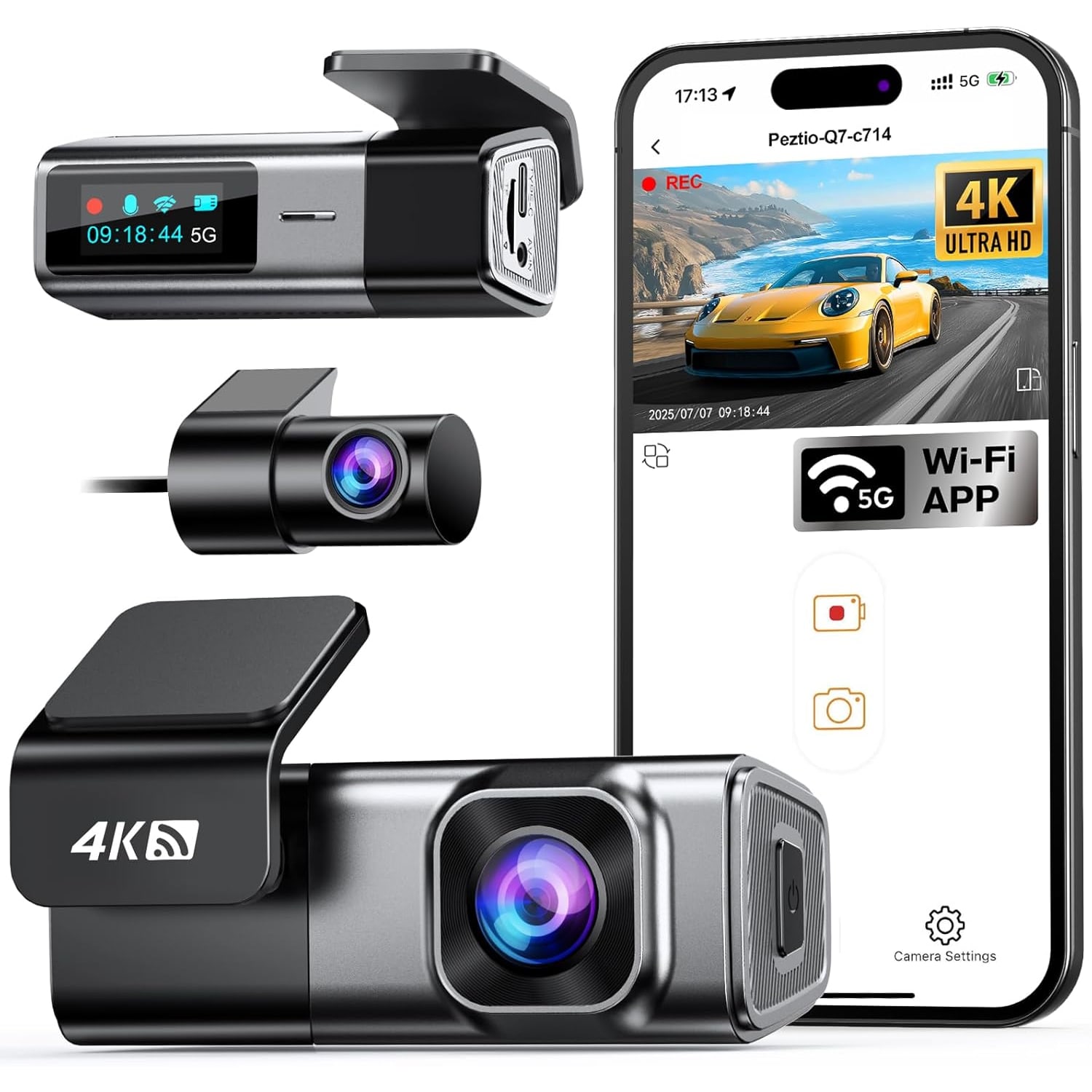
A dual-channel car camera recording 4K at the windshield and 1080P out the back, with 5GHz WiFi app control, loop recording, a gravity sensor and a compact body with a 1.5 inch display that stays out of your sightline.

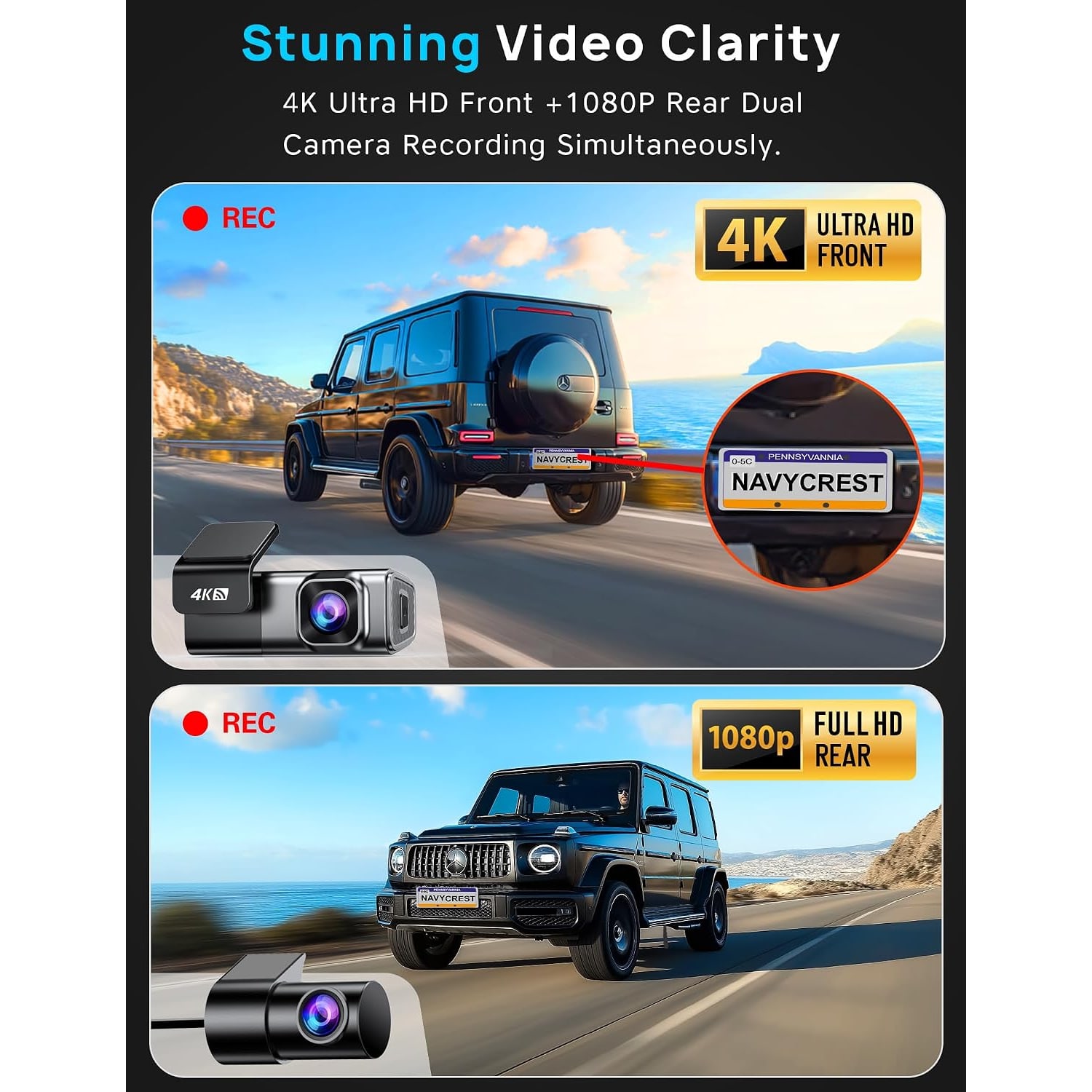
Records the road ahead in 4K 2160P while a second camera covers what is happening behind you in 1080P.

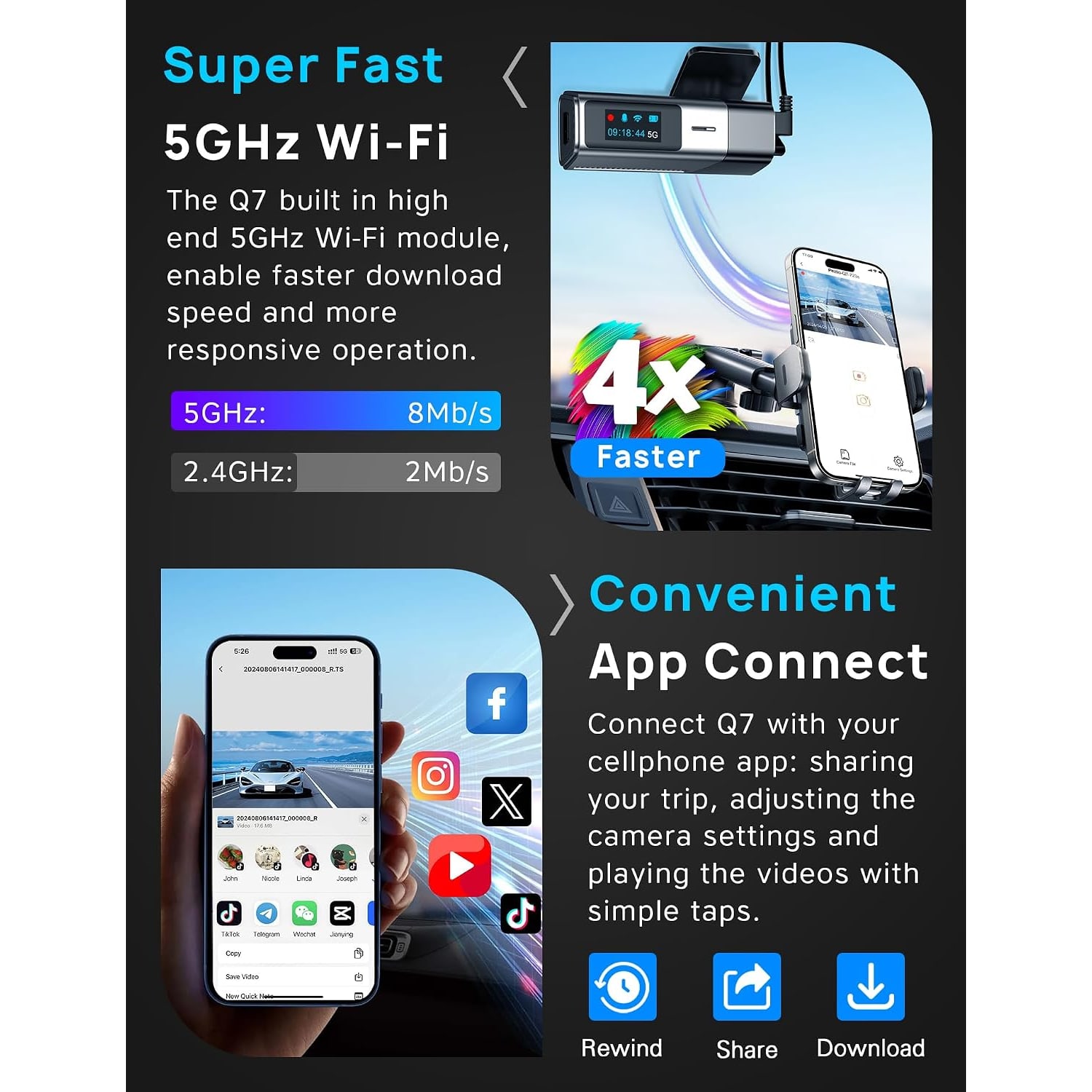
The 5GHz WiFi link connects to your phone so you can preview footage, change settings and save clips on the spot.

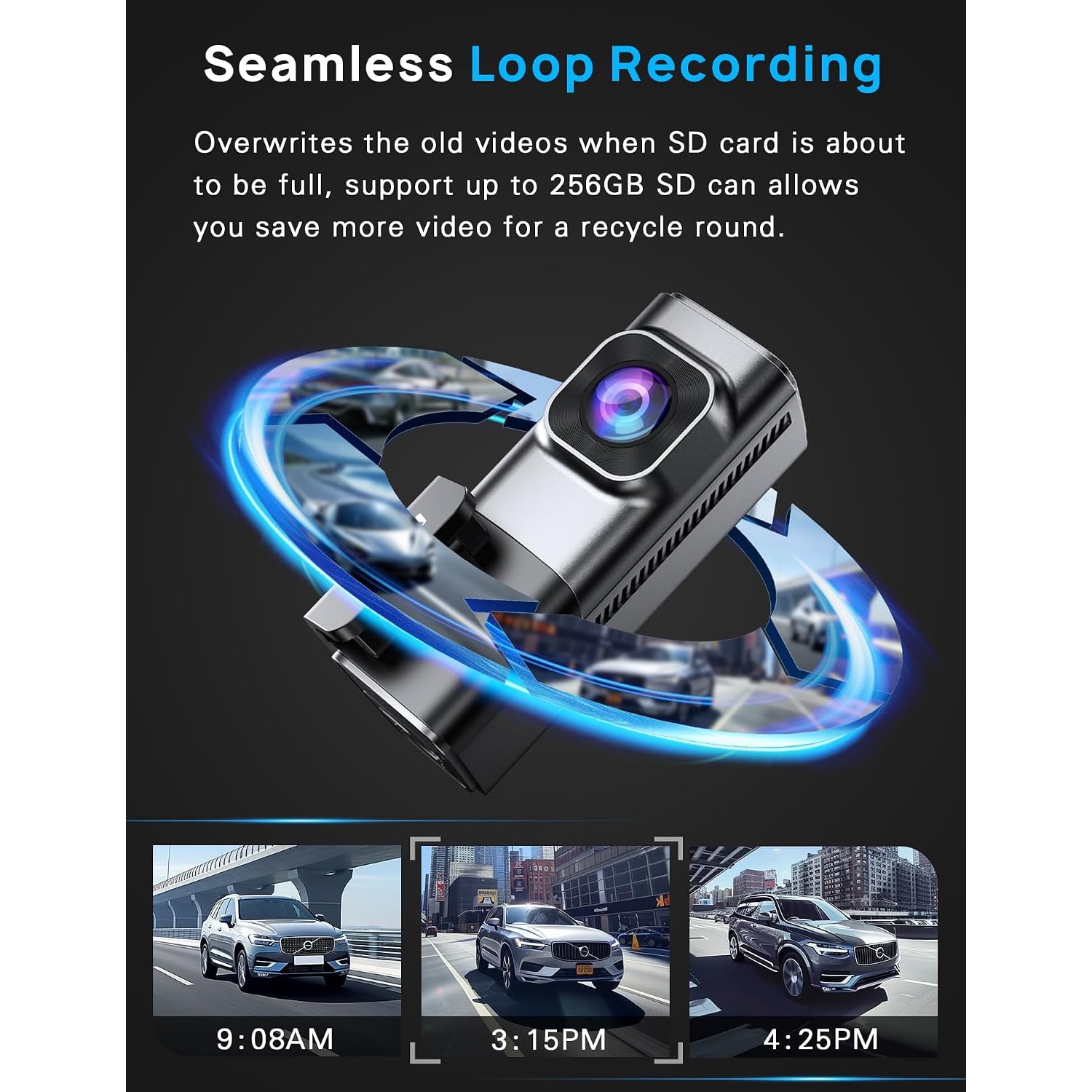
Loop recording keeps the card rolling by writing over the oldest unprotected files once storage fills up.

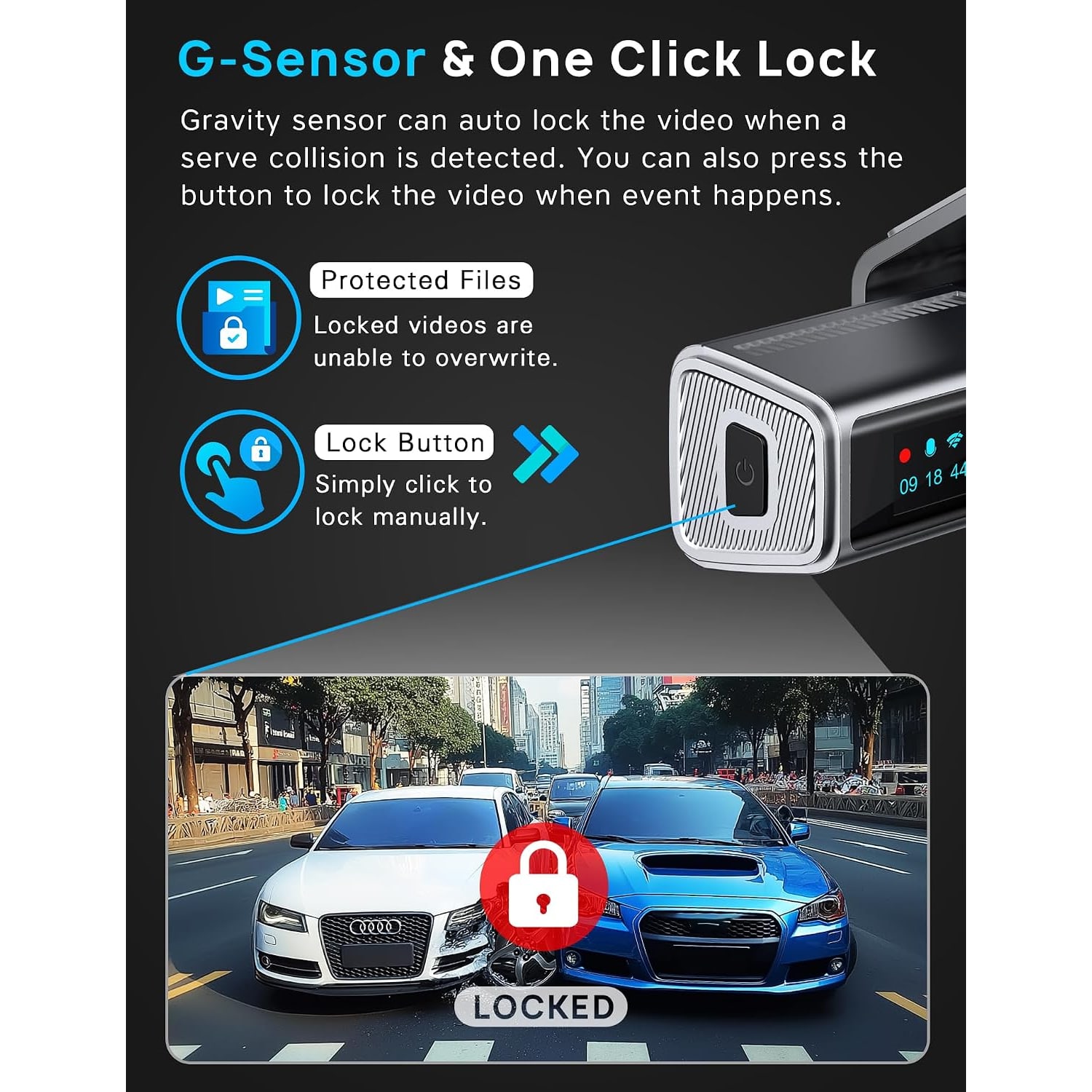
A built in gravity sensor locks the current clip when it senses a sudden impact, keeping it out of the overwrite cycle.

The compact body with its 1.5 inch display tucks behind the mirror and leaves your view of the road clear.

4K Front and Rear Dash Cam with 5GHz WiFi

A dash cam earns its keep on the one day you wish you had one. This is a dual channel car camera built around that idea. The front unit records at 4K 2160P through a lens with a 155 degree field of view, which is wide enough to take in both lanes beside you without squashing the center of the frame. A separate rear camera records at 1080P, so a tap from behind at a stop light is covered as well as anything that happens ahead.

4K Front and Rear Dash Cam with 5GHz WiFi

The 5GHz WiFi module is what makes the thing pleasant to live with. Instead of pulling the memory card and hunting for a reader, you open the app on your phone, connect to the camera and watch the footage right there. You can adjust the camera's settings and save a specific clip to your phone in a few taps. It is the difference between a camera you check once a year and one you actually use.

4K Front and Rear Dash Cam with 5GHz WiFi

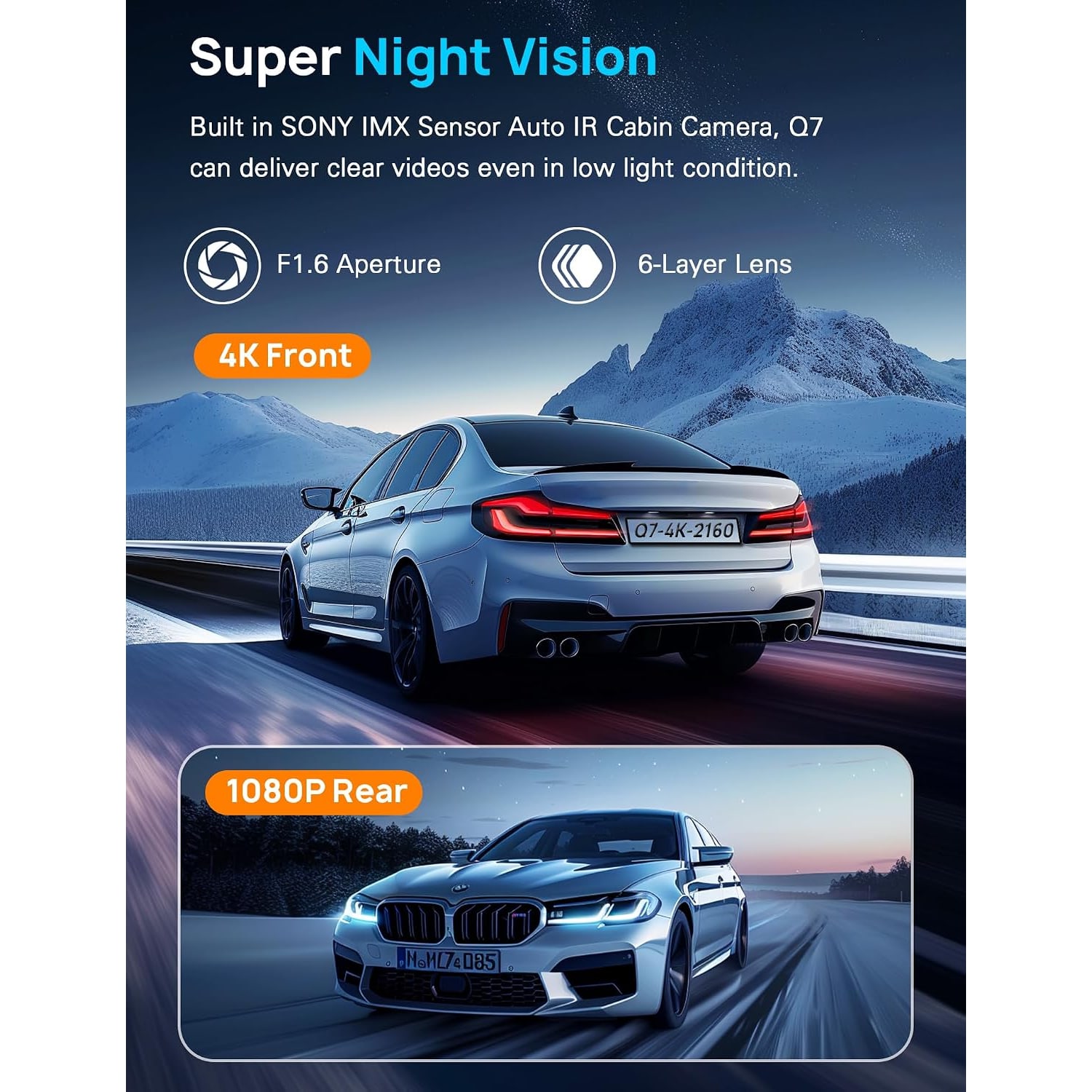
Low light is where cheap cameras fall apart. This one pairs a CMOS sensor with an f1.6 aperture, a 6 glass lens and wide dynamic range processing, a combination the maker says performs well in color and clarity day or night. The 30 FPS capture keeps movement smooth enough to follow. Nothing records perfectly in pitch black, but a brighter lens gives you a real advantage over a narrow one.

4K Front and Rear Dash Cam with 5GHz WiFi

Recording is continuous. Loop recording fills the microSD card and then begins writing over the oldest unprotected footage, so you never have to remember to clear it. When the three axis gravity sensor picks up a sudden jolt, it flags the current clip and keeps it out of that cycle. Parking mode is supported as well, which keeps the camera watching after the engine is off, though that setup needs a hardwire kit that is not part of this package.

4K Front and Rear Dash Cam with 5GHz WiFi

Physically it is small and designed to sit high on the windshield behind the mirror where it does not interfere with your view. The 1.5 inch display on the body shows status icons and the time in the product photos, and live view and playback happen in the app. A car charger and a wiring tool come in the box, and the tool makes it straightforward to tuck the cable along the headliner and down the pillar for a clean install.

Not sure yet? That is fine.

A camera has to suit the job you bought it for, and you cannot always judge that from a photograph. If it is not right for you, send it back within 14 days of delivery in resaleable condition and we refund the price you paid, including standard delivery. That is a voluntary policy we offer on top of your legal rights.

If it turns up faulty, damaged or not as described, that is on us. The consumer protection law of your state covers you, and we pay the return postage. Read the full detail on our refunds and returns page, or ask us anything before you order.

Frequently Asked Questions

What does this dash cam actually record?

It records two video channels at once. The front camera captures the road ahead at 4K 2160P and the rear camera captures what is behind the vehicle at 1080P, both at 30 frames per second.

How wide is the view from the front camera?

The field of view is listed at 155 degrees, with a real angle of view of 160 degrees. That takes in your own lane plus the lanes either side in most road situations.

Does 4K really make a difference over 1080P?

It mostly matters for small detail at distance, like a plate on a car two lengths ahead. More pixels across the frame means that detail survives when you zoom in on a still. For general road context 1080P is fine, which is why the rear channel uses it.

What is the 5GHz WiFi for?

It creates a direct link between the camera and your phone so you can preview live video, change settings and download clips. The maker states 4 times the download speed of 2.4G links, up to 8 MB/s, which matters when the files are 4K.

Do I need mobile data or an internet connection to use the app?

No. The camera makes its own WiFi network and your phone joins it directly. You only need data if you want to share a clip online afterwards.

Can I change settings from my phone?

Yes. The maker says you can adjust the camera's settings in the app, as well as view live video from the front and rear cameras and download, edit and share clips.

What size memory card do I need?

It takes a microSDXC card up to 256 GB. A Class 10 or U3 rated card is the right spec for 4K recording, since slower cards can drop frames.

Is a memory card included?

No. The maker's product name and its note both say an SD card is not included with this dash cam, although one line of the specifications still mentions a card. Plan on buying a card separately.

How long does 4K footage last on a card?

It depends on the card size and your settings, but 4K plus 1080P dual recording eats space quickly. Loop recording handles it for you by overwriting the oldest unlocked files, so the card never simply stops.

What is loop recording?

The camera records in short segments and, once the card is full, begins writing over the oldest segment that is not protected. It means you never have to manually clear footage to keep recording.

What does the gravity sensor do?

It is a three axis sensor that detects sudden movement, like a collision or a hard brake. When triggered it locks the current clip so loop recording will not overwrite it, keeping that footage available as a record of the event.

What can I set parking mode to do?

With a hardwire kit fitted, the maker describes two choices. Parking monitor starts recording automatically when a collision happens, and time-lapse recording keeps recording continuously with low power consumption. A hardwire kit is not included.

Does it work as a parking camera?

Parking mode is supported, which keeps the camera monitoring once the engine is off. It needs a hardwire kit to draw power from the vehicle, and that kit is not included in this package.

Why is a hardwire kit needed for parking mode?

A standard 12V socket usually cuts power when the ignition is off, so the camera shuts down with the car. A hardwire kit taps a constant power source instead, which is what lets the camera keep watching.

How good is the night footage?

The f1.6 aperture lets a good amount of light reach the CMOS sensor, so well lit streets and headlight-lit roads come out clearly. Completely unlit rural roads are harder for any camera, as there is simply very little light to work with.

Will it fit my vehicle?

The maker names sedans, SUVs, trucks and minivans as compatible vehicle types. The front unit mounts at the top of the windshield.

Where should I mount it?

High on the windshield, behind or just beside the rear view mirror, is the usual spot. It keeps the camera out of your eyeline and gives the lens a clear, unobstructed view over the hood.

Is it hard to install?

The maker describes the wiring design as simplified. The wiring tool in the box helps you tuck the cable up into the headliner and down the pillar trim so nothing dangles. The rear camera cable takes the longest, since it runs the length of the vehicle.

Where does the rear camera go?

Typically on the inside of the rear window, high and central. On some trucks and vans people mount it at the top of the tailgate or above the rear glass instead, depending on how the body is shaped.

Does it have a screen?

Yes, the maker gives a 1.5 inch screen size. In the product photos it is a small status display on the body showing the time and recording, sound, WiFi and card icons. The phone app is where you watch live video and play back footage.

Does it record sound?

The product photos show a microphone icon on the display and mute on and mute off voice prompts. Keep in mind that recording audio and recording other people is covered by federal and state law, so check the rules that apply where you drive.

Does it come with a charger?

Yes, a car charger is included along with the wiring tool. That covers a standard setup running from the vehicle's 12V socket.

What is the battery for?

The maker gives the battery cell type as lithium polymer. The camera is powered by the included car charger while you drive, and parking mode needs a hardwire kit, so the cell is not there to run the camera for long periods.

How heavy is it?

The maker gives the item weight as 300 g.

How do I look after it?

Clean the lens with a microfiber cloth, keep cleaning sprays away from the glass, and format the card in the camera every few weeks. On very hot days, park in shade where you can.

Why format the memory card regularly?

Constant loop recording creates and deletes thousands of files, and over time the file system can get messy enough to cause skipped recordings. A quick format in the camera resets it and is the single best habit for a reliable car camera.

Can I view footage on a computer?

The maker gives cellphone and PC as compatible devices. On a computer, the simple route is to put the microSD card into a card reader and open the files there.

How is it delivered?

We deliver to addresses across the United States by tracked delivery. Most orders arrive within 3 to 8 business days of the order date, and Alaska, Hawaii and remote addresses can take a little longer. Delivery is free on orders of $150 or more and a flat $20 under that.

Does this make a reasonable gift?

It does, especially for a new driver, a commuter or someone who has just bought a car. It arrives as a complete recording setup, and the recipient only needs to add a memory card.

What if it is not right for me?

Returns are accepted within 14 days of delivery as long as the item is in resaleable condition, with the buyer paying return shipping. Repack it with the charger and wiring tool, get in touch, and we will walk you through the return.

How to Choose a Front and Rear Dash Cam That You Will Actually Use

6 min read Camera Company

The problem a dash cam solves

Most drivers buy a dash cam after something happens, not before. Someone backs into the car in a parking lot and leaves. A driver cuts across three lanes, brakes hard, and then tells a very different story afterward. A branch comes down on the hood in a storm. In every one of those cases the frustrating part is not the damage, it is the lack of any record. Two accounts of the same event, no footage, and the whole thing turns into a slow argument.

A camera running quietly on the windshield takes that argument off the table. It records what happened, with a timestamp, from a fixed point of view. You rarely need it. On the day you do, it is the only thing that matters.

Why front and rear instead of just front

A single front camera covers the direction you are looking, which sounds like enough until you think about where collisions actually happen. Rear end impacts at lights and in slow traffic are common, and a forward-facing camera sees none of it. Neither does it see a vehicle that tailgates you for a mile or one that swings out of a side street behind you.

A dual car camera closes that gap. This camera runs two channels at once, 4K 2160P at the front and 1080P at the rear, with a stated frame rate of 30 FPS. Having both views makes it much easier to piece together what happened when you look at the footage later.

The resolution split makes sense when you think about what each camera is for. The front view is the one where you need to read a plate on a vehicle that is moving away from you, so the extra pixels earn their place. The rear view is usually recording something a few feet behind your bumper, where 1080P has plenty of detail to work with.

How the picture quality holds up

Resolution is only part of the story. A 4K sensor behind a poor lens still gives you a soft image. What matters as much is how much light the lens lets through, and this one has a maximum aperture of f1.6. That is a bright lens for a dash cam. It means more light reaches the CMOS sensor in the moments that are hardest to record, early morning, dusk, and the stretch of night driving where streetlights are intermittent.

The field of view is listed at 155 degrees, with a real angle of view of 160 degrees. That is a sensible range. Go much wider and you start bending the edges of the frame and shrinking everything in the middle, which works against you when you are trying to read a plate. Go much narrower and you lose the side lanes where a lot of incidents begin.

Frame rate is 30 FPS. For road footage that is the right number. Higher frame rates sound impressive but double your file sizes for motion that most people never slow down enough to notice.

The WiFi part, and why it changes things

Plenty of people own a dash cam and have never watched a single second of what it recorded. The reason is friction. Pulling a tiny card out of a mount wedged behind the mirror, finding a reader, plugging it into a laptop, hunting through folders full of cryptic file names. It is enough hassle that most of us put it off until we need it urgently, which is the worst possible time to learn how it works.

The 5GHz WiFi connection removes almost all of that. The camera makes its own network, your phone joins it, and the app shows you live video plus every file on the card. You tap a clip, watch it, and save the ones worth keeping to your phone. From there you can send it to an insurer or anyone else in the usual way.

The 5GHz band matters specifically because of the file sizes involved. A 4K clip is big. The maker states 4 times the download speed of a 2.4G link, up to 8 MB/s, which is quick enough that you will bother doing it.

You also adjust the camera's settings from the phone. The camera itself has a 1.5 inch display, which in the product photos shows the time and status icons for recording, sound, WiFi and the card. Use the app's live view to line up the lens during installation.

Who this suits

Commuters get the most out of a setup like this, simply because more road hours mean more chances of something happening. Rideshare and delivery drivers are in the same position, often more so, since they spend their day pulling in and out of unfamiliar streets.

It is also a sensible thing to put in a car driven by a new driver in the family. Not to monitor them, but because inexperienced drivers are more likely to end up in a disputed situation and least likely to be believed without evidence.

The maker names sedans, SUVs, trucks and minivans as compatible vehicle types, so vehicle shape is not much of a barrier. The one thing worth thinking about ahead of time is the rear camera run. In a long van or a truck that cable has a fair distance to travel, so plan the route before you start.

Choosing a memory card

The camera takes microSDXC cards up to 256 GB. Buy a card rated Class 10 or U3. This is not a detail to skip. Recording 4K and 1080P together writes a constant stream of data, and a slow card cannot keep up, which shows up as dropped frames or recordings that stop without warning.

Size is a trade off. A larger card holds more history before loop recording starts overwriting, which is useful if you only check the camera occasionally. A smaller card costs less and still covers you for recent trips. For most drivers something in the 128 GB range is a comfortable middle ground for dual channel recording.

Buy a card from a source you trust. Fake high capacity cards are common and they fail in exactly the way you do not want, quietly, without any error until you go looking for footage that was never saved.

Looping, locking and parking

Loop recording is what makes the camera self managing. It records in segments, and when the card fills it writes over the oldest segment that is not protected. You never have to clear anything.

The protection comes from the gravity sensor. It is a three axis sensor watching for sudden movement, and when it is triggered it locks the current clip so the loop cannot touch it.

Parking mode is supported and keeps the camera watching after the engine is off. It needs a hardwire kit to reach a constant power source, and that kit is not part of this package. Worth knowing before you order if parking coverage is your main reason for buying.

Installing it and living with it

The box includes a car charger and a wiring tool. The tool is for tucking the cable behind the edge of your headliner and pillar trim, out of sight. It takes a cable that would otherwise swing across your dashboard and makes the install look like it came with the car.

Mount the front unit high on the windshield, behind or beside the mirror. Clean the glass properly first with something that leaves no residue, then press the mount firmly and give the adhesive a few hours before hanging the camera on it. The rear camera goes high and central on the rear glass.

Ongoing care is light. Wipe the lens occasionally with a microfiber cloth. Format the card in the camera every few weeks so the file system stays clean, which is the best single habit for keeping a car camera reliable. If you record audio, remember that recording audio and recording other people is covered by federal and state law, and the rules vary by state.

The short version

If you want a dash cam that covers both directions, records the front channel sharply enough to be useful as evidence, and does not make you fight with a memory card every time you want to see something, this configuration is a strong fit. 4K front, 1080P rear, a bright f1.6 lens for low light, and a 5GHz WiFi link to your phone.

Add a Class 10 or U3 microSD card up to 256 GB, spend half an hour on a tidy install, and then mostly forget it is there. That last part is the point.

Browse the shop

Not sure which setup suits your car?

Tell us the vehicle and how you drive, and we will point you to the right camera and card combination.

Ask us a question

Page summary

This is a dual channel dash cam that records 4K 2160P at the front and 1080P at the rear, at 30 FPS, through a CMOS sensor with an f1.6 maximum aperture. Field of view is listed at 155 degrees with a real angle of view of 160 degrees. It has a 1.5 inch display, 5GHz WiFi with phone app control, loop recording, a gravity sensor and parking mode support. Storage is microSDXC up to 256 GB, and the maker states an SD card is not included. A car charger and wiring tool are included. Weight is 300 g, color given as silver. Parking mode requires a hardwire kit that is not included. Brand, country of origin, material and overall product dimensions are not specified by the maker.