

The complete guide
How to Choose a Battery Indoor Security Camera
The problem with most indoor cameras
You buy an indoor camera, open the box, and then spend twenty minutes walking around the room with the cable in your hand looking for an outlet that is both near enough to the wall and close enough to whatever you actually wanted to watch. Usually there is not one. So the camera ends up behind a lamp, pointing at a wall, catching the corner of a doorway when what you cared about was the sofa.
That is the problem a battery indoor security camera solves. Take the cord out of the equation and the camera goes where the view is, not where the power is. Put it on a bookshelf, a kitchen counter, the top of a dresser. Move it next week if the room changes.
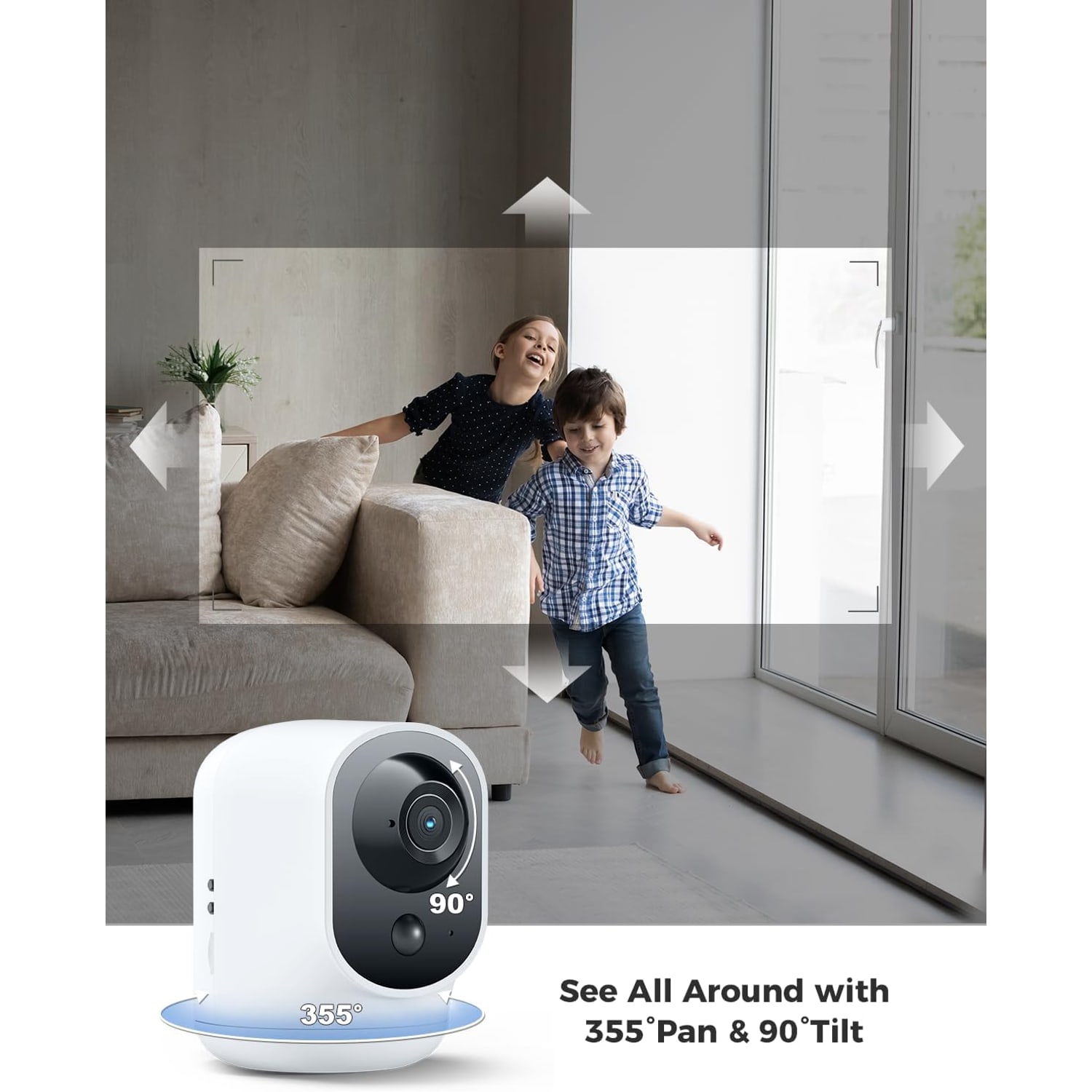
The second half of the problem is the fixed lens. A camera that looks at one angle only is fine if you know exactly what you want to see and it never moves. Most of the time it does move. The dog wanders out of frame. The package gets left just outside the shot. A pan and tilt head fixes that, because one camera in a corner can look almost anywhere in the room when you tell it to.
How this one works
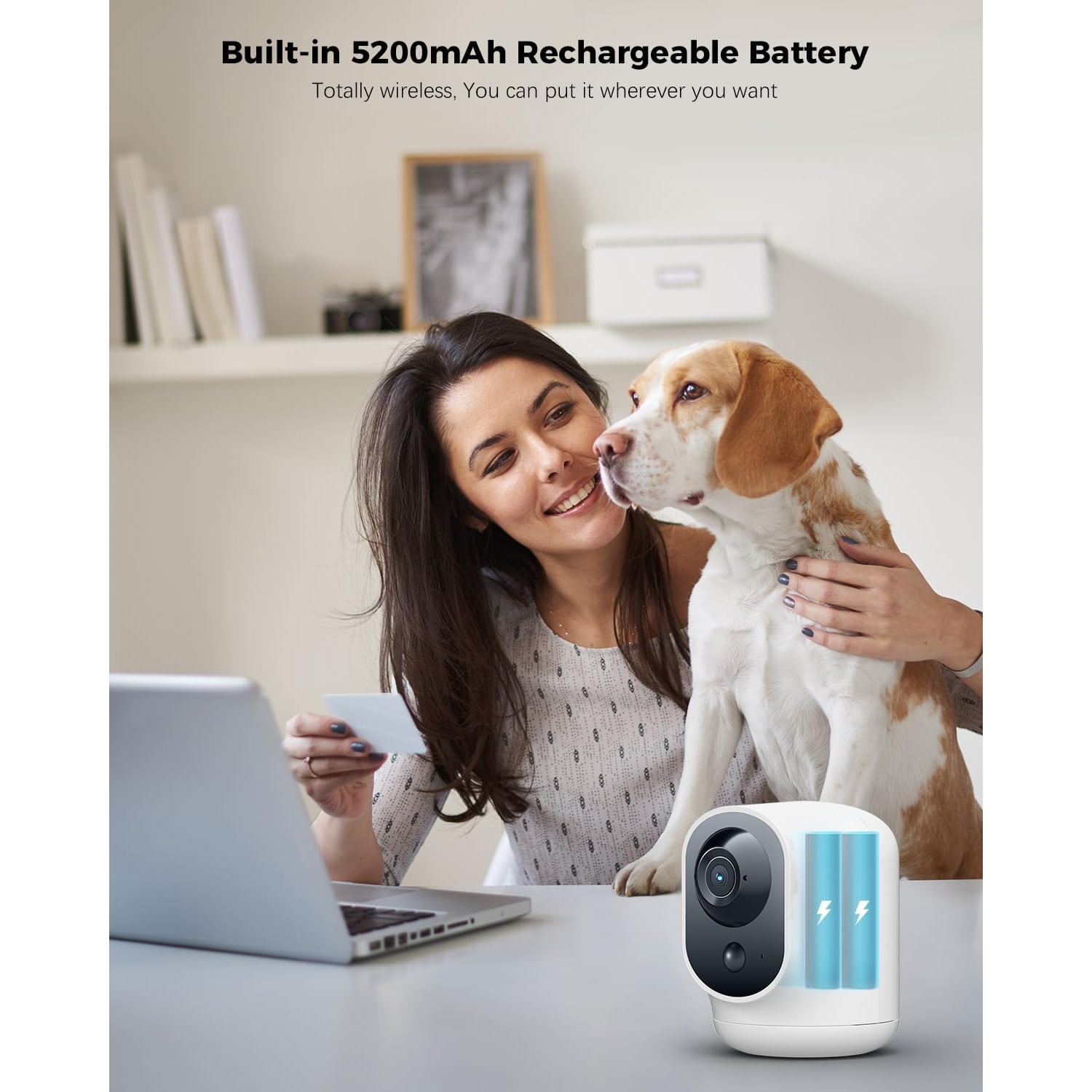
This is a cordless indoor camera running on a 5200mAh rechargeable battery, charged with the USB cable in the box. The head pans 355 degrees across and tilts 90 degrees up and down, driven by a small motor and controlled from the app on your phone.
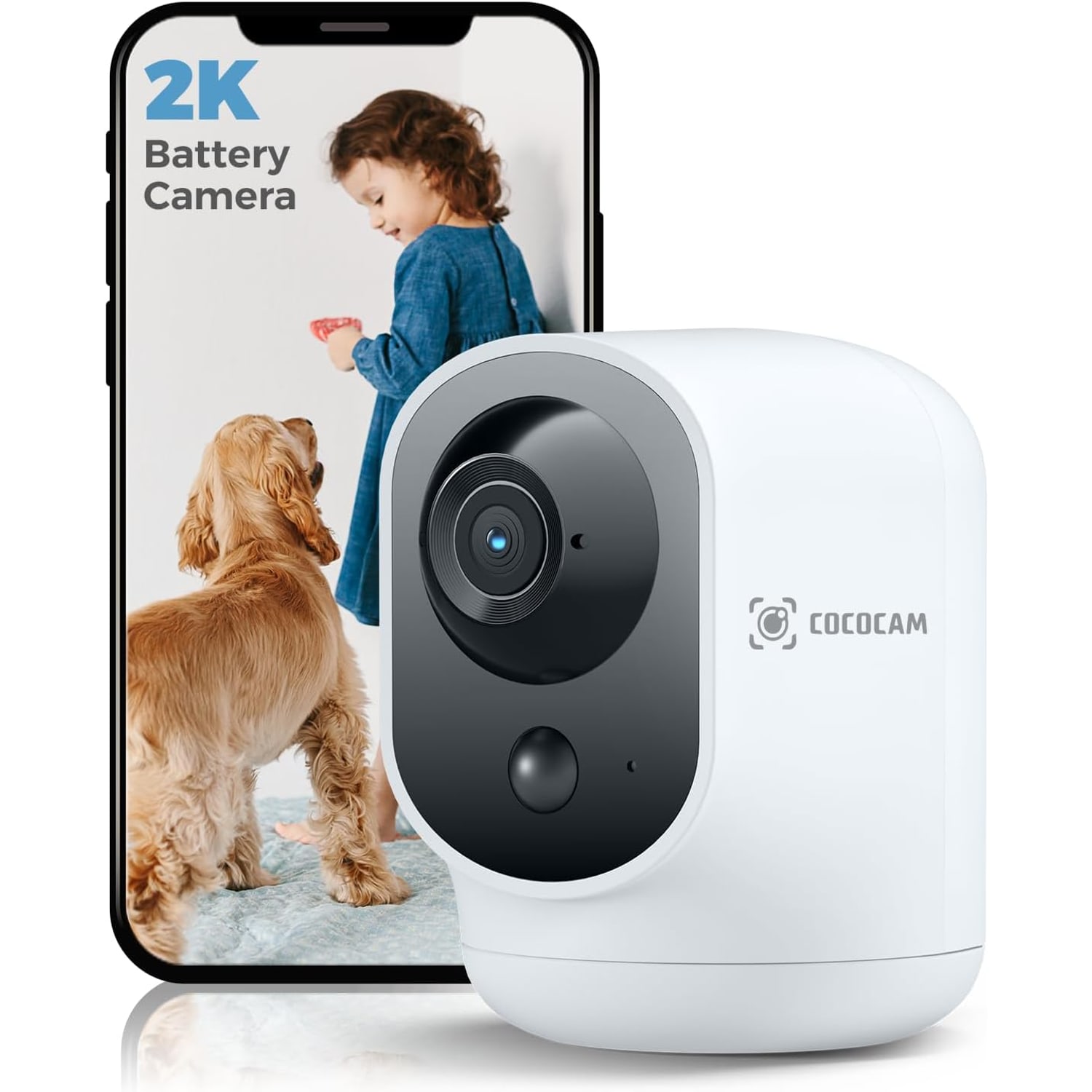
It records at 2K, which here means 2304 x 1296 from a 3MP sensor. The practical difference against 1080p shows up when you zoom into a frame. A face across the room stays recognizable rather than turning into four gray squares. The same is true for a license plate through a window or the writing on a box left by the door.
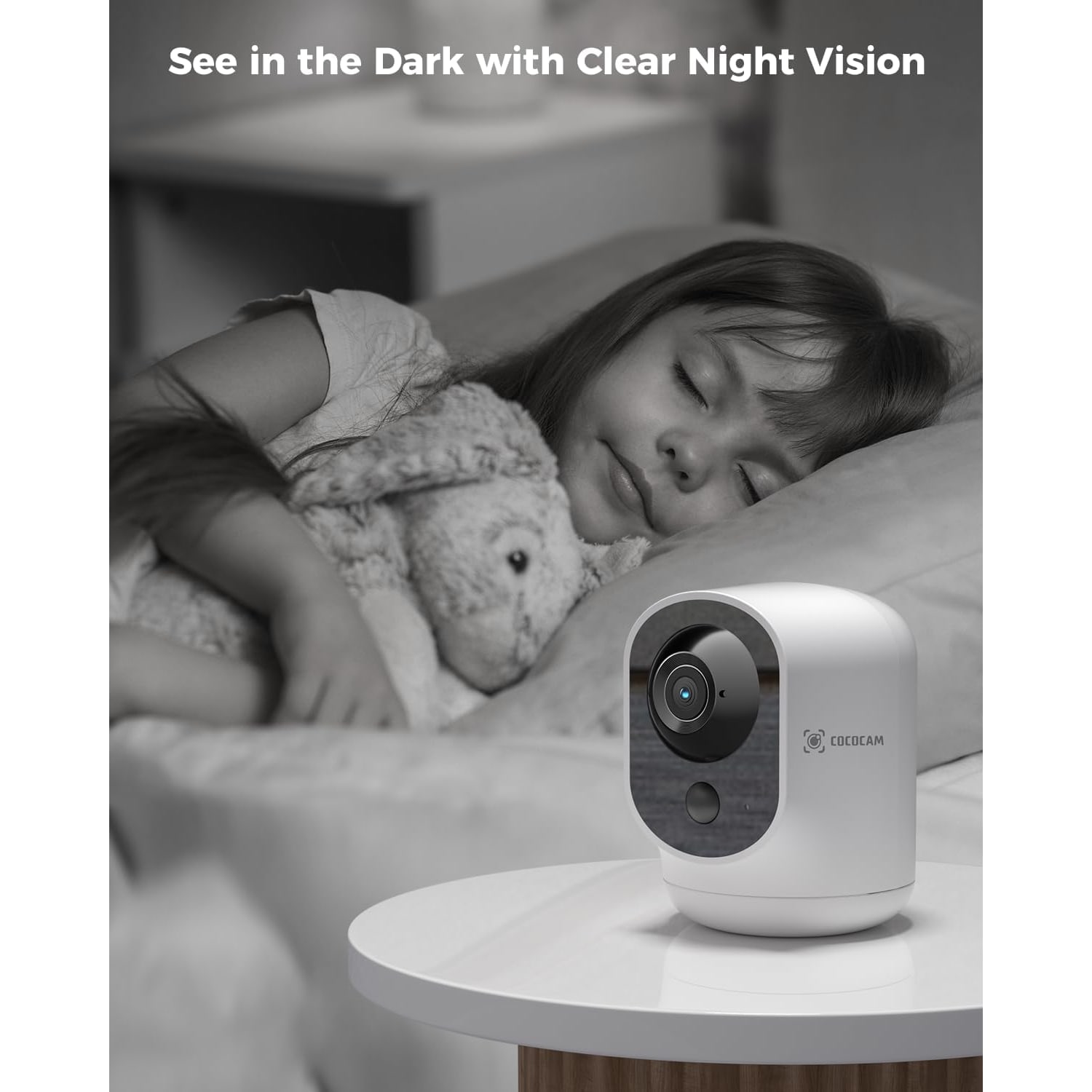
Night vision comes from four infrared LEDs, with a stated range of 20 meters. The picture goes black and white in the dark, which is how infrared works. It is not a downside. Stripping out color usually makes shapes easier to read in a dim room.
Motion detection is PIR based. That means it reacts to body heat and movement rather than any change in the pixels. The practical result is fewer alerts from a curtain shifting in a draft or afternoon sun crawling across the carpet. You can also set which part of the frame you want watched, so the camera pays attention to the hallway and ignores the television.
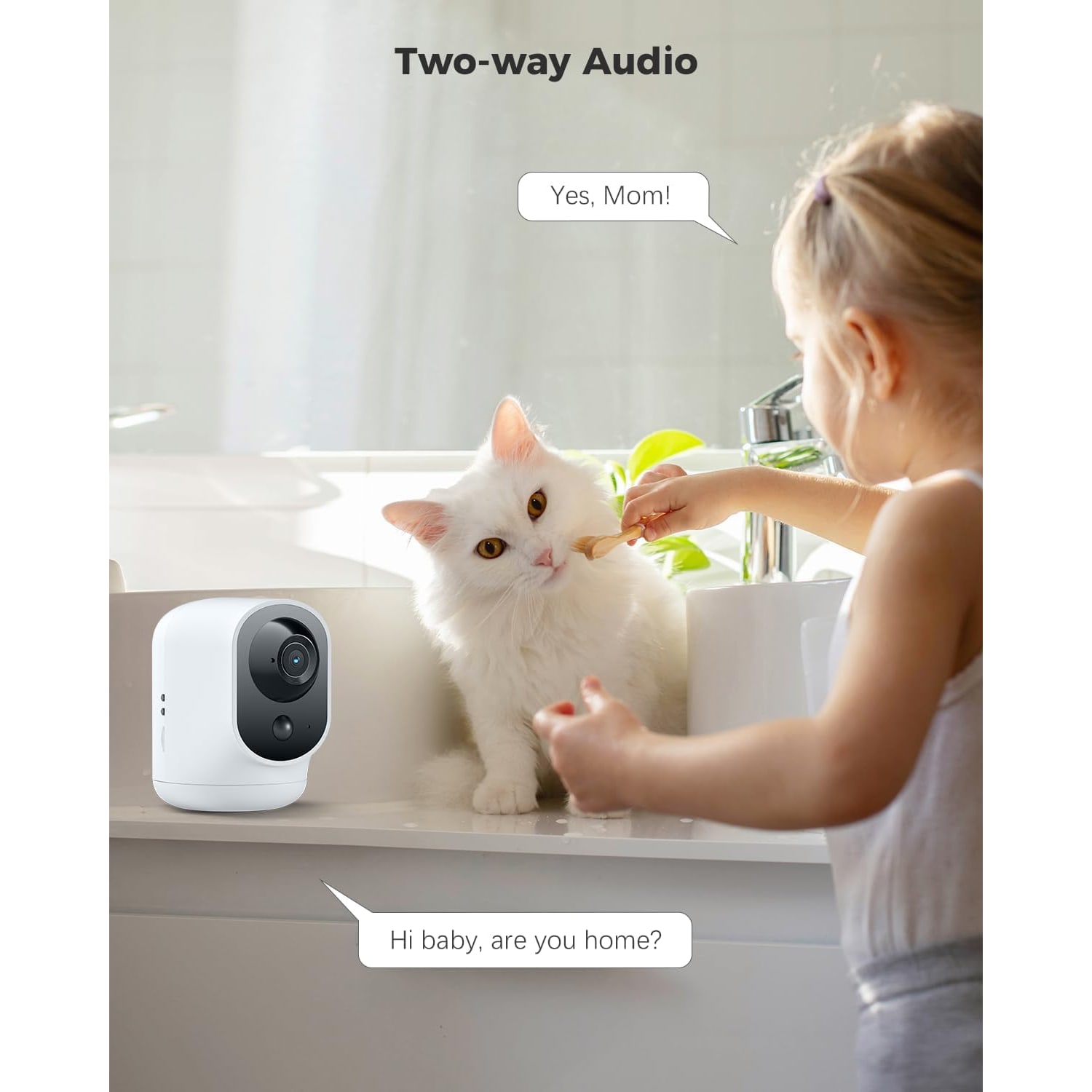
Recordings go to a microSD card of up to 128GB, which you buy separately, or to cloud storage through the app. Two-way audio lets you hear the room and talk back. Setup runs through the CloudEdge app on 2.4GHz Wi-Fi (the maker also names Bluetooth), and the camera works with Alexa and Google Assistant once it is on your network.
Who it suits
The best battery indoor security camera for most people is a small one in a single room, not a multi-camera system. This suits that job.
It makes sense if you rent and cannot drill into walls. It makes sense if you want to check on a dog during the day and talk to them when they start chewing something. It suits a nursery, a hallway by the front door, a home office where you keep tools or gear, a vacation place you visit a few times a year.
It is less suited to a few situations. It is indoor only and not water resistant, so a porch, a garage that gets damp or a bathroom are all out. It is freestanding and made for flat placement, so if you had your heart set on a ceiling mount, this is not the one. And if you need continuous twenty four hour recording rather than event-triggered clips, a battery camera will always be the wrong tool. Battery life comes from sleeping between events.
What to look at when you compare
Battery capacity against how busy the room is. A 5200mAh battery is a decent size for this class of camera. The maker's figure of around 5000 motion detections per charge is more useful than a number of days, because days depend entirely on traffic. A quiet spare room will go much longer between charges. A front hallway in a house with three kids will need charging more often. Think about your room, not the headline number.
Pan range. 355 degrees is close to a full circle, leaving only a narrow blind spot behind the camera. Put that blind spot against a wall and you have effectively covered the room. Cameras with a 90 or 120 degree fixed field of view cannot do that.
Resolution you will actually use. 2K at 3MP is the sweet spot for indoor work right now. Higher resolutions eat storage and battery faster for detail you rarely need in a single room.
Local storage support. Being able to run a 128GB card means you are not dependent on a plan to see your own footage. Buy a card rated for continuous video writing rather than the cheapest one on the shelf, because cards sold for cameras handle repeated overwriting much better.
Wi-Fi band. This camera uses 2.4GHz. That band travels further through walls than 5GHz, which is what you want for a camera in a back room, but it means you may need to check your router settings during setup if your network combines both bands under one name.
Audio and law. Two-way audio is genuinely useful. Just be aware that recording audio and recording other people is covered by federal and state law, and the rules differ depending on where you are and who is being recorded.
Setting it up well
Charge it fully before you start. Pair it standing near your router, then move it to its final spot and check the signal in the app.
Height matters more than people expect. Chest height to just above eye level gives the best mix of face detail and room coverage. Too low and you get a lot of furniture. Too high and you are looking at the tops of heads.
Avoid pointing it straight at a window. Bright daylight behind a subject turns them into a silhouette, and no resolution fixes that. If a window is unavoidable, angle the camera so the window sits off to one side.
Set your alarm area before you set your notification preferences, not after. If you get the detection zone right first, you will need far fewer alert tweaks later.
Looking after it
Wipe the body with a dry microfiber cloth now and then. Dust on the lens cover is the single most common cause of a soft or hazy picture, and a dry lens cloth clears it in seconds. Keep solvents and alcohol wipes away from the plastic.
Recharge before the battery is completely flat where you can. If you put the camera away for a season, store it charged rather than empty.
Keep it dry and keep it indoors. The ABS housing has no water resistance rating, so steam from a kitchen or bathroom will cause problems over time.
The short version
If you want to watch one room, do not want to run a cable, and want the ability to look around rather than stare at a fixed rectangle, this covers it. The 5200mAh battery keeps it cord free, the 355 degree pan and 90 degree tilt turn one camera into something that can cover most of a space, and 2K video with 20 meter infrared night vision gives you footage that is actually readable when it matters.
It is indoor only, it stands on a surface rather than mounting on a wall, and you will want to add a microSD card. Within those limits, it does the ordinary job well, which is usually all anyone needed.