


The complete guide
How to Choose a Kids Waterproof Camera That Actually Gets Used
The problem with giving a child a camera
Most parents try this once. They hand over an old phone or a cheap compact camera, it gets dropped in the pool or buried in sand, and that is the end of the experiment. The camera was never built for the way children actually use things, which is enthusiastically and without much caution.
A kids waterproof camera solves a narrow but real problem. It assumes the camera will go in the water, get dropped, get carried by a strap, and be handed over sticky. Instead of asking a child to be careful, it removes the need for them to be.
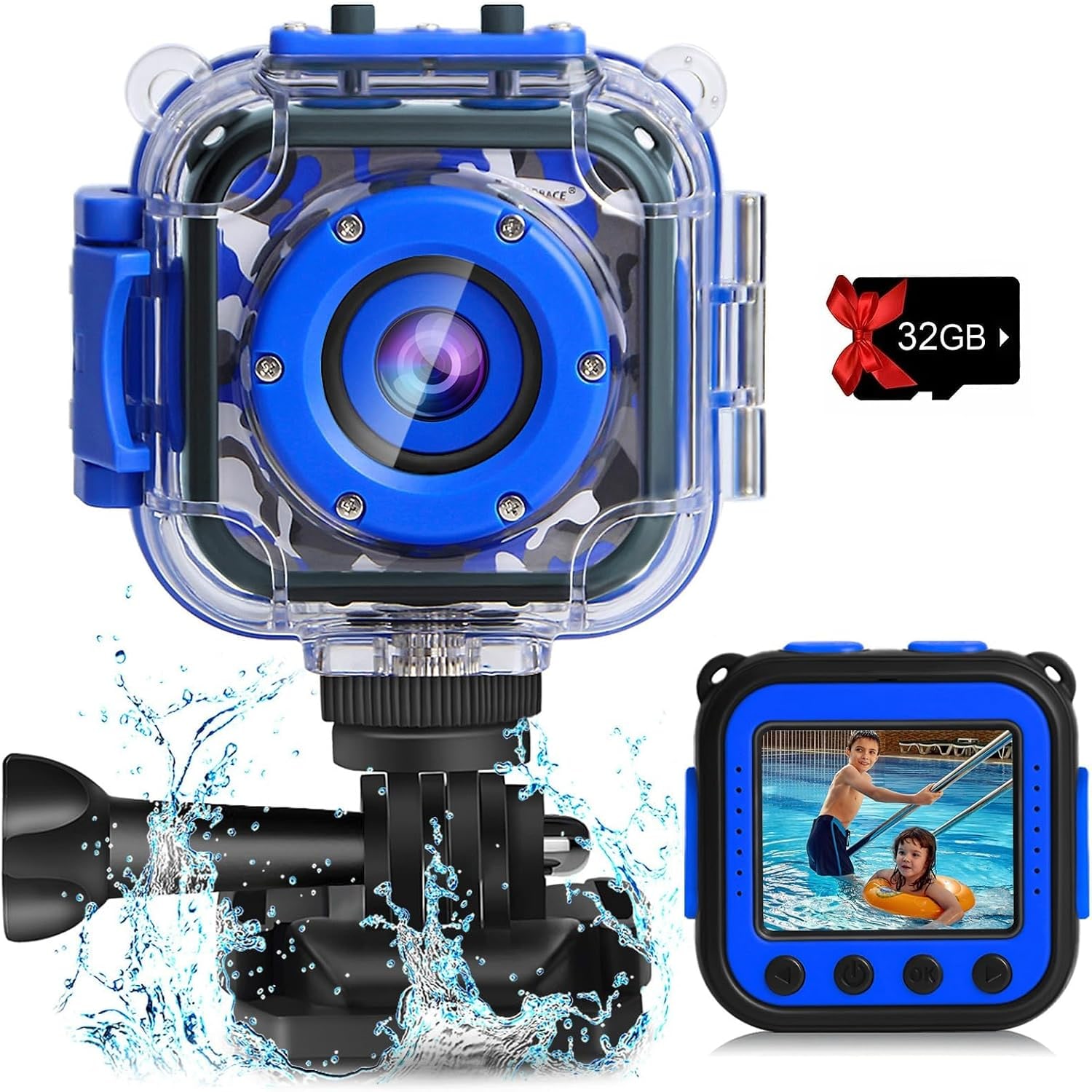
This one is a small blue action camera measuring 2.36 by 2.28 by 0.98 inches and weighing 1.76 ounces. It ships with a waterproof case, a 32GB micro SD card, a micro USB cable, two fastening straps, a bicycle mount, a helmet mount, two lanyards and a manual. That matters more than any single spec, because the most common reason a kids camera stays in the box is a missing memory card.
How it works
The camera uses a 1/4 inch CMOS sensor behind a lens with a 10 millimeter focal length and a maximum aperture given as 2.8 millimeters. Video records at 1080p and saves as AVI files. Photos are JPEGs in a 16:9 aspect ratio, with an effective still resolution of 5 MP in the specifications and 40MP photos advertised in the product images.
Almost everything else is automatic. Focus is auto focus. Exposure control is automatic. White balance is set to auto. There is digital image stabilization and a sports shooting mode for moving subjects. A child does not need to understand any of that. They point the camera, press the button, and look at the 1.77 inch screen on the back to see what they got.
That screen is the part people underestimate. Without it, a camera is a black box and a child loses interest fast. With it, they get instant feedback. They notice their thumb was over the lens. They try the same shot again from lower down. That small loop is how kids actually learn to take better pictures, and it happens without anyone teaching them.
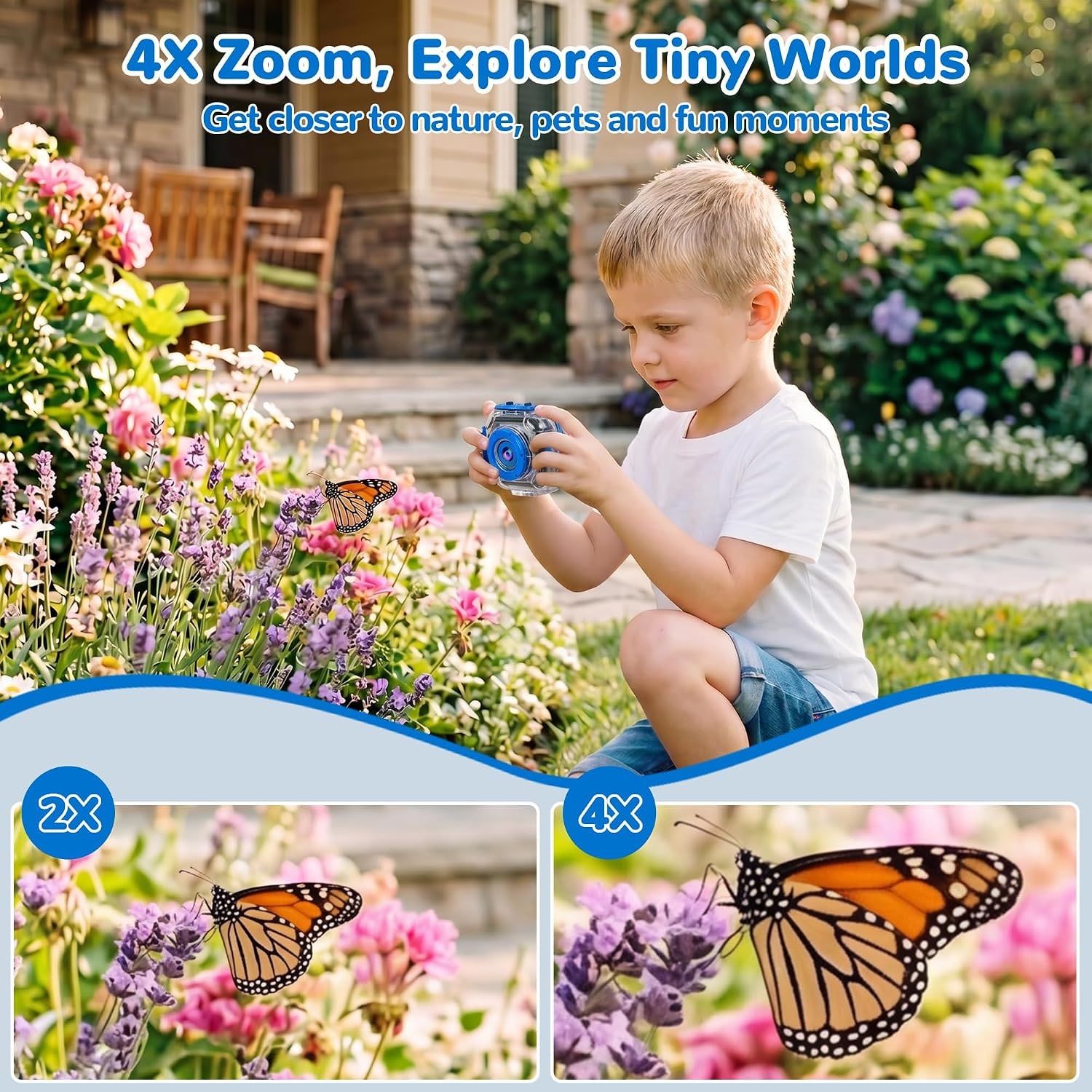
The maker describes a 4x zoom. The specifications list 4x under both optical and digital zoom while giving a single 10 millimeter focal length, so do not count on it being optical. For a child filming a dog across the yard, it does the job. The maker also describes time-lapse, burst mode, 40+ frames, stickers and 7 color filters.
Storage uses a micro SD card, and the included 32GB card is rated C10, UHS speed class 3 and V30. Those ratings describe sustained write speed, which is what video recording needs. A slow card is a common cause of dropped frames, so starting with a properly rated one removes a frustration before it happens.
Who it suits
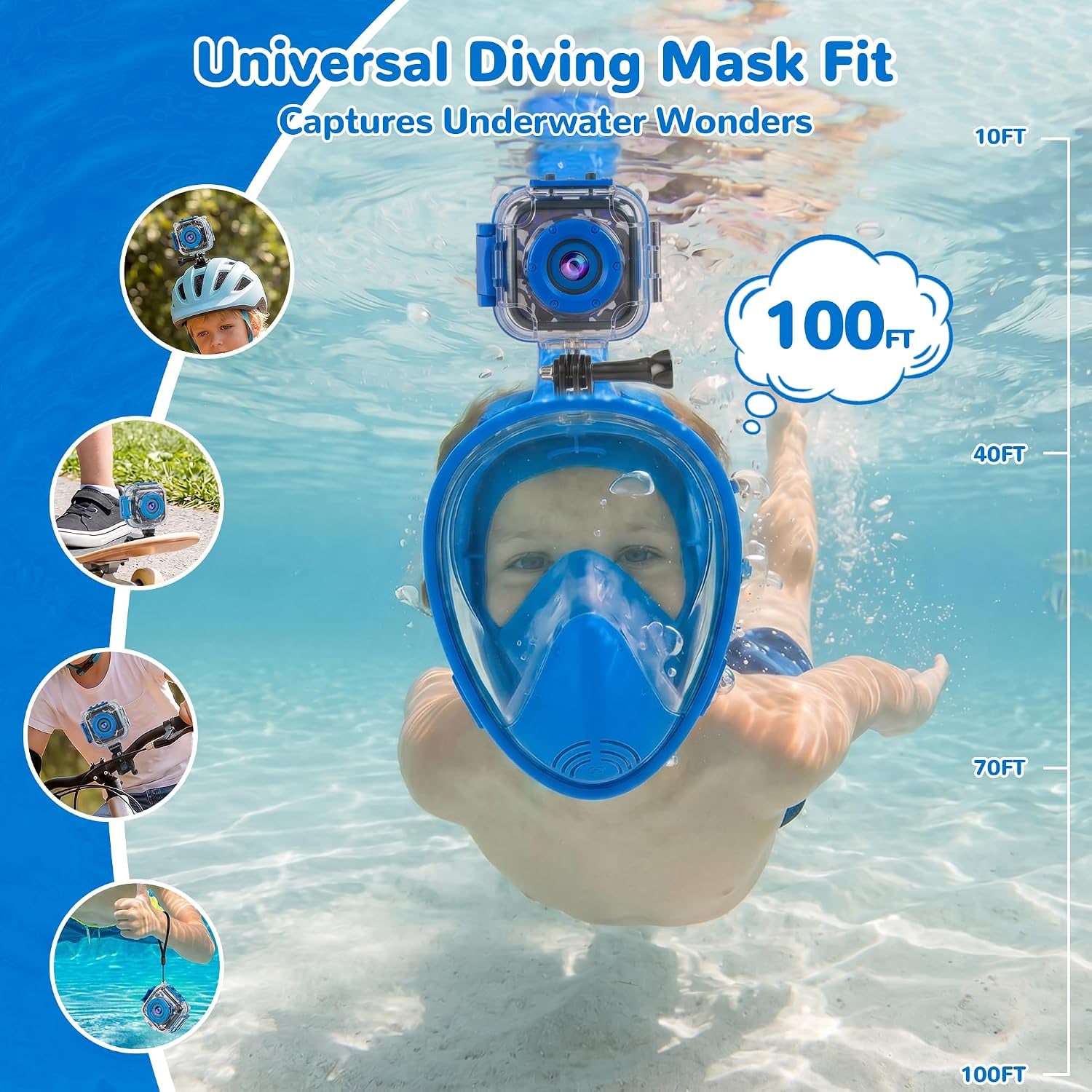
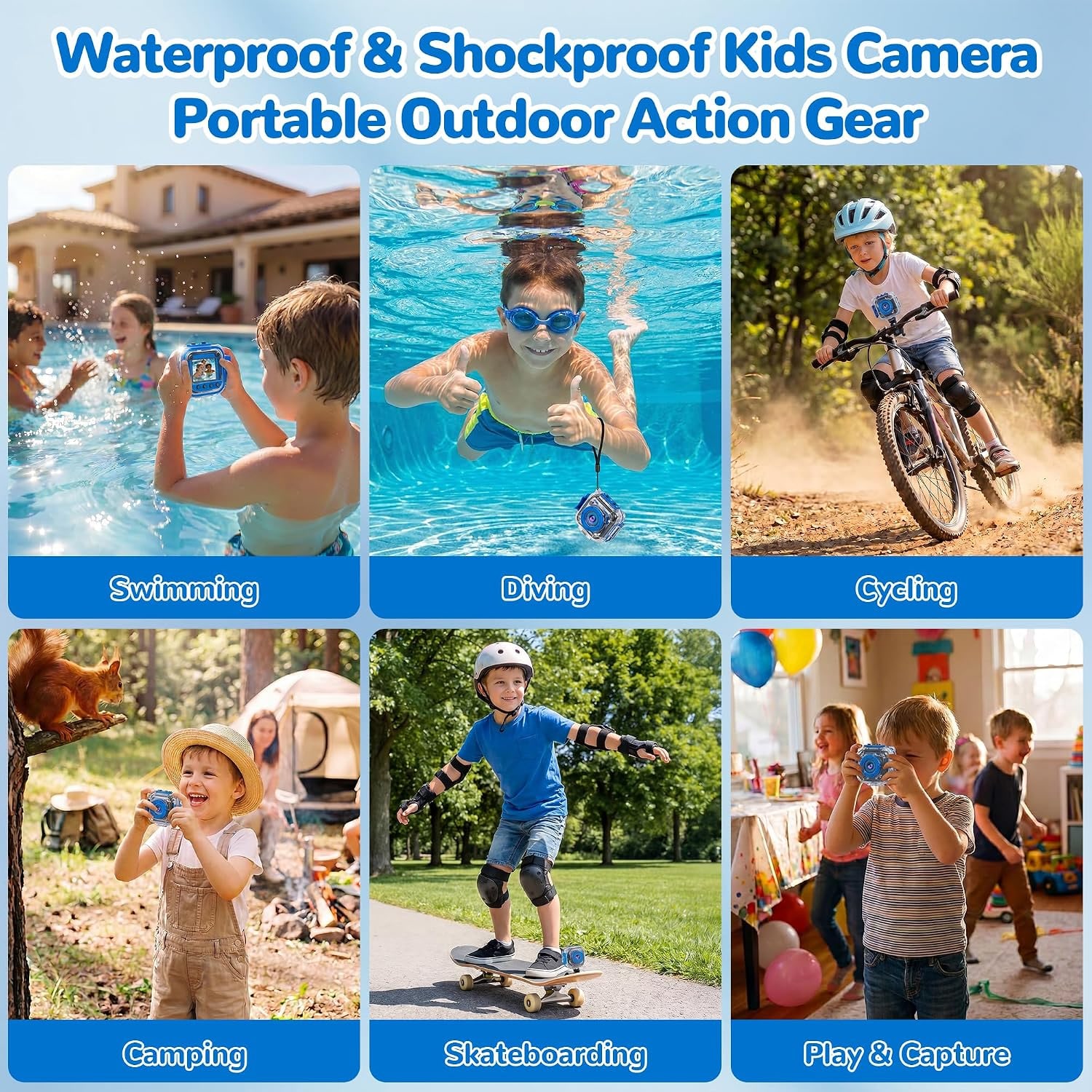
This camera fits a child who wants to be outside. Pool afternoons, beach trips, bike rides around the block, scooter runs at the park, poking around a creek with a bucket. The supplied bike mount and helmet mount point clearly at that use.
It also suits the parent who wants to stop handing over a phone. A phone invites apps, notifications and the risk of a cracked screen. A dedicated camera does one thing. The child gets to carry something that is theirs, and the phone stays in your pocket.
It is less suited to a child looking for professional image quality. A still from a 1/4 inch sensor is a snapshot, not a portrait. If you want gallery prints, this is not that camera. If you want your eight year old to come back from the pool with forty clips of their cousin doing cannonballs, it is exactly that camera.
Age wise, the maker describes it as a camera for kids ages 3 to 12. Younger children will mostly enjoy the pressing. Older ones will start thinking about angles, zoom and where to mount it. Searches for the best kids video camera usually come from parents in that second group, where the child has already shown interest.
How to choose
Start with water. Decide whether the camera will mostly be near water or actually in it. Near water means splashes, rain and wet hands, and a case handles that easily. In the water means swimming, snorkeling and pool dives, and the case becomes essential equipment to check before every session. The maker describes the supplied case as 100ft waterproof.
Then look at what is included. A camera without a memory card is not a camera yet. A camera without a cable means hunting through a drawer. This one comes with both, plus the mounts, which saves two or three small purchases that would otherwise add up.
Weight is worth a thought. At 1.76 ounces this sits comfortably in a child's hand and on a helmet without feeling top heavy. Heavier action cameras get taken off and left behind.
Finally, think about how footage comes off the camera. Connectivity here is USB, and compatible devices are listed as computer and tablet. You plug in the supplied micro USB cable and copy files across. The maker's details mention no app, which some parents will see as the main selling point. Anyone comparing options for the best underwater camera for kids should weigh that simplicity against the convenience of wireless transfer on more expensive models.
Care and getting a long life out of it
The case does the hard work, so look after the case. Rinse it closed under fresh water after the pool or the ocean, then dry it fully before opening. Salt and chlorine both leave residue, and residue in the seal groove is what eventually lets water in.
Check the seal before every swim. Run a finger around it. A single hair or a grain of sand is enough to break the seal, and you will not notice until it is too late. Take ten seconds, every time.
Clean the lens with a soft dry cloth. Paper towel scratches plastic lens covers, slowly, and the damage shows up as haze in bright sun.
Store the camera somewhere cool and dry when the season ends. Leaving it in a hot car or a sunny windowsill is hard on both the battery and the case seal. The listed battery average life is two years, and reasonable storage is part of reaching it.
Teach the lanyard habit early. Two lanyards are supplied for a reason. A camera on a wrist does not get dropped off a dock.
A note on what you film
Cameras get pointed at people, which is worth a short conversation. Recording audio and recording other people are covered by federal and state law, and the rules are not the same everywhere. The practical version for a child is simple enough to teach: ask before you film someone, and stop if they say no. That covers most situations and builds a decent habit.
The short version
This is a compact blue action camera built for kids who are going to get wet. It shoots 1080p video and 5MP photos, has a 1.77 inch screen so children can see what they captured, and runs on automatic focus, exposure and white balance so there is nothing to learn before the first shot.
The box includes the waterproof case, a 32GB V30 card, a USB cable, two straps, a bike mount, a helmet mount, two lanyards and the manual. Nothing else is needed on day one.
It is not a replacement for a serious camera and it is not trying to be. It is a durable, light, self contained kit that lets a child take a camera places you would never take yours. For a lot of families, that is the whole point.