
The complete guide
How To Choose An Endoscope Camera That Actually Earns Its Place In Your Tool Bag
The problem with not being able to see
Almost every annoying repair starts with a guess. Water is coming through a ceiling somewhere, but you do not know where. The dryer takes twice as long as it used to, but the duct runs under the floor. The engine is burning oil and the only way to check the bore is to pull the head. A drain backs up every few weeks and the plumber shrugs.
In each case the actual fix might be small. The expensive part is the exploratory work: cutting drywall, lifting boards, dismantling an assembly, just to find out what you are dealing with. An inspection camera flips the order around. You look first, then you decide. Sometimes you discover the job is trivial. Sometimes you discover it is beyond you and you call someone, which is also a win, because now you can describe the problem accurately and hand over a video clip.
How a borescope works
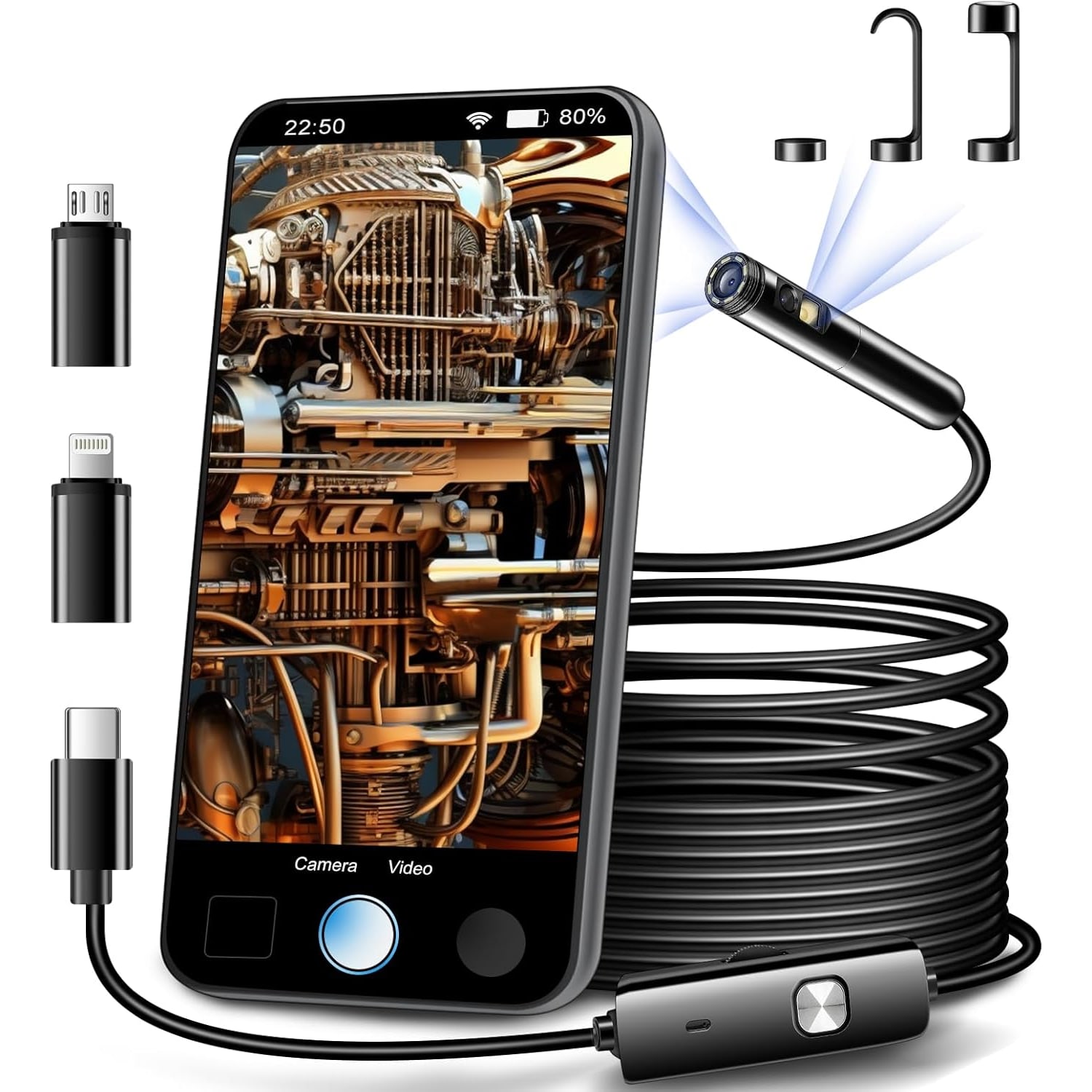
The idea is simple. A tiny camera sensor and a ring of LEDs sit at the tip of a long cable. The cable carries power and the video signal back to a screen. On older units the screen was a built-in monitor you had to buy, charge and carry. On a phone-connected model like this dual lens endoscope camera, your phone is the screen, which saves money and gives you a better display than most dedicated handsets ever had.
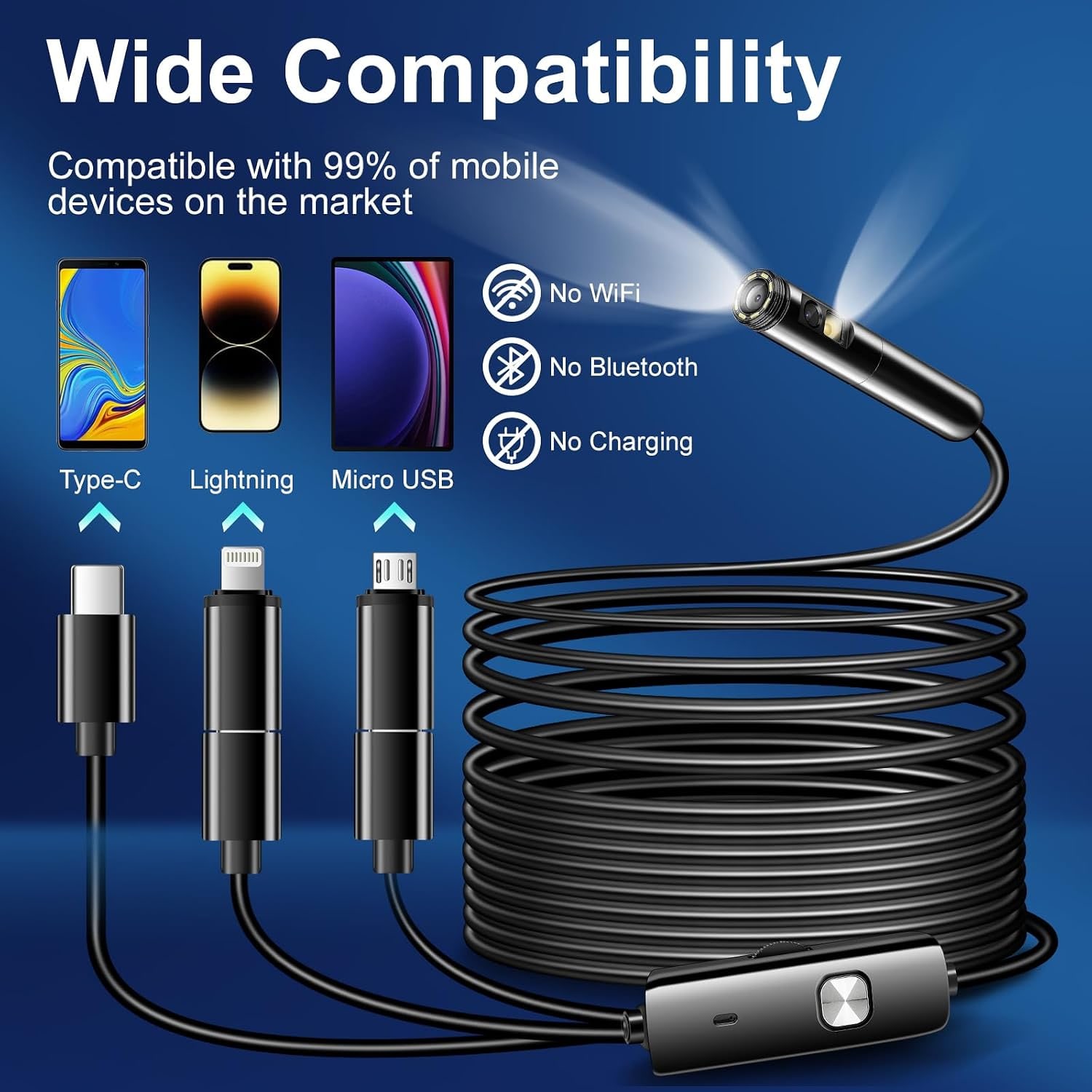
This one connects by wire over USB, with a USB-C plug on the camera and Micro-USB and Lightning adapters in the box. That covers the great majority of phones and tablets in use. Android users often need to turn on OTG in settings so the phone will talk to a USB accessory, which is a one-time step.
Wired matters more than people expect. Wireless borescopes create their own Wi-Fi hotspot, which means your phone leaves your normal network, the video lags by a fraction of a second, and the picture sometimes freezes at the worst moment. A cable has none of that. Plug it in and the live view is there, with no pairing step.
Two lenses instead of one
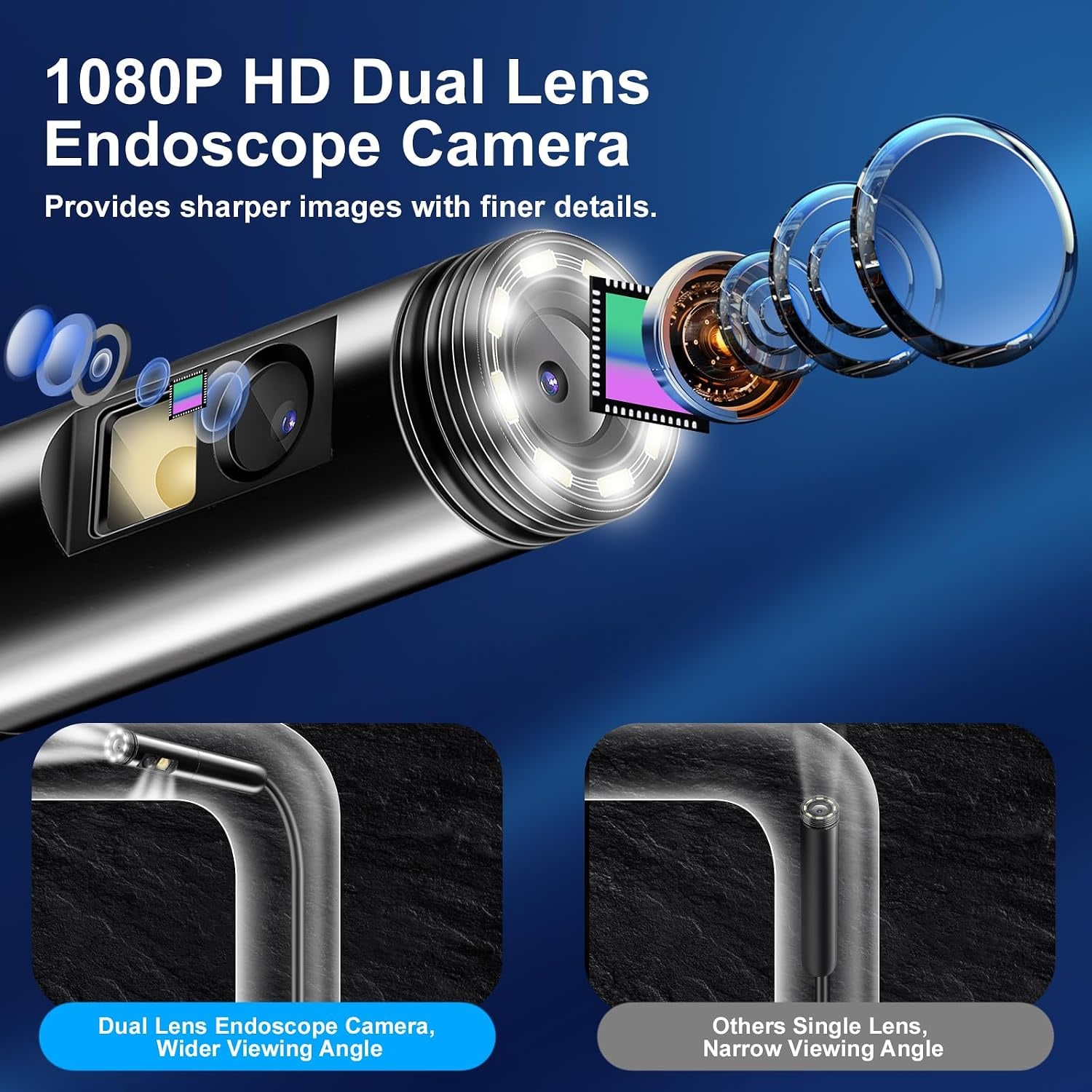
Here is the part that changes how you work. A standard borescope has one camera looking straight forward. Inside a straight pipe that is fine. Everywhere else it is limiting, because what you usually want to inspect is the surface beside the probe, not the darkness ahead of it.
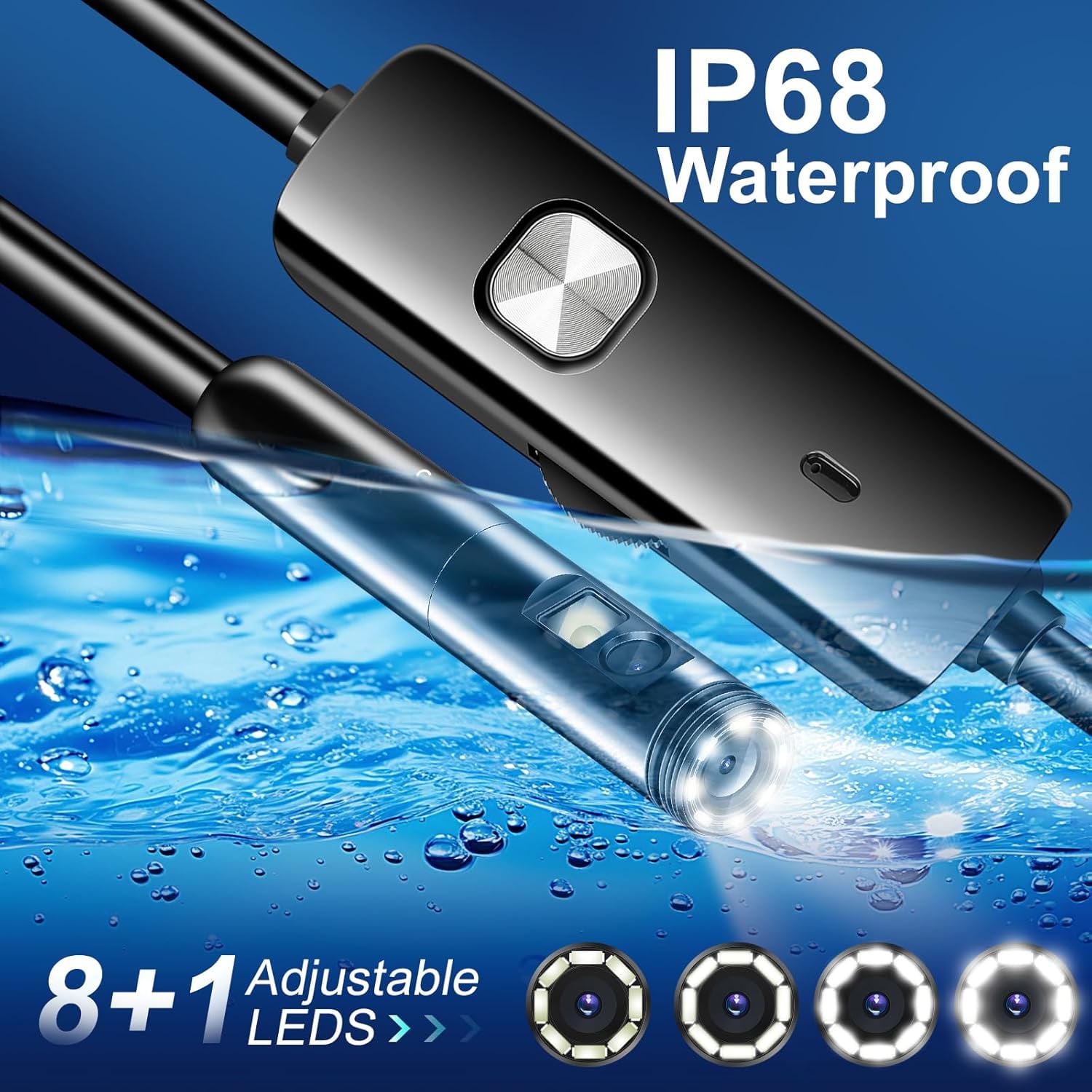
This model puts a 1080p camera on the front and another on the side. You push the probe along a run and the side lens shows you the pipe wall, the joint, the weld, the corrosion, the root that has pushed through. In an engine, the side lens is what lets you look at a cylinder wall properly instead of staring down at a piston crown. Switching between the two is a button press on the control panel built into the cable.
Lighting is matched to each lens: eight LEDs around the front camera and one bright LED beside the side camera. Brightness is adjustable, and you will use that more than you think. Inside shiny copper or a wet plastic drain, full brightness just bounces back as white glare. Dialing it down two steps often gives a far more readable picture.
Who it suits
Home owners get the most out of it, honestly. Blocked drains, damp patches, dryer ducts, wall cavities, the gap behind a built-in oven, the space under a deck. Any time you would otherwise be cutting a hole to look.
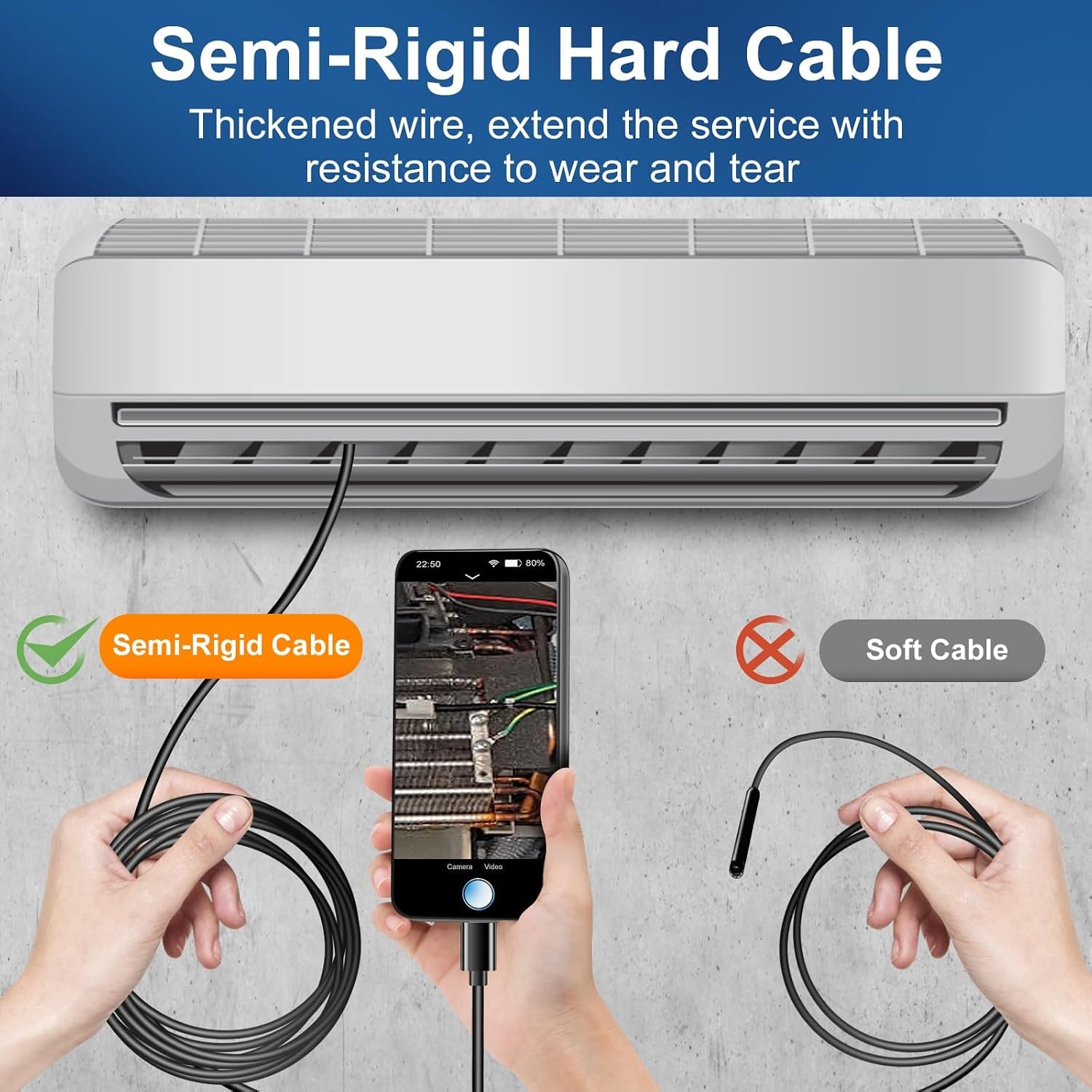
Mechanics and DIY car enthusiasts use it for bore inspections, checking behind manifolds, finding a dropped socket in the engine bay and looking at things that sit two hands deep. The semi-rigid cable is what makes a vehicle inspection camera genuinely useful, because you can shape it and it stays shaped.
Trades use it for quick evidence. A photo of a cracked joint, sent from the job site, settles an argument faster than a description. Landlords and property managers do the same thing in reverse, documenting condition before and after work.
It is less suited to very long sewer runs or anything needing a locator sonde. At 16.5 ft you are covering household distances, not whole street laterals.
What to check before you buy
Reach. Measure, do not estimate. Work out how far in the thing you want to see actually sits, then add a couple of feet for the bends. This cable is 16.5 ft. If your target is forty feet down a run, you need a different tool.
Probe fit. The hole you are feeding through has to be bigger than the probe head. If you are buying specifically for a spark plug hole or a small drilled inspection hole, ask us first, because the probe diameter is not stated by the maker.
Cable behavior. Fully flexible cable is easier to coil but will not push around a bend. Fully rigid cable goes exactly where you aim it but cannot follow a curve at all. Semi-rigid, as here, is the middle ground most people want for mixed work.
Wet or dry. If there is any chance of water, you want a waterproof probe. The IP68 rating on this one means drains, traps and damp cavities are fine. Your phone and the plug end still need to stay dry.
Screen. With a phone-based model, the screen you already own is the screen you get. That is usually an upgrade over a built-in panel, but it does mean one hand is occupied holding the phone. A small phone clamp or a magnetic mount on a nearby surface helps a lot.
Getting a usable picture
A few habits make the difference between a clear inspection and a smeared mess.
Clean the lens before you start and again partway through if you are in anything greasy. A fingerprint or a film of oil on the lens ruins a 1080p image faster than poor lighting.
Move slowly. Fixed focus cameras have a distance that is sharpest. Creep forward and back until the detail snaps in rather than shoving the probe along at speed.
Record rather than relying on memory. Hit record and do one continuous pass, then review it afterward on a bigger screen. You will spot things on playback that you walked straight past live.
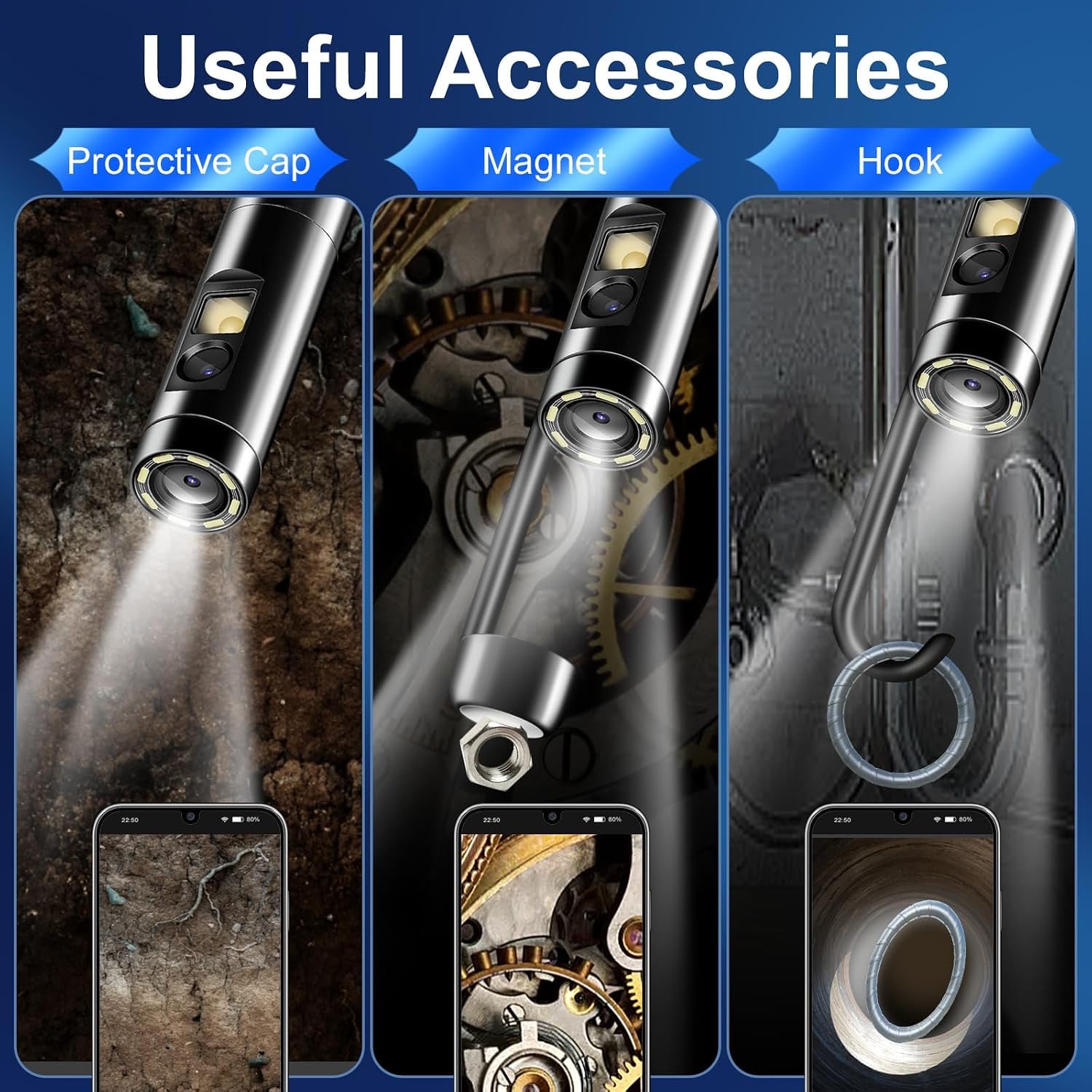
Use the hook and magnet. If you are going after a dropped fastener, fit the magnet first. People often do a full inspection pass, find the bolt, then have to withdraw and refit the attachment.
Care and storage
None of this is demanding. Rinse the probe if it has been in anything dirty, wipe the cable with a damp cloth, and dry everything before it goes away. Water that sits in the connector is the one thing likely to kill a wired camera, so keep the USB end clean and dry and put the protective cap back on the lens.
Coil the cable in wide loops. Semi-rigid cable remembers abuse. Repeated sharp kinks in the same place will eventually weaken it. Store it out of direct sun and somewhere it will not get crushed under heavier tools.
The short version
If you want to stop guessing what is behind a wall, down a drain or inside an engine, this covers the common household and automotive jobs well. You get two 1080p views instead of one, nine LEDs with adjustable brightness, an IP68 waterproof probe, 16.5 ft of semi-rigid cable that holds a bend, and a straight wired USB connection with no pairing or network setup. Your phone does the screen work, the camera does the looking, and the whole thing weighs 0.19 kg.
Check your reach and your hole size first. If both work, it is a tool you will reach for far more often than you expect.