Camera Company
Company
Shop By Category
T&Cs
Shop Online
  • The maker's specifications on every page
  • Free tracked USA-wide delivery over $150
  • 14-day returns

4K Dual Dash Cam with GPS | Front and rear dash cam | Dash cam with 64GB card

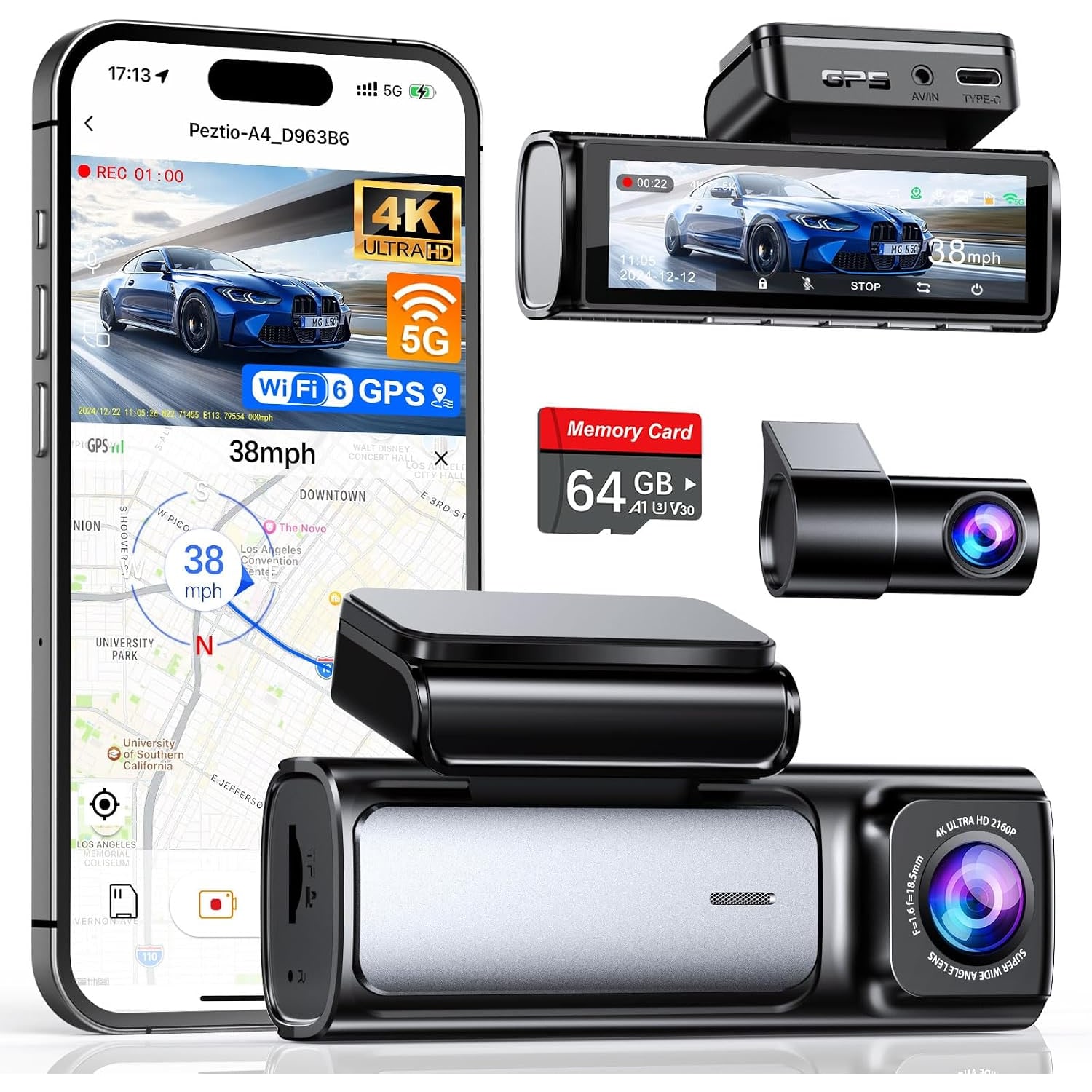
4K Dual Dash Cam with GPS and 64GB Card

$179.99 $215.99 Save $36
  • Dual Channel 4K
  • Built-In GPS
  • App Control
  • 64GB Card Included

Price: $179.99 $215.99

  • Free tracked USA-wide delivery on orders $150+, otherwise a flat $20
  • Pay by card or PayPal, handled by the payment provider
  • 14 days to change your mind, plus your statutory rights
Product specifications
Model NameA4 4K Dash Cam Front and Rear
Model NumberA4
ChannelsFront and rear
Video Capture ResolutionDual channel 4K 30fps front, 2.5K 25fps rear
Frame Rate30 fps front, 25 fps rear
Front Camera Field Of View160 degrees
Rear Camera Angle Of View155 degrees
Maximum Aperturef/1.5 stated by the maker (the lens ring in the photos is marked F=1.6)
Screen Size3.59 inches
Display TypeIPS LCD
Connectivity5GHz Wi-Fi 6
Control MethodApp
PositioningBuilt-in GPS
Mounting TypeWindshield mount
Memory Card Included64GB microSD
Maximum Card Supported256GB microSD
Memory Card Slots1
Video File Format.TS
Battery Cell TypeLithium polymer
Recording FeaturesLoop recording, G-sensor accident lock, voice recording, 24 hour parking monitor
Compatible DevicesSmartphone
Vehicle TypesCar, minivan, truck
ColorGray
In The BoxDual dash cam, rear camera and extending cable, 64GB card, 11.5ft Type-C car charger, wiring trim tool and cable clips, adhesive pad and electrostatic films, user manual
Shipping & returns

Tracked delivery anywhere in the USA. It is free on orders of $150 or more, and a flat $20 below that.

If it is not right for you, send it back within 14 days of delivery in resaleable condition and we refund the price you paid, including standard delivery. That is a voluntary policy we offer on top of your legal rights. You cover the cost of returning it unless the item is faulty.

If it arrives faulty, damaged or not as described, we put it right at no cost to you under the consumer protection law of your state and the Federal Trade Commission Act, return postage included.

Shipping details · Refunds and returns

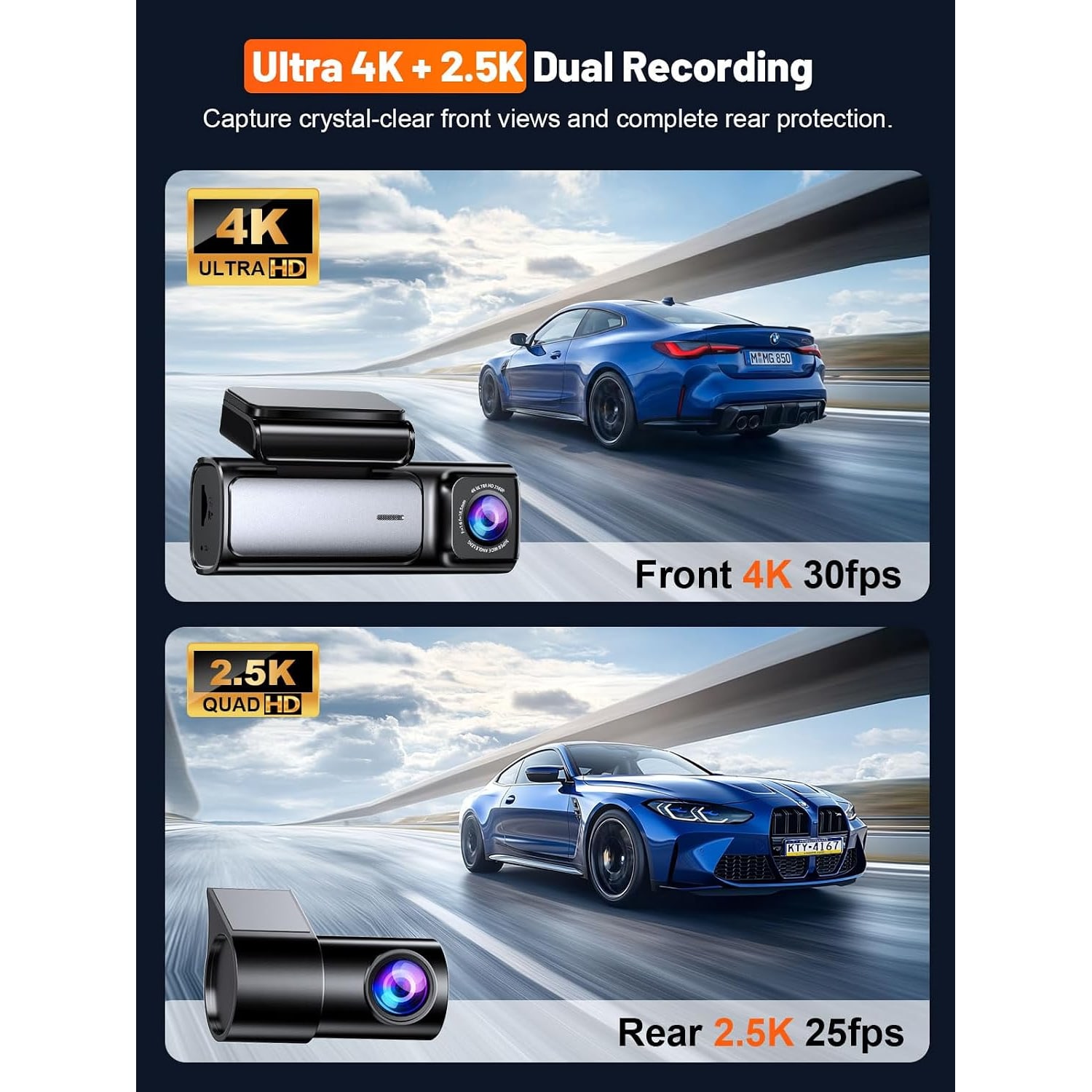
Dual Channel 4KFront records 4K at 30fps, rear records 2.5K at 25fps.
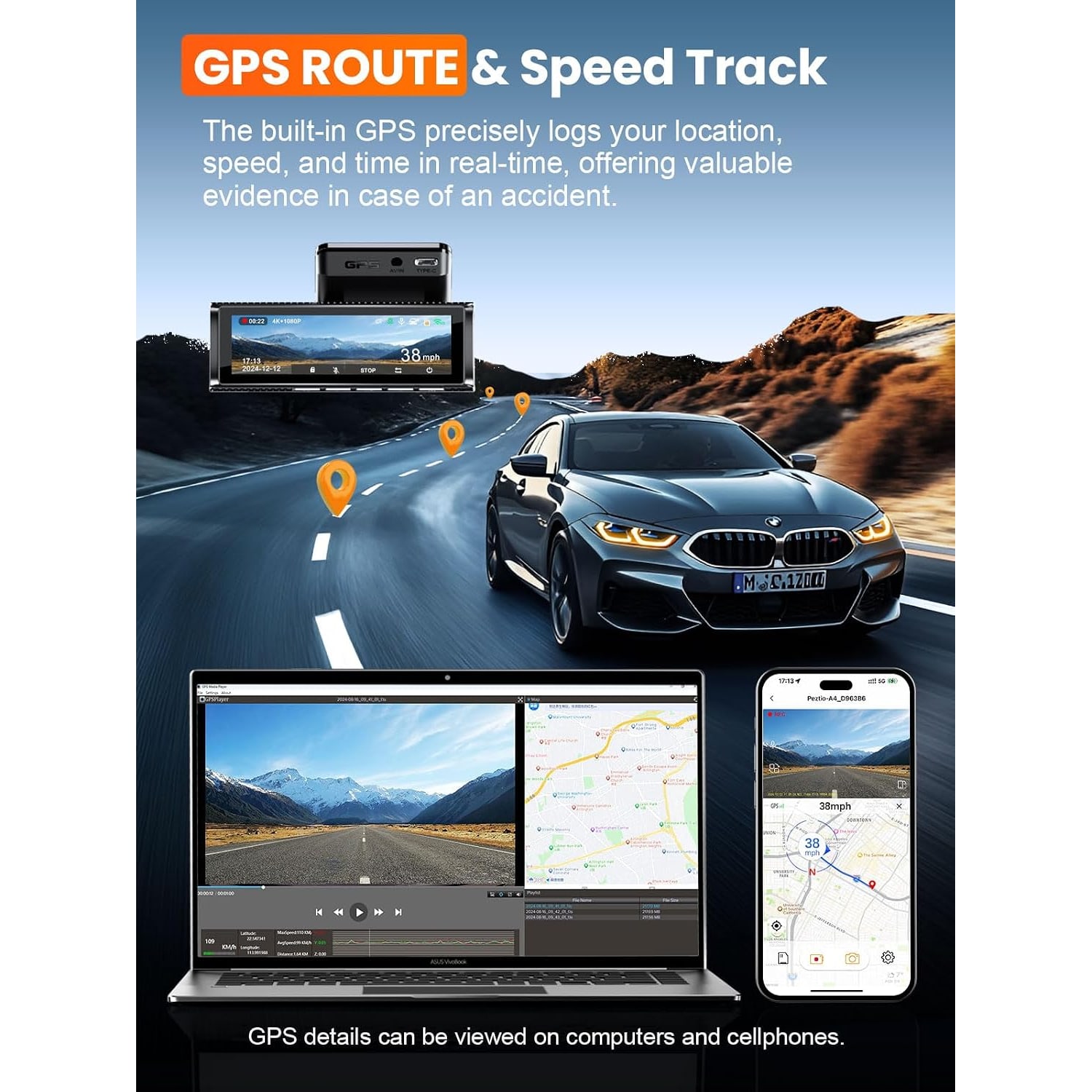
Built-In GPSLogs speed, route and coordinates alongside the video.
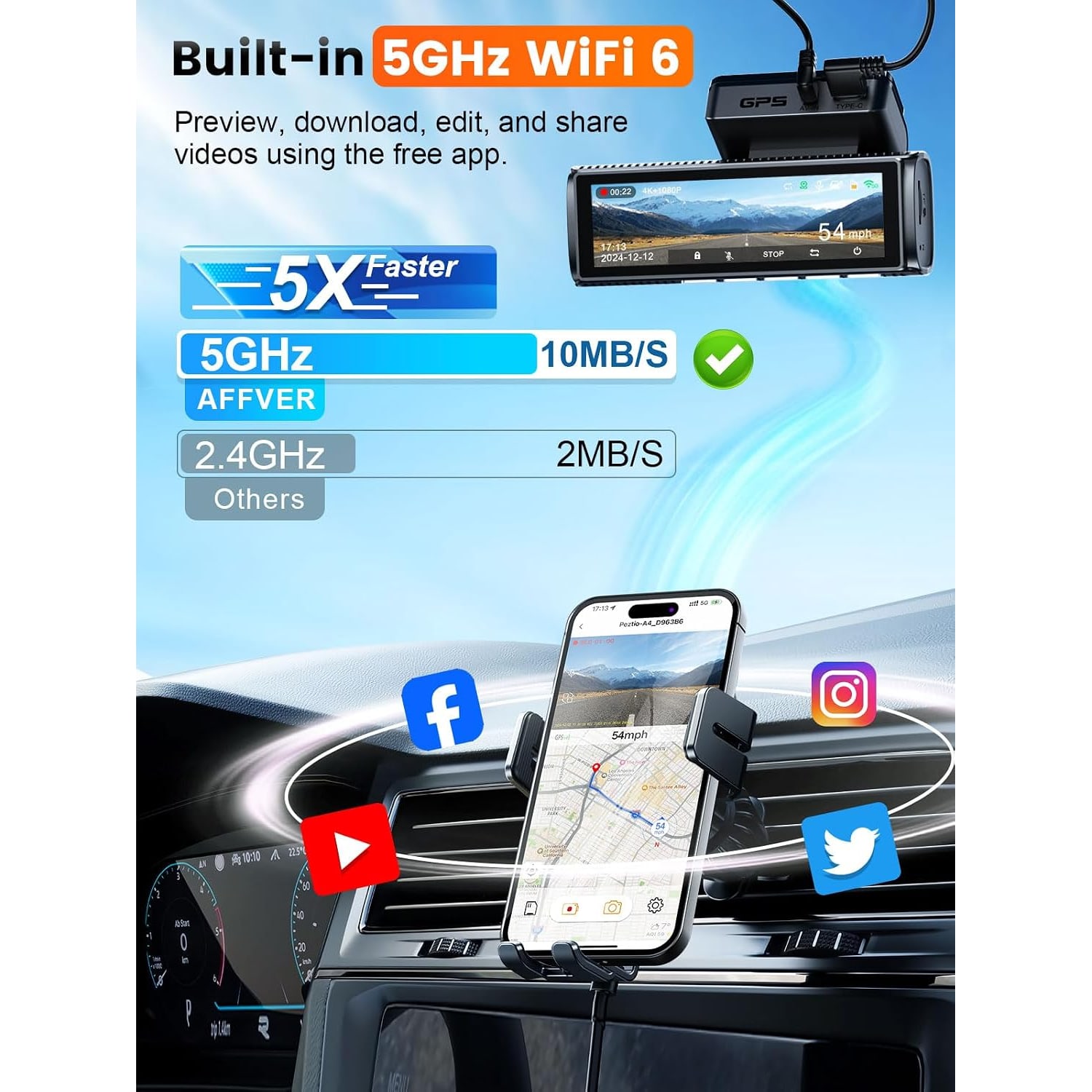
App ControlWi-Fi connects the camera to your smartphone for review and download.
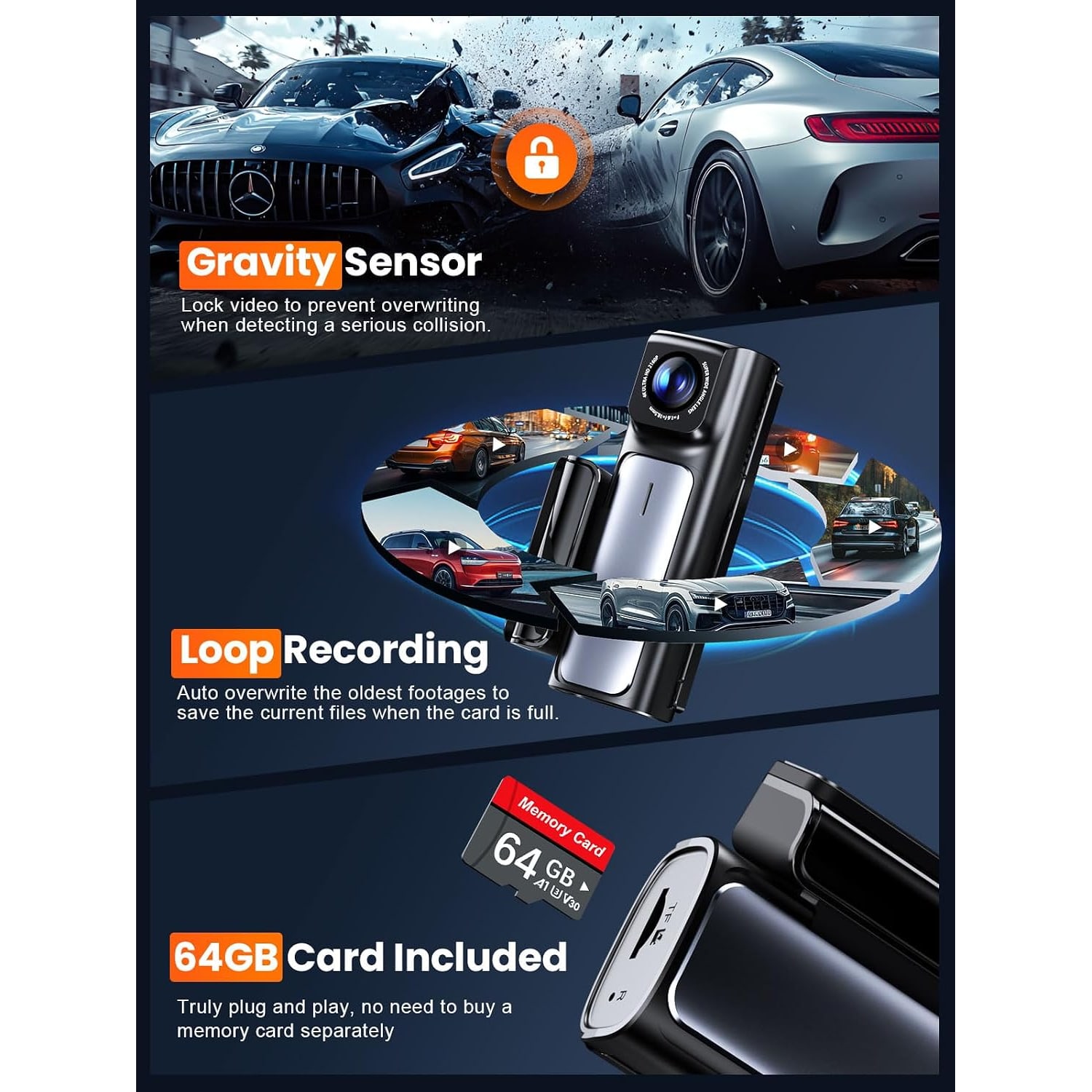
64GB Card IncludedPlug in and record straight away, with support up to 256GB.

Drive with a clear record of every mile, because a 4K dual dash cam with GPS turns a stressful roadside argument into a short video you can simply play back.

Dual channel 4K 30fps front and 2.5K 25fps rear recording, a 3.59 inch IPS screen, built-in GPS, Wi-Fi app control, loop recording, G-sensor lock and 24 hour parking monitor, with a 64GB microSD card in the box.

This 4K dual dash cam with GPS records the road ahead at 4K 30fps and the view behind at 2.5K 25fps, so both directions are captured on every trip.

A 160 degree field of view at the front and a 155 degree view at the rear keep lane lines, side traffic and plates inside the frame.

Built-in GPS stamps your speed, route and coordinates onto the footage, which makes a timeline easy to follow later.

Wi-Fi links the camera to your phone through the app so you can watch clips, pick what you need and save them without pulling the card.

A 64GB microSD card comes in the box, and the camera accepts cards up to 256GB when you want longer loops.

4K Dual Dash Cam with GPS and 64GB Card

Most drivers never think about a dash camera until the week they need one. A car backs out of a parking space without looking, somebody changes lanes into your door, or a claim turns into one person's word against another's. The point of this 4K dual dash cam with GPS is simple. It keeps recording while you drive, so when something happens you have a clip instead of a memory.

4K Dual Dash Cam with GPS and 64GB Card

The front camera records at 4K 30fps through an f/1.5 aperture with a 160 degree field of view, which is wide enough to hold the next lane over without squeezing the center of the frame. The rear camera records at 2.5K 25fps with a 155 degree angle of view. Running both channels means a rear-end hit, a tailgater or a parking lot nudge is recorded from the side it actually happened on, rather than from a single forward-facing lens that saw nothing.

4K Dual Dash Cam with GPS and 64GB Card

Built-in GPS is what turns raw footage into something you can explain. The camera logs speed, route and coordinates along with the video, so a clip is tied to a place and a pace instead of floating free. When you review footage in the app over Wi-Fi, you get the picture and the data together, and you can download the section you need straight to your phone rather than hunting for a card reader.

4K Dual Dash Cam with GPS and 64GB Card

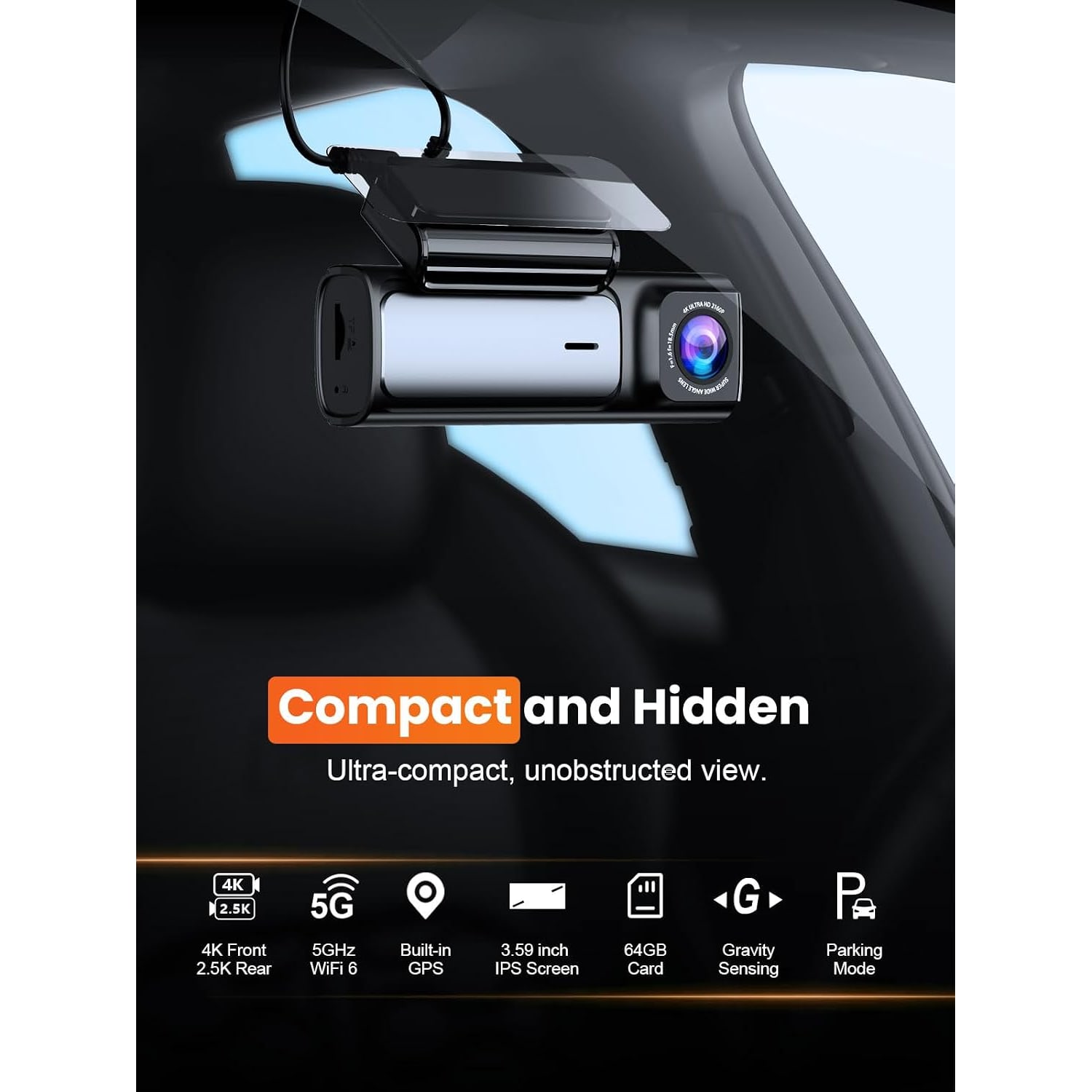
Day to day it mostly runs itself. Loop recording writes over the oldest unprotected files once the card fills, so you are not deleting clips every weekend. The 3-axis G-sensor watches for a serious collision and locks that file so the loop cannot overwrite it. A 24 hour parking monitor keeps an eye on the car when you are not in it, and the 3.59 inch IPS screen gives you a real view of what each lens is seeing while you line up the install.

4K Dual Dash Cam with GPS and 64GB Card

Everything needed for a tidy first install is in the box. There is the main camera, the rear camera and its extending cable, a 64GB microSD card, an 11.5ft Type-C car charger, a trim tool and cable-hiding clips, plus adhesive pads and electrostatic films for the windshield. If you want longer recording loops later, the camera supports microSD cards up to 256GB.

Not sure yet? That is fine.

A camera has to suit the job you bought it for, and you cannot always judge that from a photograph. If it is not right for you, send it back within 14 days of delivery in resaleable condition and we refund the price you paid, including standard delivery. That is a voluntary policy we offer on top of your legal rights.

If it turns up faulty, damaged or not as described, that is on us. The consumer protection law of your state covers you, and we pay the return postage. Read the full detail on our refunds and returns page, or ask us anything before you order.

Frequently Asked Questions

What is a dual dash cam?

A dual dash cam uses two cameras, one facing forward through the windshield and one facing back. Both record at the same time to a single memory card. This model pairs a 4K 30fps front camera with a 2.5K 25fps rear camera.

What resolution does the front camera record at?

The front channel records at 4K at 30fps. That means 30 frames per second at 4K resolution. Higher resolution helps when you need to read small details in a still frame.

What resolution does the rear camera record at?

The rear camera records at 2.5K at 25 frames per second. That is a step above standard 1080p and gives you more detail from behind the car. It is the channel that matters most for rear-end incidents.

How wide is the view?

The front camera has a 160 degree field of view and the rear camera has a 155 degree view. Both are wide enough to include adjacent lanes rather than just the road directly ahead.

Does it have GPS?

Yes, GPS is built in. It records your driving speed, route and real-time coordinates alongside the footage. That location data travels with the clip when you review it.

Why does GPS matter on a dash cam?

Video alone shows what happened but not where or how fast. GPS adds that context, which is often the part people argue about. For many buyers it is the difference between a useful clip and an ambiguous one.

How do I get footage onto my phone?

The camera has Wi-Fi and is controlled through a smartphone app. You connect your phone to the camera, browse the recordings and download the clips you want. There is no need to remove the memory card for everyday review.

Is a memory card included?

Yes, a 64GB microSD card comes in the box. That means you can install the camera and start recording the same day. You do not have to buy a card separately to get going.

What is the largest card I can use?

The camera supports microSD cards up to 256GB. A larger card simply gives you a longer loop before older files are overwritten. If you drive long distances daily, a bigger card is worth considering.

What is loop recording?

Loop recording means the camera keeps writing new video and automatically overwrites the oldest unprotected files when the card gets full. You never have to manually clear space. Protected files are skipped by the loop.

What does the G-sensor do?

The 3-axis G-sensor detects a serious collision. When it triggers, the camera locks the current file so loop recording cannot erase it. That clip stays on the card until you choose to delete it.

What is the 24 hour parking monitor?

Parking monitor keeps the camera watching while the vehicle is parked and switched off. It is the feature that covers door dings and parking lot bumps you are not present for. Parking modes generally need a power source that stays live when the ignition is off.

How big is the screen?

The screen is 3.59 inches and uses an IPS LCD panel. It is large enough to check framing at install and to play back a clip in the car. Menu text is easy to read on a panel this size.

Will the screen block my view?

The camera is designed as a low profile unit for windshield mounting, usually behind or beside the rearview mirror. Mounted there it sits in an area your eyes already skip over. Check your local rules on windshield-mounted devices before you choose a position.

Does it record audio?

Yes, the camera lists voice recording among its features. Audio capture can usually be switched on or off in the menu. Recording audio and recording other people is covered by federal and state law, so review what applies where you drive.

What file format does it use?

Recordings are saved in .TS format. This format is common on dash cams because it handles sudden power loss without corrupting the whole file. Most video players and the companion app will open it.

How good is it at night?

The front lens uses an f/1.5 maximum aperture, which is a wide opening that lets in more light than a narrower lens. Wide apertures are the main hardware factor in low-light dash cam performance. Results still depend on street lighting and windshield cleanliness.

What vehicles does it fit?

It is made for cars, minivans and trucks. It mounts to the windshield, so any vehicle with a suitable glass area will work. The rear camera and its extending cable handle the run to the back of the vehicle.

Is this a good choice for rideshare drivers?

A front and rear dash cam suits drivers who spend long hours in traffic and want both directions covered. The app makes it quick to pull a clip between trips. Many people searching for the best dash cam for uber drivers end up on dual channel models for exactly this reason.

How is it powered?

An 11.5ft Type-C car charger is included, which plugs into the vehicle's power outlet. The cable length is intended to reach around the trim from the outlet to the windshield. The camera also has an internal lithium polymer battery cell.

Does the included charger block my phone charging port?

The supplied charger includes an extra USB port, so you can keep a phone or another device charging while the camera runs. That saves you from giving up your only power outlet. Charging speed depends on the device you connect.

Do I need a professional installer?

Most people fit this themselves. The box includes a trim tool and cable-hiding clips so the cable can be tucked into the headliner and door pillar. If you want a hardwired parking mode setup, a professional installer is the easier route.

How do I mount it to the glass?

Adhesive pads and electrostatic films are included. The film goes on the glass first and the mount attaches to the film, which makes repositioning much easier later. Clean the glass with alcohol and let it dry before sticking anything down.

What is in the box?

You get the dual dash cam, the rear camera with its extending cable, a 64GB microSD card, the 11.5ft Type-C car charger, a wiring trim tool with cable-hiding clips, adhesive pads and electrostatic films, and the user manual. It is a complete first install kit.

What color is it?

The camera is gray. A neutral finish tends to blend with the dark band at the top of most windshields. The unit is designed with a low profile shape.

How should I maintain the card?

Format the card in the camera every few weeks rather than on a computer. microSD cards in dash cams are written to constantly, and regular formatting keeps the file system clean. If recordings start failing, replace the card.

How do I keep the footage sharp?

Clean the lens with a dry microfiber cloth and keep the windshield clean in front of it. A film of haze on the inside of the glass will soften every clip. This small habit matters more than any setting in the menu.

How long does delivery take?

Most orders arrive within 3 to 8 business days of the order date, so allow for that if you need it by a set date. Delivery is to US addresses only, free on orders of $150 or more and a flat $20 under that, and you get tracking by email once the order is on its way.

Can I return it?

Yes. You can return it within 14 days of delivery if you change your mind, as long as it is in resaleable condition in its original packaging with everything included. You pay the return shipping. Contact us first and we will send the return details.

What if it is not right for my car?

If the fit, the cable run or the mounting position does not work in your vehicle, send it back within 14 days of delivery in resaleable condition. Message us first and we will walk through the problem, since many install issues come down to mount placement rather than the camera itself. If it genuinely is not a match, we will process the return.

How to Choose a 4K Dual Dash Cam with GPS

6 min read Camera Company

The thing nobody plans for

Almost nobody buys a dash cam on a good day. People buy one the week after something happened. A car drifts into your lane and the driver insists you were the one who moved. Somebody reverses into your bumper in a parking lot and leaves. You get rear-ended at a light, and the other driver's story changes between the roadside and the claim form.

In all of those situations the facts are simple and the evidence is nothing. That is the gap a dash cam fills. It records continuously while you drive, and when something goes wrong you play back the clip instead of arguing about who remembers what.

The reason to look at a front and rear dash cam rather than a single forward camera is that a lot of incidents happen behind you. A forward-only camera is pointed in the wrong direction for the most common type of collision in traffic. Dual channel fixes that.

What dual channel 4K actually means

This camera records two streams at once. The front channel runs at 4K, 30 frames per second. The rear channel runs at 2.5K, 25 frames per second. Both write to the same microSD card.

Resolution matters less for seeing that a crash happened and more for reading detail when you pause. A plate at a distance, a street sign, the state of a traffic light. At 4K you have more pixels to work with when you freeze a frame and zoom in. At 1080p that same frame often turns to mush at the exact moment you need it.

The front lens has a 160 degree field of view. Wide angles keep the lanes on either side inside the frame. That matters when the other car never entered your lane properly but still made contact. The rear camera's 155 degree view does the same job behind you.

One thing worth understanding about wide lenses is that very wide views spread the same pixels across more scene. This is why pairing a wide angle with 4K is sensible. The resolution offsets the spread.

Why GPS changes the conversation

Video shows what happened. It does not show how fast you were going or exactly where you were. Those are usually the two points under dispute.

Built-in GPS logs speed, route and real-time coordinates along with the footage. When you review a clip, the location data travels with it. Instead of saying you were doing a reasonable speed, the file says what the speed was. That is a different kind of conversation.

Route playback also helps for less dramatic reasons. If you drive for work, log mileage, or simply want to retrace where you went on a long day, the GPS track gives you a timeline. People hunting for the best dash cam with gps tracking are often after this as much as the crash evidence.

Living with it day to day

A camera you have to manage is a camera you eventually unplug. This one is built to run itself.

Loop recording means the card never fills up and stops. When the card gets near capacity, the oldest unprotected clips are written over. You do nothing.

The G-sensor is the exception to the loop. It is a 3-axis sensor that detects a serious collision. When it triggers, the current file is locked. The loop skips it. That clip stays until you deliberately remove it, which is exactly the behavior you want from a file you might need weeks later.

The 24 hour parking monitor covers the car when you are not in it. Parking lot damage is one of the most frustrating things that happens to a vehicle, because there is usually no witness and no note. A camera that keeps watching is the only practical answer. Note that parking modes generally need power that stays live with the ignition off, which usually means a hardwire kit rather than the 12 V socket.

The screen and the app

There is a 3.59 inch IPS screen on the unit. That is a useful size. It is big enough to line up both cameras properly during install, which is the step people rush and regret. It also lets you play back a clip right there in the car if you need to show somebody something.

For anything beyond a quick look, the app is the better tool. The camera has Wi-Fi, and the app connects your phone to it directly. You browse the recordings, pick what you want and download it to your phone. No card reader, no laptop, no sitting in the driveway with a cable.

This matters more than it sounds. The moment you need footage is usually the moment you are standing on the side of a road with your phone in your hand. Being able to pull the clip then and there, and send it, is the whole point.

Night driving

Most incidents that require footage happen in poor light. Dawn, dusk, rain, night streets with uneven lighting.

The hardware factor that matters most here is aperture. This camera's front lens has a maximum aperture of f/1.5, which is a wide opening. A wider aperture lets more light reach the sensor, which means less noise and a cleaner image in the dark. If you are comparing models and want the best night vision dash cam you can get for the money, the aperture number is the first spec to check.

Two practical things also affect night footage. Keep the lens clean, and keep the inside of your windshield clean. A haze of film on the glass scatters every headlight into a starburst and will ruin otherwise good footage.

Installing it without a mess

Everything you need is in the box. There is an 11.5ft Type-C car charger, a trim tool, cable-hiding clips, adhesive pads and electrostatic films.

The electrostatic film is worth using. It goes on the glass first, and the mount sticks to the film instead of the glass. If you want to move the camera later, or take it out when you sell the car, you peel the film off cleanly.

For the cable, run it up into the headliner, along the edge, then down the A-pillar and into the footwell toward the power outlet. The trim tool is for tucking the cable behind the trim so none of it dangles. Work slowly and check behind the pillar trim for airbag components before you push anything in there.

The rear camera uses the included extending cable. The usual route is along the headliner to the rear window. Take your time with this part. A neat run takes about twenty extra minutes and makes the whole thing look factory-fitted.

Cards and storage

A 64GB microSD card is included, so you can record on day one. The camera accepts cards up to 256GB if you want a longer loop before footage gets overwritten.

Think about how much driving you do. Two channels at 4K and 2.5K eat storage quickly. A 64GB card is enough to get started. If you drive all day, or you want several days of history before anything is overwritten, a larger card is a sensible upgrade.

Format the card in the camera every few weeks. Dash cams write to a card constantly, and that constant writing is hard on the file system. A regular format keeps it healthy. If you start seeing failed recordings, replace the card rather than troubleshooting it.

A note on audio

The camera lists voice recording as a feature, and audio can typically be turned on or off in the menu. Audio can be useful because it captures what was said at the scene.

Recording audio and recording other people is covered by federal and state law, and the rules vary. If you carry passengers, or you drive across state lines, look up what applies to you and decide accordingly.

The short version

If you want a camera that covers both directions, records in enough detail to be useful when you pause the frame, and ties that footage to a speed and a location, this is that kind of setup. The front channel is 4K at 30fps, the rear is 2.5K at 25fps, GPS is built in, and the app means you can get a clip onto your phone without pulling the card.

The parts that make it easy to live with are the unglamorous ones. Loop recording so the card never fills. A G-sensor that saves the file you need. A 64GB card already in the box. A complete install kit so the first fit does not turn into a trip to the parts store.

Fit it once, check the framing on the screen, and then mostly forget about it. That is the right relationship to have with a dash cam.

Browse the shop

Not sure which setup fits your car?

Send us your vehicle and where you want the cameras, and we will tell you what the install involves.

Ask us a question

Page summary

This is a dual channel dash cam that records the road ahead at 4K 30fps and the view behind at 2.5K 25fps. The front lens has a 160 degree field of view with an f/1.5 maximum aperture, and the rear camera has a 155 degree angle of view. It has built-in GPS for speed, route and coordinate logging, Wi-Fi with smartphone app control, and a 3.59 inch IPS LCD screen. Features include loop recording, a G-sensor accident lock, voice recording and a 24 hour parking monitor. It mounts to the windshield and suits cars, minivans and trucks. A 64GB microSD card is included and cards up to 256GB are supported. Files are saved in .TS format. Color is gray. Weight, dimensions and country of origin are not specified by the maker.