Camera Company
Company
Shop By Category
T&Cs
Shop Online
  • The maker's specifications on every page
  • Free tracked USA-wide delivery over $150
  • 14-day returns

Full Frame Camera Cleaning Kit | Sensor cleaning swabs | Lens cleaning kit with case

Full Frame Camera Cleaning Kit with Sensor Swabs and Hard Case

$69.99 $83.99 Save $14
  • Sealed 24mm Swabs
  • Gentle Solution
  • Hard Zip Case
  • Full Tool Set

Price: $69.99 $83.99

  • Free tracked USA-wide delivery on orders $150+, otherwise a flat $20
  • Pay by card or PayPal, handled by the payment provider
  • 14 days to change your mind, plus your statutory rights
Product specifications
Set NameCamera Lens Cleaning Kit, Full Frame Lens and Sensor Cleaner
Model NumberQM0859
Number of Items1
Unit Count1 count
Included ToolsCleaning solution, sensor swabs, lens pen, air blower, brush, cloth, hard case
Swab Width24 mm (full frame)
Swab Quantity6, individually wrapped and vacuum sealed
Liquid Volume60 ml
Lens Tissue50 sheets
ColorBlack
MaterialMicrofiber, paper
Item Weight12 ounces
Compatible DevicesCanon EOS 6D MK II, Canon EOS 5D MK IV, Canon EOS-1D X, Nikon D610, D750, D780, D810, D4, D5, Sony A7 III, A7R IV, A7S II
Weight0.34 kg
Shipping & returns

Tracked delivery anywhere in the USA. It is free on orders of $150 or more, and a flat $20 below that.

If it is not right for you, send it back within 14 days of delivery in resaleable condition and we refund the price you paid, including standard delivery. That is a voluntary policy we offer on top of your legal rights. You cover the cost of returning it unless the item is faulty.

If it arrives faulty, damaged or not as described, we put it right at no cost to you under the consumer protection law of your state and the Federal Trade Commission Act, return postage included.

Shipping details · Refunds and returns

Sealed 24mm SwabsSix dry sensor swabs, each individually wrapped and vacuum sealed until use.
Gentle Solution60 ml formula with no alcohol and no ammonia, made for coated glass.
Hard Zip CaseEvery tool has a place, so nothing rattles loose in your camera bag.
Full Tool SetBlower, lens pen, brush, 50 lens tissues and a microfiber cloth included.

Keep every frame clean with a full frame camera cleaning kit that packs the swabs, solution and tools you actually use into one zippered case.

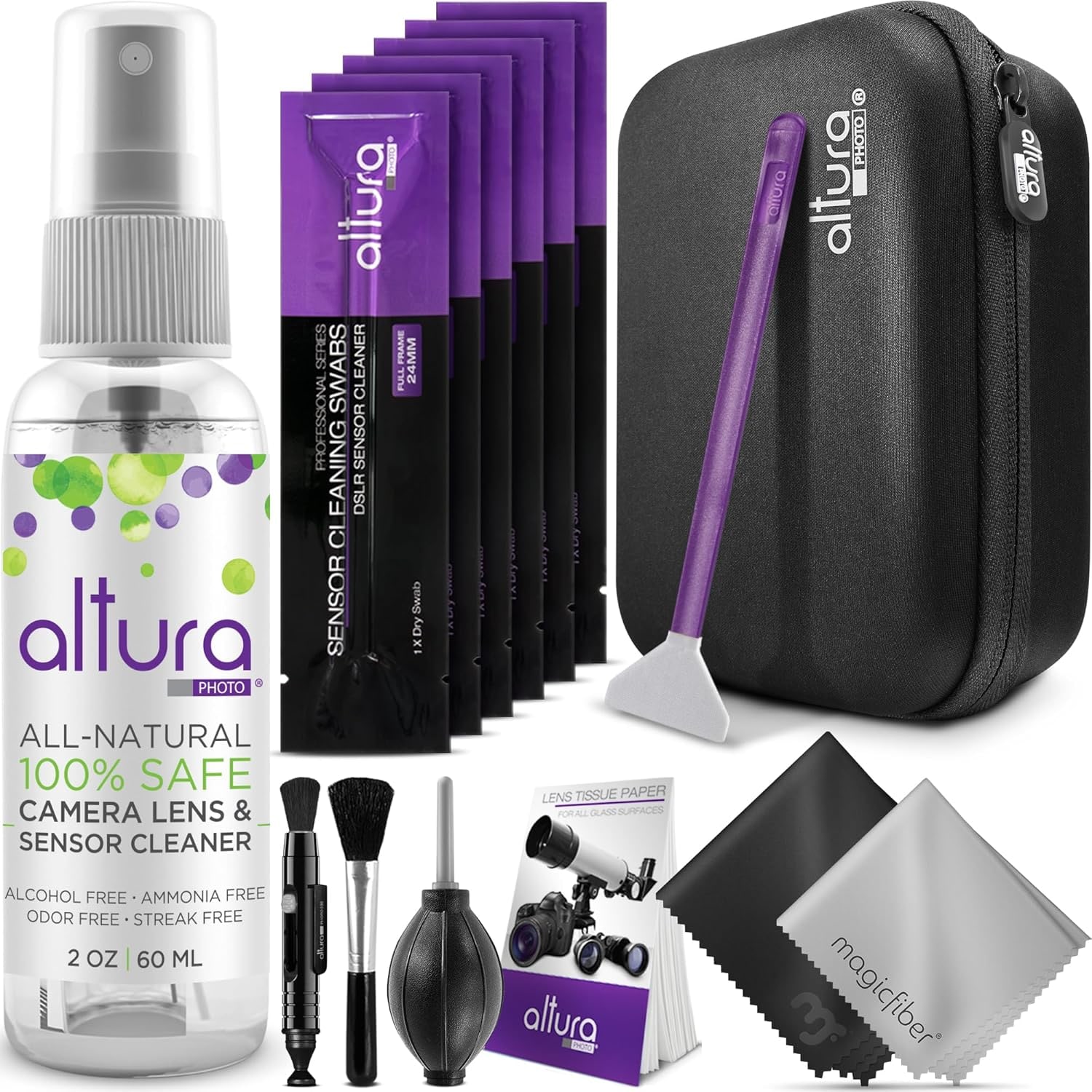
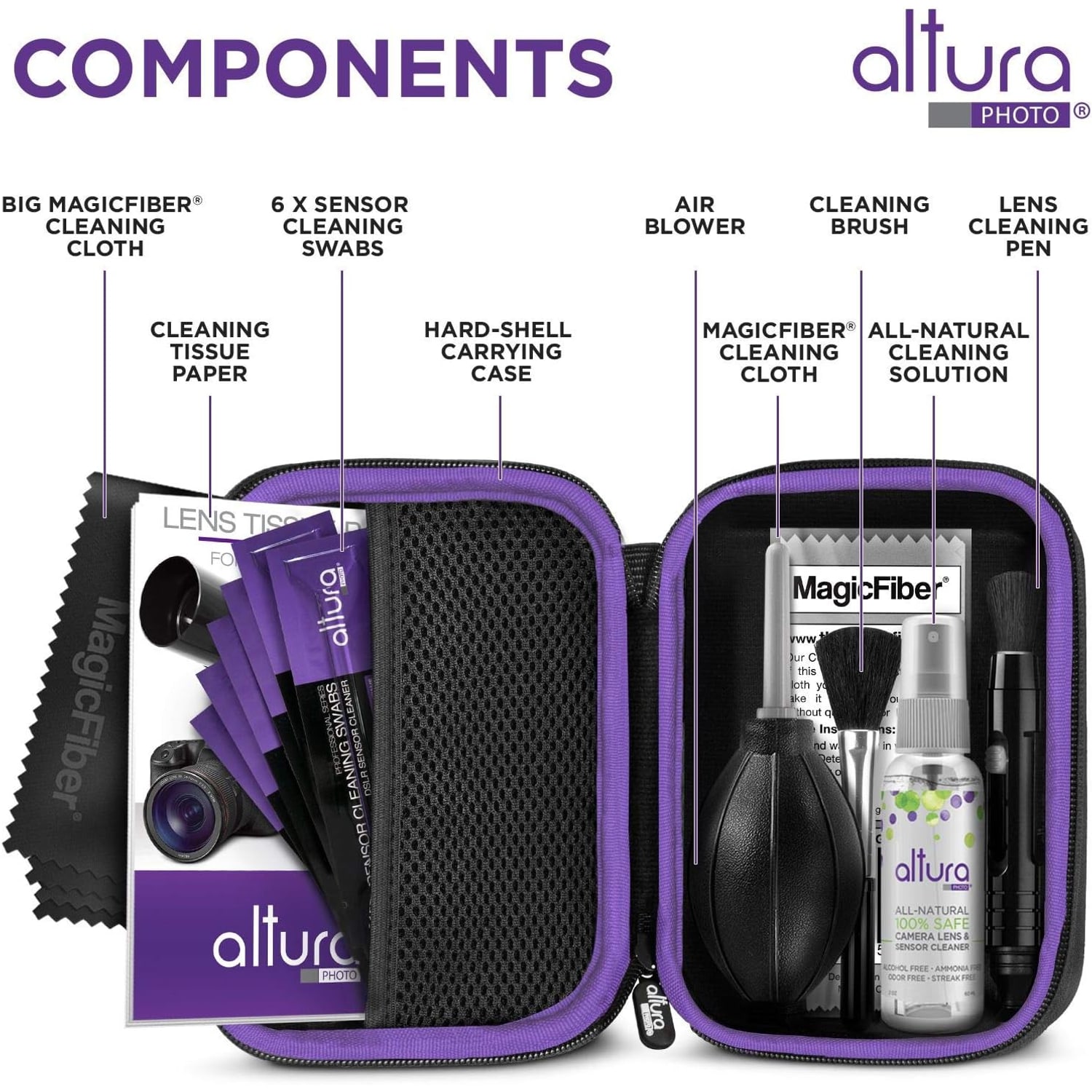
Six individually sealed 24mm dry sensor swabs, a 60 ml alcohol-free and ammonia-free solution, air blower, lens pen, brush, 50 sheets of lens tissue and a microfiber cloth, all organized in a hard-shell case built for a camera bag.

A complete full frame camera cleaning kit that covers sensor, lens, screen and body in one zippered hard-shell case.

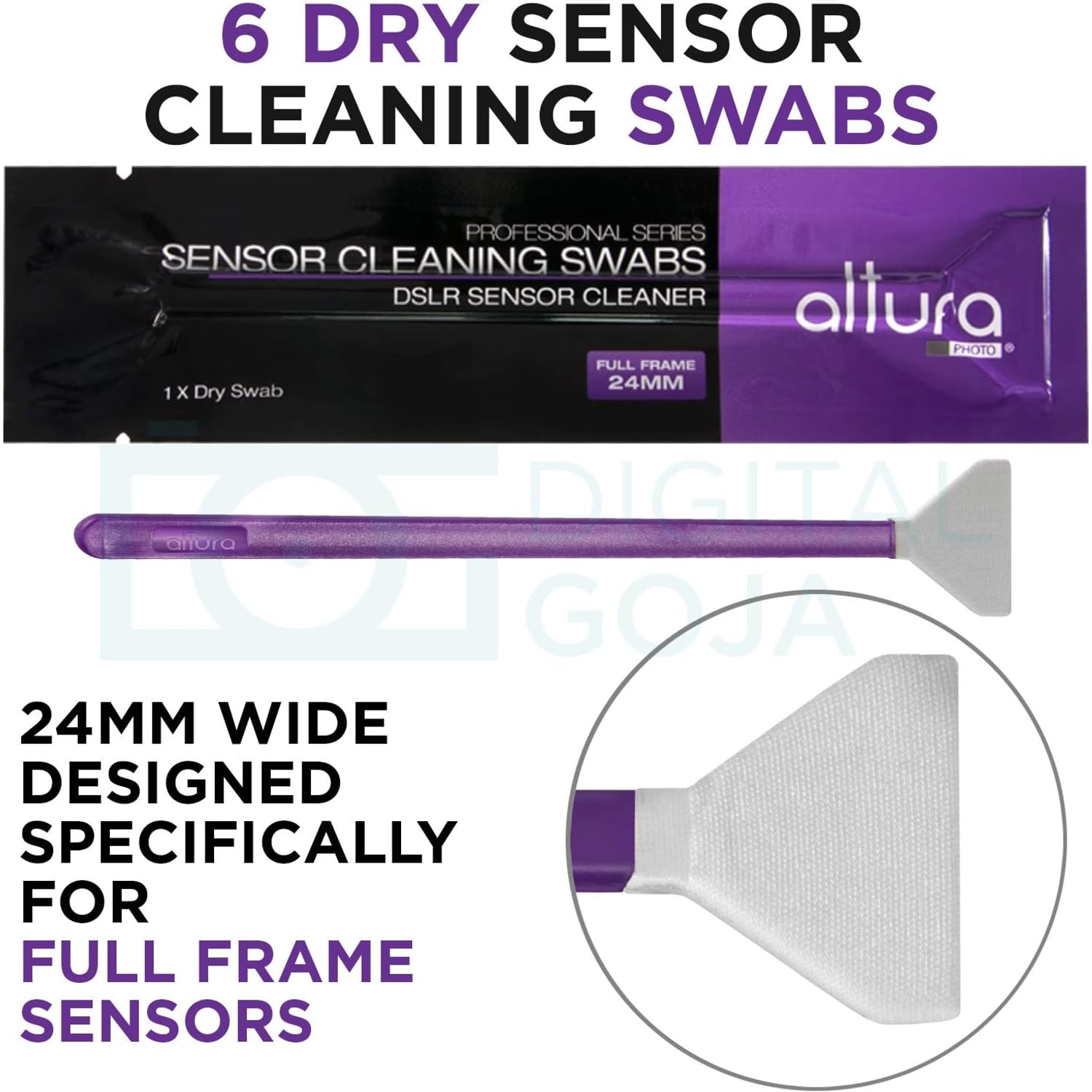
Six 24mm dry sensor swabs arrive individually wrapped and vacuum sealed, sized for full frame sensors.

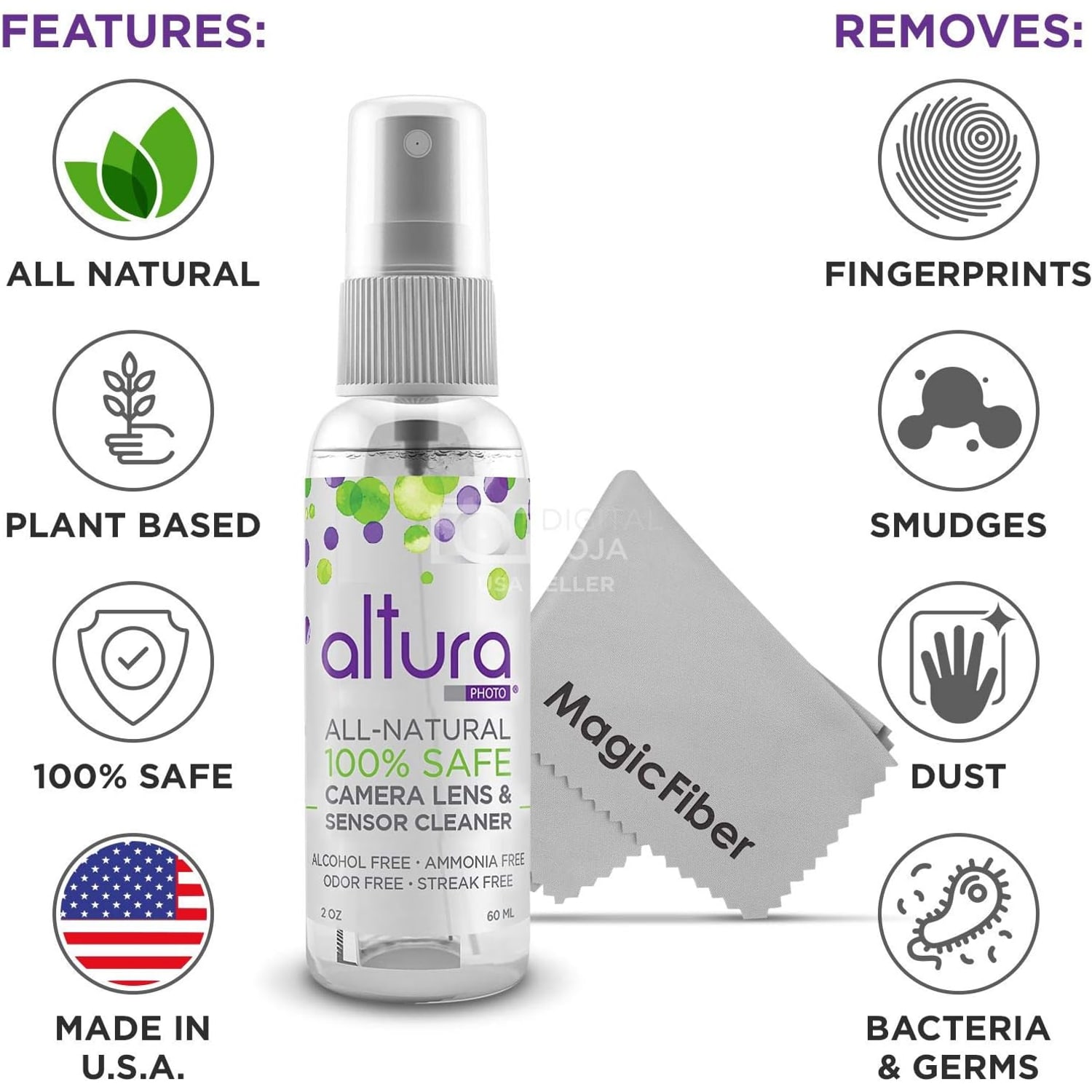
The 60 ml cleaning solution contains no alcohol and no ammonia, so it is gentle on multi-coated optics.

An air blower, lens cleaning pen, soft brush, 50 sheets of lens tissue and a microfiber cloth handle the everyday dust.

The compact case slips into a camera bag and keeps the small parts together between shoots.

Full Frame Camera Cleaning Kit with Sensor Swabs and Hard Case

Dust is the quiet tax on digital photography. It lands on the front element while you change position, it drifts onto the rear element when you swap lenses, and sooner or later a few specks settle on the sensor itself and show up as soft gray dots in every sky you shoot. This full frame camera cleaning kit is built to deal with all three layers of that problem without asking you to buy four separate products from four separate sellers.

Full Frame Camera Cleaning Kit with Sensor Swabs and Hard Case

The sensor side of the kit is six dry swabs cut to 24 mm, the width that matches a full frame sensor in a single controlled pass. Each one is wrapped on its own and vacuum sealed, so the swab that touches your sensor has not been sitting open in a drawer collecting the very dust you are trying to remove. You use one, you throw it away, and you move on. For APS-C cameras you would want 16 mm swabs instead, so check your sensor format before you order.

Full Frame Camera Cleaning Kit with Sensor Swabs and Hard Case

For glass and screens, the 60 ml solution is the workhorse. It is formulated without alcohol and without ammonia, which matters because modern lenses carry multiple coating layers and harsh solvents are the fastest way to dull them. A light spray on a lens tissue or the microfiber cloth lifts fingerprints, salt spray and smudges, and the formula helps cut static on optical glass so loose dust is less likely to settle straight back down.

Full Frame Camera Cleaning Kit with Sensor Swabs and Hard Case

The rest of the case covers the daily routine. The air blower moves loose grit off the front element and out of lens mounts before anything physical touches the surface, which is always the safest first step. The lens pen has a soft brush at one end and a cleaning tip at the other for stubborn fingerprints. The separate brush handles body crevices, dials and hot shoe grooves. Fifty sheets of lens tissue mean you are never tempted to reach for a shirt corner.

Full Frame Camera Cleaning Kit with Sensor Swabs and Hard Case

Everything lives in a zippered hard-shell case that was designed to ride in a camera bag rather than sit on a shelf. The tools stay in place, the swab packets stay sealed, and the solution bottle stays upright. It travels well for a wedding weekend, a wildlife trip or a studio day, and when you open it you can see at a glance whether you are running low on swabs or tissue.

Not sure yet? That is fine.

A camera has to suit the job you bought it for, and you cannot always judge that from a photograph. If it is not right for you, send it back within 14 days of delivery in resaleable condition and we refund the price you paid, including standard delivery. That is a voluntary policy we offer on top of your legal rights.

If it turns up faulty, damaged or not as described, that is on us. The consumer protection law of your state covers you, and we pay the return postage. Read the full detail on our refunds and returns page, or ask us anything before you order.

Frequently Asked Questions

What is actually in the box?

You get six individually wrapped 24 mm dry sensor swabs, a 60 ml cleaning solution, an air blower, a lens cleaning pen, a lens brush, 50 sheets of lens tissue paper and microfiber cleaning cloths (the photos show a large one and a small one). All of it stores in a zippered hard-shell case. That covers sensor, lens, screen and body in one purchase.

Will this fit my camera?

It is sized for full frame sensors, which measure 24 mm across. The compatible bodies the maker names include Canon EOS 6D Mark II, 5D Mark IV and 1D X, Nikon D610, D750, D780, D810, D4 and D5, and Sony A7 III, A7R IV and A7S II. Other full frame DSLR and mirrorless bodies with the same sensor width work the same way.

Can I use it on an APS-C camera?

The swabs in this kit are 24 mm, which is wider than an APS-C sensor. The solution, blower, pen, brush, tissue and cloth all work fine on any camera. For APS-C sensor swabs you want the 16 mm size instead.

Why are the swabs described as dry?

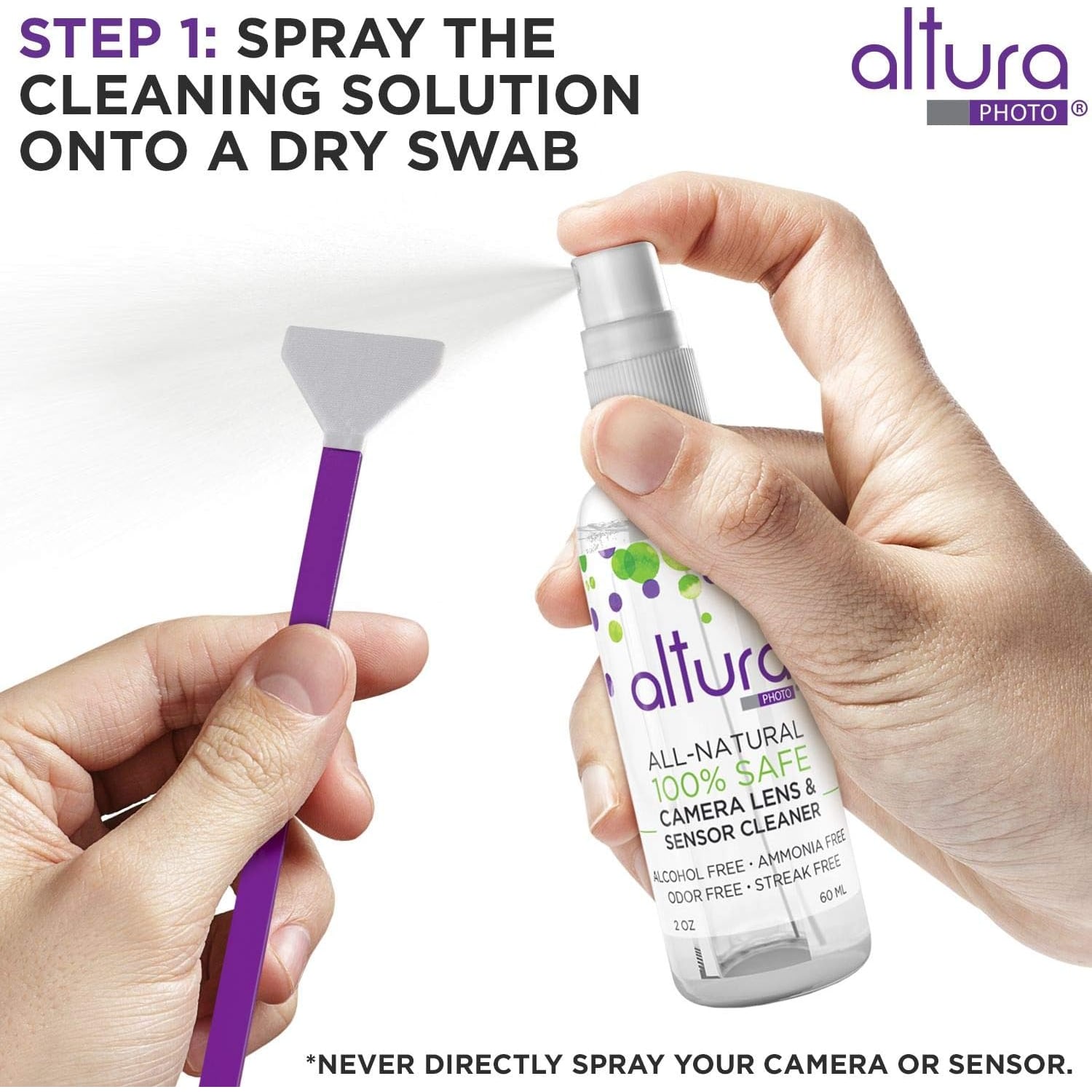
Dry swabs ship without solution already applied, so you control exactly how much liquid goes on. You add a light spray of the included solution to the swab just before the pass, as the maker's photos show, and never spray the camera or sensor directly. This keeps the swab fresh and avoids the over-saturated streaking that pre-wetted swabs can cause.

How many sensor cleanings do six swabs give me?

One swab is one cleaning pass across the sensor, and swabs are single use. Most sensors come clean in one or two passes, so six swabs typically cover three to six full cleaning sessions. How fast you go through them depends on how often you change lenses and where you shoot.

Can I reuse a sensor swab?

No. Once a swab has picked up dust, any further pass risks dragging that grit back across the sensor filter. Use it once, throw it away, and open a fresh packet next time. That single rule is the difference between a good result and a scratch.

Why is the solution free of alcohol and ammonia?

Modern lenses and sensor filters carry several thin coating layers, and aggressive solvents can haze or lift them over time. This 60 ml formula leaves both out and uses plant based ingredients instead. It is intended to be safe on multi-coated optics, screens and digital imaging sensors.

Does the solution leave streaks?

Used sparingly it should not. Streaks almost always come from too much liquid or from wiping with a cloth that already carries dust. A light spray on a tissue, a light circular pass, then a dry buff with the microfiber is the method that works.

How much solution is in the bottle?

The bottle holds 60 ml, which is about 2 fluid ounces. Because you only use a light spray at a time, that lasts a long stretch of regular cleaning. Keep the cap on tight and store it upright in the case.

What order should I clean in?

Blow first, brush second, wipe third, swab last. Air and a soft brush remove loose grit so you are not grinding it into glass with a cloth. Only go near the sensor once the lens and body are already clean.

Is it safe to use the air blower on the sensor?

A hand blower is the gentlest first step and is widely used for loose sensor dust. Hold the camera facing downward so dislodged particles fall out, and never let the nozzle touch the sensor. Avoid canned compressed air entirely, since it can spray propellant onto the filter.

What does the lens pen do that the cloth does not?

The cleaning tip on the pen is for fingerprints and smudges, which a dry cloth tends to smear rather than lift. The brush at the other end, shown in the photos, flicks off dust without pressing it into the coating. Think of the pen as the tool for spot problems and the cloth for an overall finish.

Can I clean my camera's rear screen with this?

Yes. A light spray of the solution on the microfiber cloth handles fingerprints on an LCD or EVF eyecup. Apply the liquid to the cloth, never directly to the screen, so nothing runs into the seams.

Will it work on filters and eyepieces?

It will. UV filters, polarizers, viewfinder eyepieces and the glass on an external monitor all respond to the same routine of blow, brush and gentle wipe. Filters are usually the easiest surfaces in the whole bag.

Is this useful for binoculars, telescopes or phone lenses?

The lens side of the kit is, yes. The solution, pen, brush, tissue and cloth work on most coated optical glass including binoculars, spotting scopes and phone camera windows. The 24 mm sensor swabs are specific to full frame camera sensors.

How often should I clean my sensor?

There is no fixed schedule. Shoot a plain white wall at f16 and look for gray dots, and if you see them it is time. Photographers who change lenses outdoors often will find themselves reaching for the best sensor cleaning swabs far more than a studio shooter does.

Do I need to put the camera in a special mode first?

Yes, you need to lock the shutter open for cleaning. Most bodies have a sensor cleaning or manual cleaning setting in the menu that raises the mirror and holds the shutter. Use a fully charged battery, since losing power mid-clean can close the shutter on the swab.

Is there a risk of scratching the sensor?

Any contact cleaning carries some risk, which is why the swabs are lint free, individually sealed and single use. Work in a clean, still room, use light even pressure and do not go back over the same area with a used swab. If you are nervous, start with the blower and only swab when air has not solved it.

Why are the swabs vacuum sealed?

Because a swab that collects dust before it reaches your sensor is worse than no swab at all. Each one is wrapped on its own and sealed under factory conditions. Open the packet only when you are standing in front of the camera and ready to clean.

How big is the case?

The outer case dimensions are not specified by the maker. It is described as a compact zippered hard-shell case made to sit inside a camera bag without taking much room. The whole kit weighs 12 ounces.

Does the case hold everything securely?

That is the point of it. The tools are held in place rather than loose, so nothing rolls around or rattles while you walk. It also means you can see at a glance when you are running low on swabs or tissue.

Can I take the kit on a plane?

Cleaning kits travel regularly in camera bags. The solution bottle holds 60 ml, which is within the usual carry-on liquid limit for a single container, but check your airline and airport rules before you fly. Keeping it in a clear bag at security saves time.

What is the lens tissue for?

The 50 sheets are single use paper for wet cleaning. You put the solution on a sheet, clean the glass, and discard it. Using fresh paper every time means you are never rubbing yesterday's dust back across the front element.

How do I look after the microfiber cloth?

Hand wash it in plain water with no fabric softener, since softener coats the fibers and ruins the grab. Air dry it and keep it in the case rather than loose in a pocket. Replace it when it stops lifting smudges cleanly.

Is this suitable for a beginner?

Lens, screen and body cleaning with the blower, pen, brush and cloth is beginner friendly and hard to get wrong. Sensor swabbing takes a steadier hand, so read your camera manual first and try it at home rather than on a shoot day. Many people use the kit for months before they ever open a swab.

Would this make a good gift for a photographer?

It works well as a gift because almost every camera owner needs this gear and very few get around to buying it. The hard case presents neatly and it suits DSLR and mirrorless shooters alike. Just confirm the recipient shoots full frame so the swab size matches.

Can I buy replacement swabs later?

Sensor swabs are a consumable, so you will eventually want more 24 mm packs for a full frame body. The solution, blower, pen, brush and case all keep going long after the swabs run out. Search our camera accessories range for the best 24mm sensor swabs when you restock.

How long does delivery take?

Most orders arrive within 3 to 8 business days of the order date, so allow for that if you need it by a set date. Delivery is to US addresses only, free on orders of $150 or more and a flat $20 under that, and you get tracking by email once the order is on its way.

What is the returns policy?

You have 14 days from delivery to return it for a change of mind, provided it is in resaleable condition, complete and in its original packaging. Return shipping is yours to pay. If it arrives damaged, tell us so we can help.

What if it turns out not to be right for my camera?

If you ordered the full frame kit and your body is APS-C, or the kit simply is not what you expected, get in touch within 14 days of delivery with the order number. As long as it comes back in resaleable condition we will arrange the return and point you to the right swab size.

The Practical Guide to Cleaning a Full Frame Camera

6 min read Camera Company

The problem nobody warns you about

You buy a good camera. You buy good glass. Then one afternoon you shoot a bright sky at a small aperture, open the files, and there they are: a scattering of soft gray dots in exactly the same spot on every single frame. That is sensor dust, and it is the most ordinary problem in digital photography.

It happens because a camera with interchangeable lenses is, by design, a box you keep opening. Every lens swap pulls air into the chamber. Add a beach, a dirt road, a windy ridge or a barn full of hay, and dust gets in. Some of it lands on the front element where it barely matters. Some settles on the rear element. And some finds its way to the filter stack over the sensor, where it sits in the light path and shows up in every exposure.

The good news is that this is a maintenance task, not a repair. It needs the right tools and about ten quiet minutes. The reason most people put it off is that the tools are usually sold piecemeal, so you end up with swabs but no solution, or a blower but no swabs. A full frame camera cleaning kit solves the logistics problem first and the dust problem second.

What is in a complete kit and why each piece exists

Six dry sensor swabs cut to 24 mm sit at the center of this kit. That width matches a full frame sensor so the swab crosses the whole surface in one pass. Each swab is individually wrapped and vacuum sealed, which sounds like packaging theater until you think about it. A swab that has been loose in a bag has already collected dust, and dragging that across a sensor filter is exactly what you are trying to avoid.

The 60 ml cleaning solution is the piece people underestimate. It contains no alcohol and no ammonia. Camera lenses carry several microscopically thin coating layers that control flare and transmission, and strong solvents can dull them over the years. A gentler formula made from plant based ingredients does the job on fingerprints and salt spray without that risk. It also helps neutralize static on glass, which matters more than it sounds, because charged glass pulls dust straight back onto a surface you just cleaned.

Then come the dry tools. The air blower is your first move every time, because air removes loose grit without touching anything. The lens cleaning pen has a soft brush at one end and a cleaning tip at the other, and that tip is the honest answer to fingerprints, which a dry cloth tends to spread around. A separate lens brush gets into body crevices, around dials and along the hot shoe. Fifty sheets of lens tissue give you a fresh single-use surface for every wet clean. The microfiber cloth handles the final buff and the rear screen.

All of it lives in a zippered hard-shell case. That is not a small thing. Loose cleaning gear ends up scattered through three pockets, which means you never have the one piece you need, and it means the swab packets get crushed.

How a sensor clean actually goes

Start with a charged battery. Most bodies have a manual sensor cleaning mode in the menu that raises the mirror and holds the shutter open. If power drops partway through, the shutter can close on whatever is in there, and that is an expensive mistake.

Work somewhere still. A bathroom after a hot shower is the old trick, since the damp air has dropped most of the airborne dust. Turn off fans. Lay out what you need before you open anything.

Face the camera downward and give the chamber a few puffs with the blower. Gravity is on your side here, and a fair share of sensor dust is loose enough to fall straight out. Never use canned compressed air, which can spit propellant onto the filter.

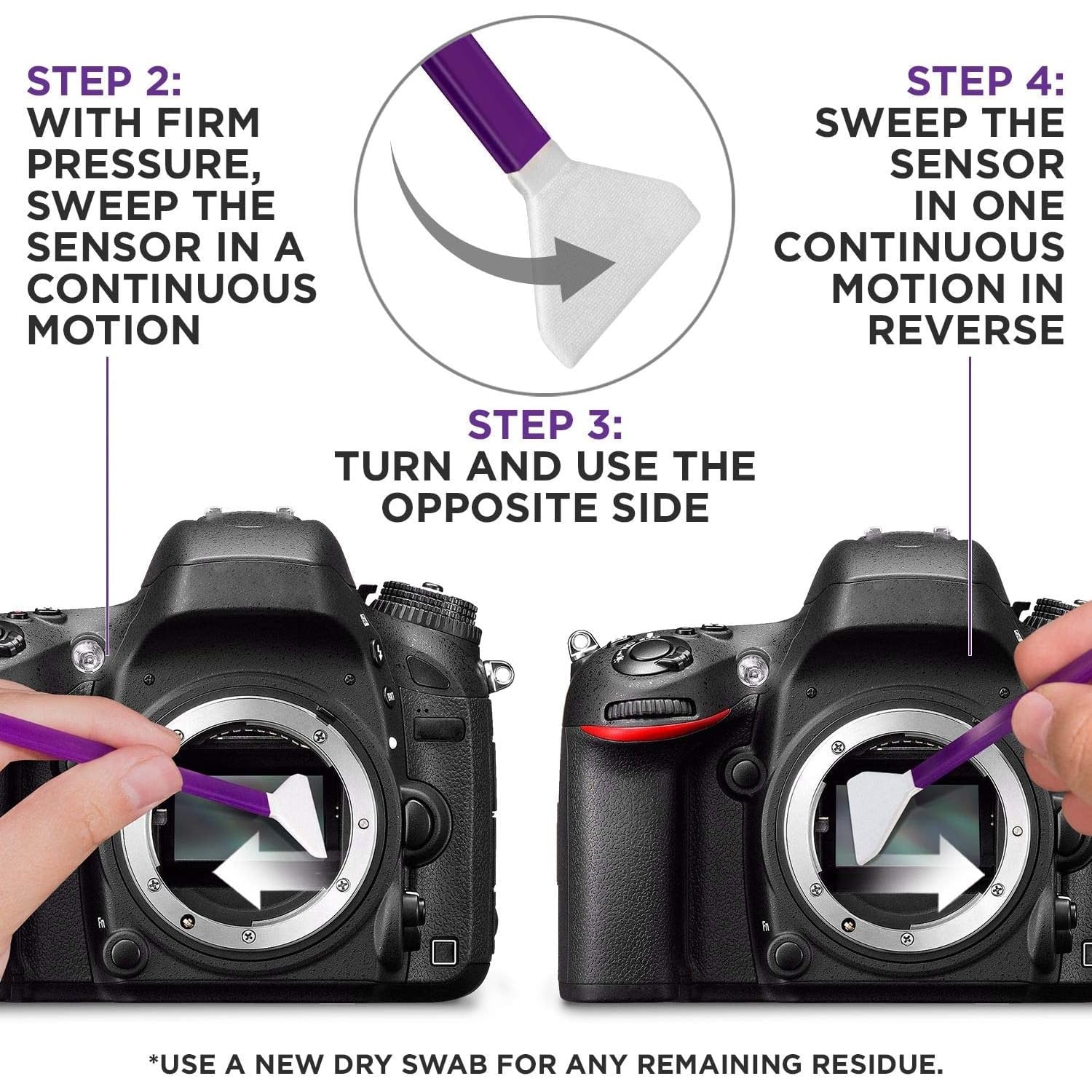
If dots remain, open one swab packet. Add a light spray of solution to the swab, no more, and never spray the camera or sensor directly. A soaked swab leaves streaks. Lay the swab flat against one edge of the sensor, draw it across in one steady pass with light even pressure, flip it, and come back the other way. Then throw it away. Do not go back over the surface with a swab that has already picked up grit.

Put the lens back on, shoot a white wall at f16, and look at the result. Often one pass does it. Sometimes you need a second swab, and that is normal.

Choosing the right kit for your gear

The single thing to check before ordering is sensor format. This kit holds 24 mm swabs for full frame bodies such as the Canon EOS 6D Mark II, 5D Mark IV and 1D X, the Nikon D610, D750, D780, D810, D4 and D5, and the Sony A7 III, A7R IV and A7S II. If you shoot APS-C, the sensor is narrower and you want 16 mm swabs instead. A swab that is too wide will not seat cleanly against the surface.

Beyond that, look at what you shoot. If you change lenses outdoors constantly, you will burn through swabs faster and should think about a restock pack early. If you mostly work in a studio with one lens, the blower, pen and cloth will cover you for months at a time and the swabs stay sealed until you need them.

Also think about where the kit will live. A case that stays home does nothing for you on a trip. This one is sized for a camera bag and weighs 12 ounces, which is light enough that you stop noticing it.

Looking after the kit itself

Keep swab packets sealed until the moment of use. That is the whole reason they are packed that way. Store the solution bottle upright with the cap tight, and keep the case out of direct heat and sunlight.

Wash the microfiber cloth by hand in plain water. Skip fabric softener entirely, because it coats the fibers and kills the grip that makes microfiber work. Air dry it and put it back in the case rather than a jacket pocket where it will pick up lint.

Squeeze the blower a few times pointed away from your gear before you use it. A blower that has been sitting in a bag has usually drawn some dust in through the intake, and you do not want that landing on your front element.

Who gets the most out of this

Wedding and event shooters, because there is no time between a ceremony and a reception to go hunting for a cloth. Wildlife and landscape photographers, because wind and grit come with the territory. Anyone who has just bought their first full frame body and realized the maintenance is now on them. And honestly, anyone who has spent an evening cloning out dust spots in editing software and decided never again.

It also works as a gift. Most photographers need this gear and most never get around to buying it, which is a reliable sign of a good present.

The short version

Dust is going to get in. The fix is cheap, fast and entirely in your hands if you have the right tools in one place. This kit gives you sealed 24 mm swabs for full frame sensors, a gentle 60 ml solution safe on coated glass, a blower, a lens pen, a brush, 50 lens tissues and a microfiber cloth, all in a hard zip case that rides in your bag.

Check your sensor size, blow before you wipe, wipe before you swab, and never reuse a swab. Do that and your files come out of the camera clean, which means less time at the computer and more time shooting.

Browse the shop

Ready to clear the dust?

Grab the full frame kit and keep sensor, glass and screen clean wherever you shoot.

Ask us a question

Page summary

A full frame camera cleaning kit supplied in a zippered hard-shell case, model QM0859. It contains six 24 mm dry sensor cleaning swabs that are individually wrapped and vacuum sealed, a 60 ml cleaning solution made without alcohol or ammonia, an air blower, a lens cleaning pen, a lens brush, 50 sheets of lens tissue paper and microfiber cleaning cloths. The kit is black, built from microfiber and paper materials, and weighs 12 ounces. It is intended for full frame DSLR and mirrorless cameras including Canon EOS 6D Mark II, 5D Mark IV and 1D X, Nikon D610, D750, D780, D810, D4 and D5, and Sony A7 III, A7R IV and A7S II. Brand, country of origin and outer case dimensions are not specified by the maker.