
The complete guide
How to Choose an Industrial Endoscope with Screen
The problem with looking inside things
Every trade has a version of the same frustration. A sink drains slowly and you cannot tell if it is grease, a lost ring or a cracked trap. An engine burns oil and you want to see the cylinder wall without pulling the head. A tenant reports a draft and you suspect a gap behind the drywall. In each case the fault is somewhere you cannot see, and the standard answer has always been to take things apart until you can.
That approach costs time, and it often costs more than time. Opening a wall means patching a wall. Pulling an intake manifold means new gaskets. Half the work turns out to be unnecessary once you know what the actual problem was.
An industrial endoscope with screen flips that around. The camera goes in first. You spend two minutes looking, then you decide what needs to come apart, if anything. For a lot of jobs the inspection is the entire job, because you find out the blockage is a wipe caught on a joint and you can clear it from where you stand.
How it works
The idea is simple. A tiny camera sits on the end of a flexible cable. Power and video travel back down that cable to a handset with a screen. Push the camera forward, and whatever it sees appears on the display in real time.
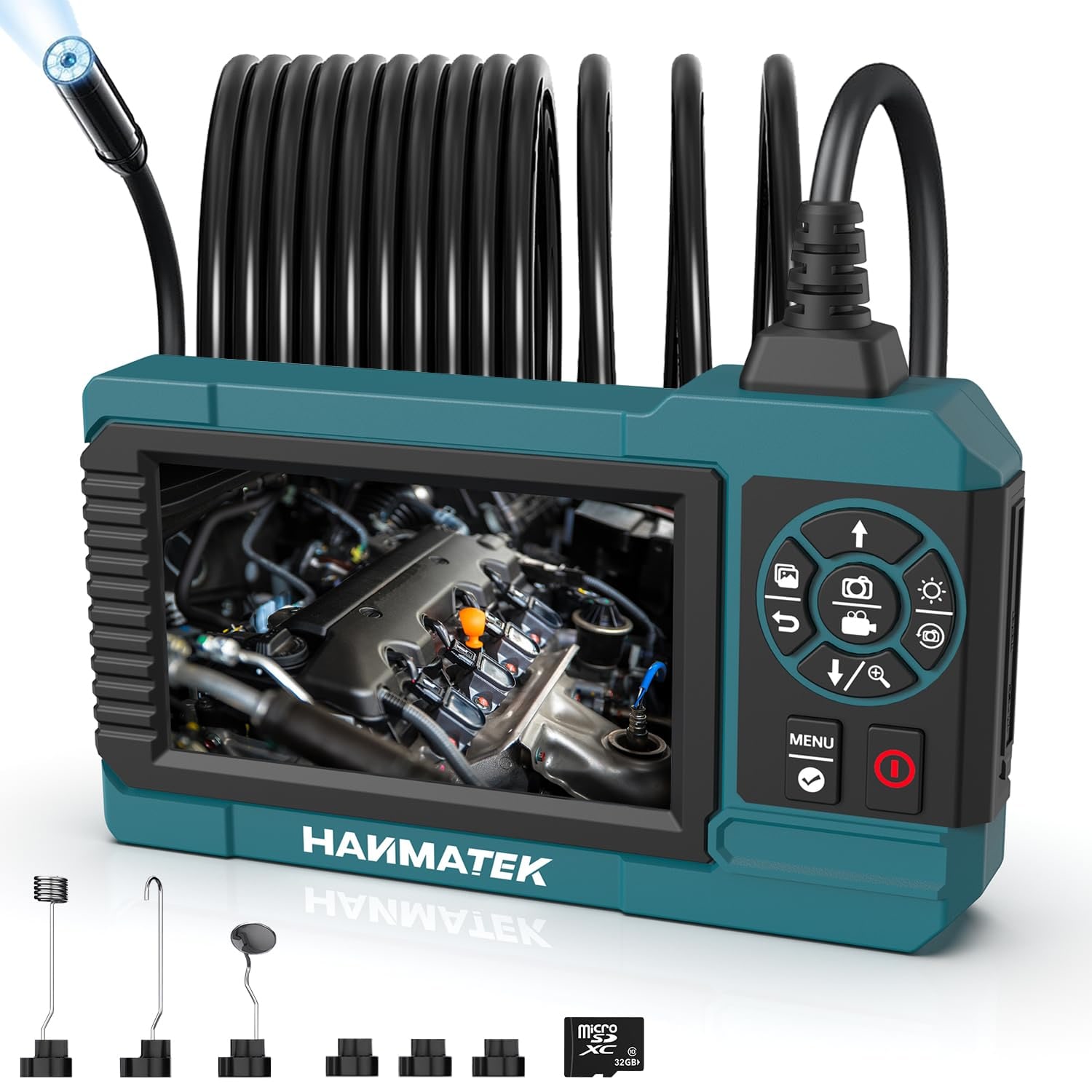
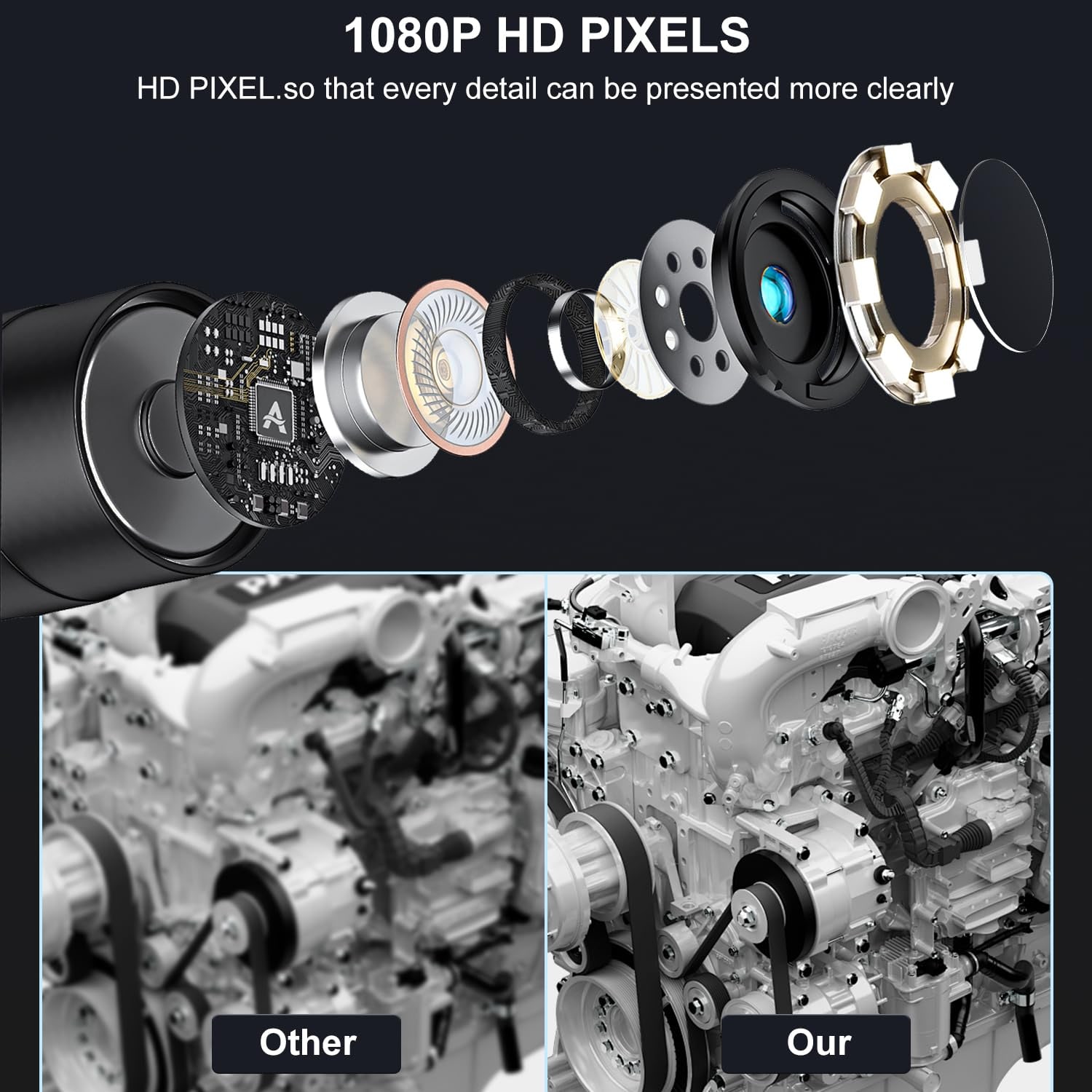
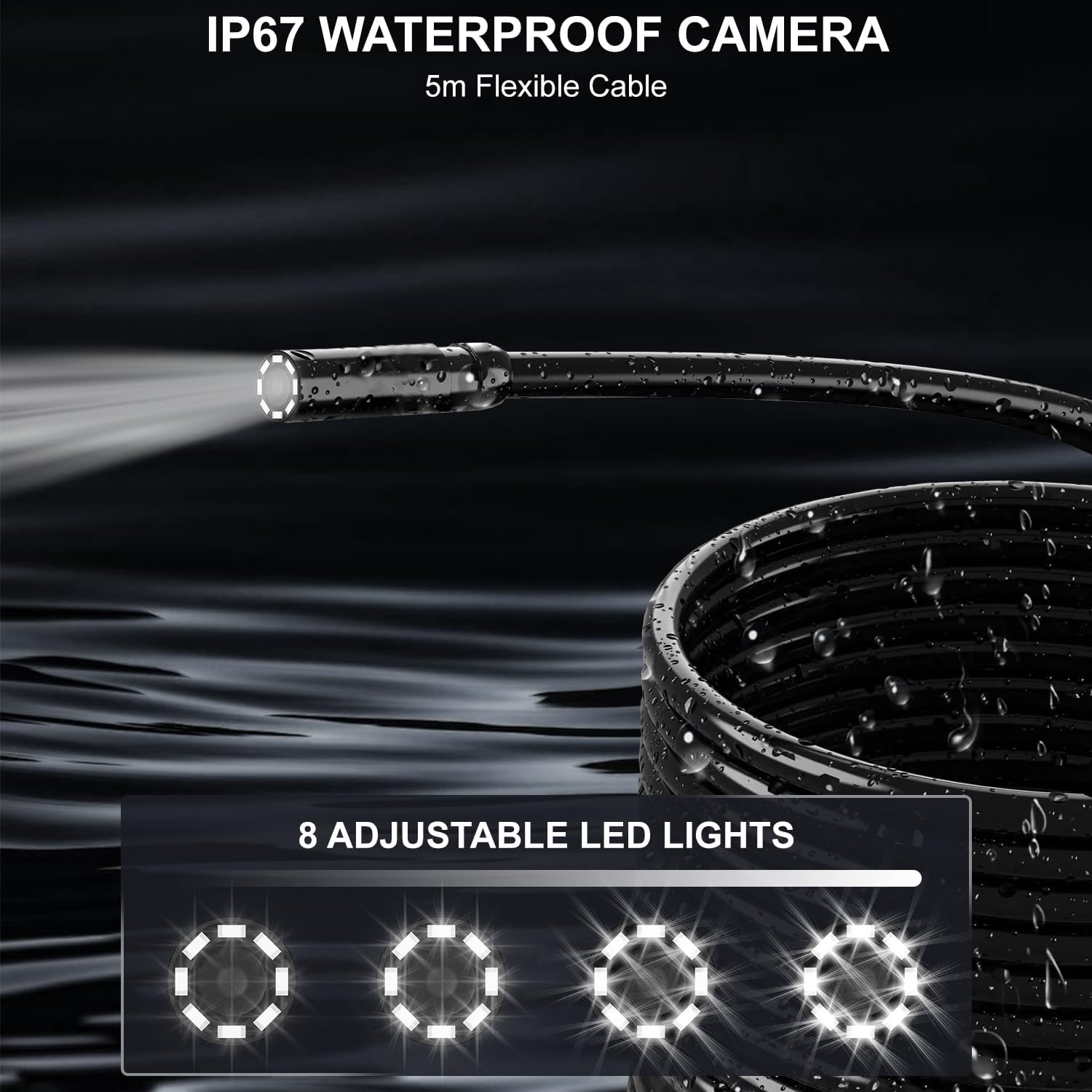
This model uses an 8mm camera head with a 1 million pixel CMOS sensor and a 58 degree field of view, on a 16.5ft (5 meter) flexible cable. Eight LED lights sit around the lens, because nowhere you point this thing has its own lighting. The brightness is adjustable, which matters more than beginners expect. Inside a narrow metal pipe, full brightness bounces straight back and washes the picture into a white smear. Dial it down and the detail reappears.
The specifications give the focus type as manual focus and the lens is set up for close work, with a stated focal range of 2 to 10 centimeters and a macro focus range of 2 centimeters. In practice you focus by moving the head. Once you get a feel for that working distance it becomes automatic. Pull back a little when things go soft, push in when they go soft the other way.
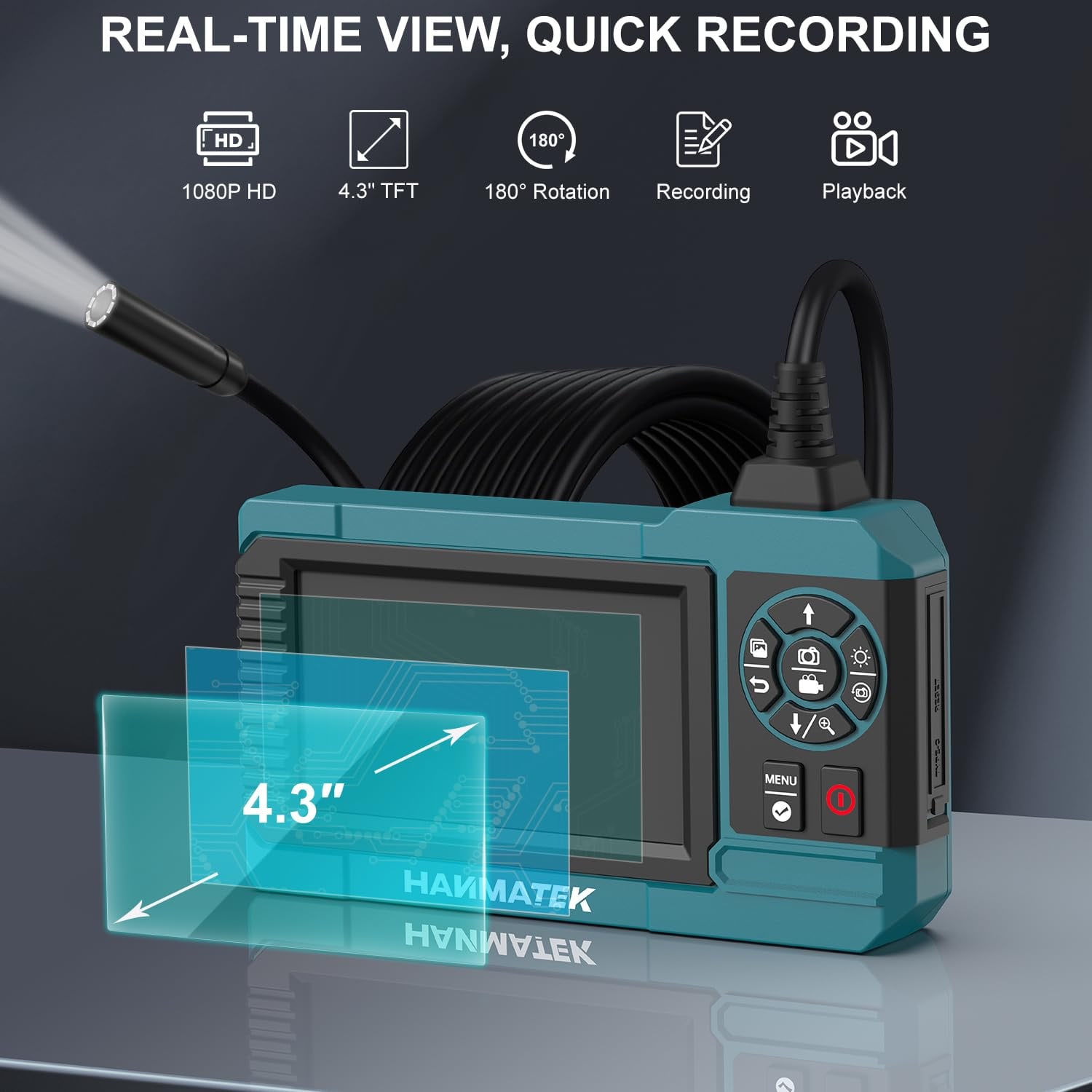
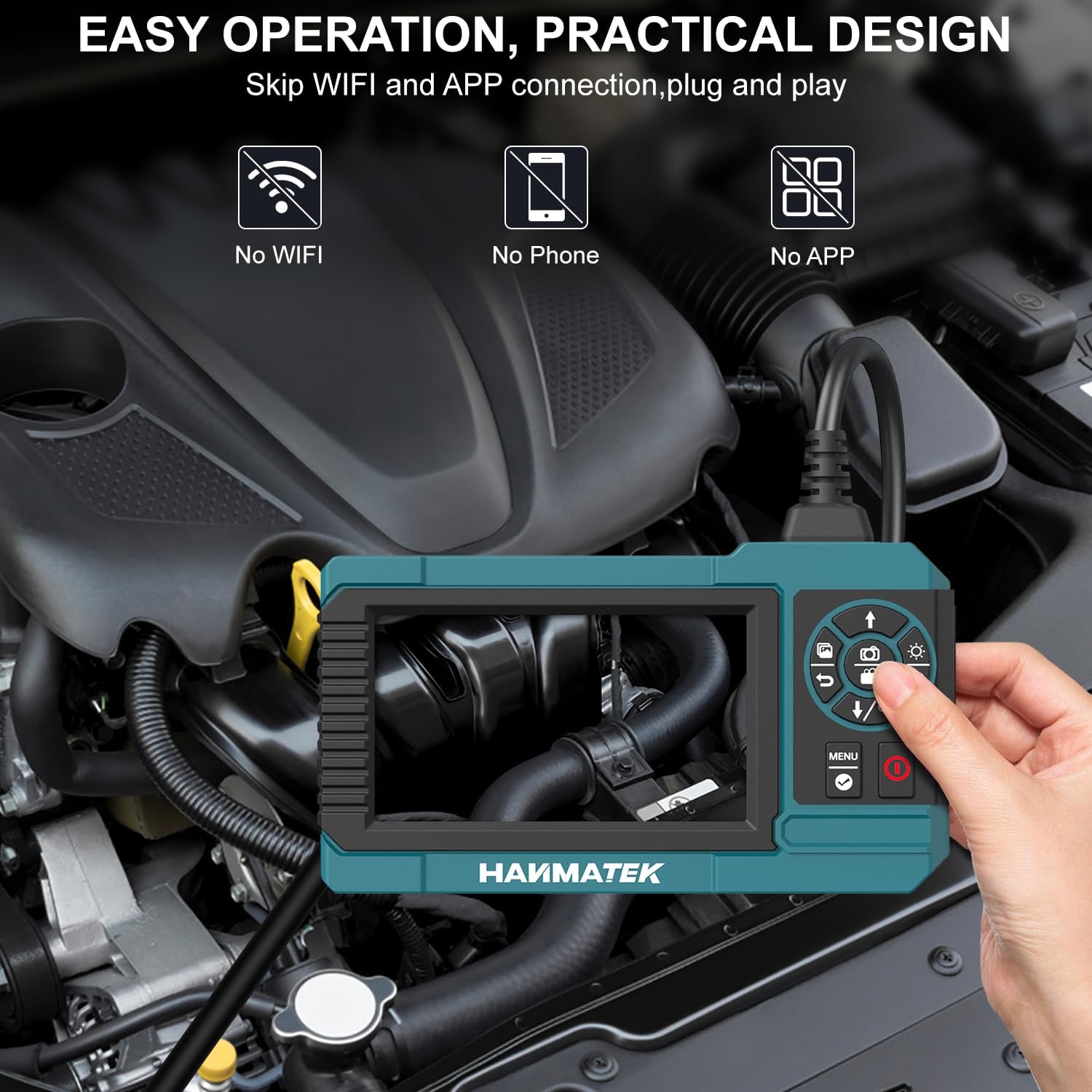
The display is a 4.3-inch TFT screen with a stated 480x272 resolution, built into the handset. There is no app, no pairing and no phone involved, which is the main reason people choose a self-contained unit over a plug-in model. The picture can be rotated 180 degrees, which you will use constantly, because a cable that has twisted through a bend delivers an upside-down view more often than not. There is also digital zoom for reading a stamped number or a crack edge on screen.
Capture is one button. Stills save as JPEG, clips as MP4, both to the included 32GB SD card. Those are ordinary file formats, which makes it simple to share what you found with a customer or a colleague.
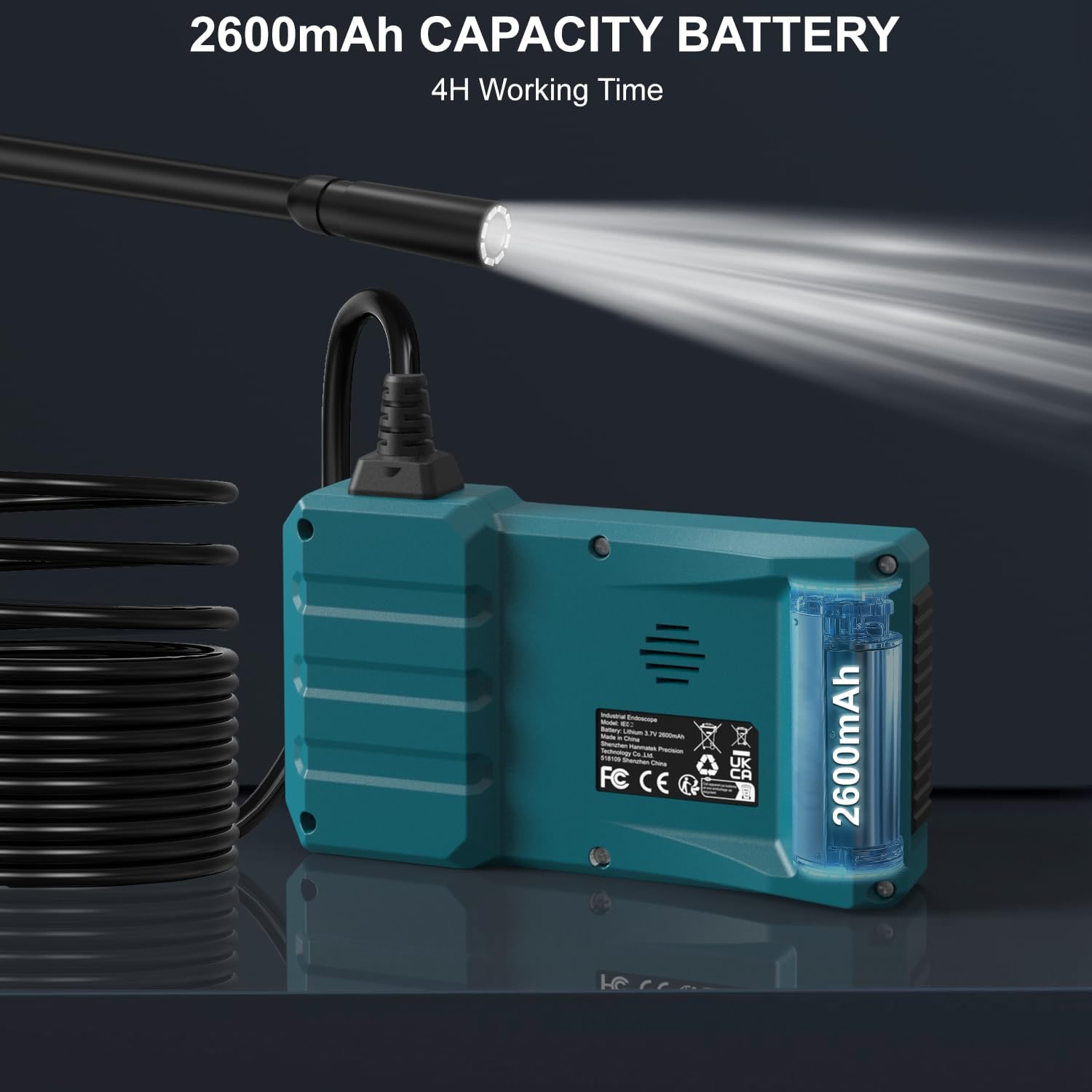
Power comes from a 3.7V 2600mAh lithium battery, which the maker says gives up to 4 hours of continuous use, charged over Type-C. The whole thing weighs 0.58 kg.
Who it suits
Plumbers use these constantly. A drain inspection camera at this diameter fits sink drains, floor drains, traps and small branch lines, and it tells you in seconds whether you are dealing with grease, roots or a hard object. It also tells you whether the pipe itself is damaged, which changes the quote.
Mechanics are the other big group. An 8mm head goes through many spark plug and glow plug holes, so you can look at a cylinder wall, a piston crown or a valve face before committing to a teardown. It is also the fastest way to find a dropped bolt in an engine bay, a job that otherwise eats an afternoon.
Electricians and HVAC techs use it for cavity work. Tracing a cable run through a stud bay, checking a duct for a collapsed flex section, looking behind a fixed panel. Drill a small hole, feed the cable, look, patch.
Home inspectors and landlords like having the files. A photo of the actual damp patch inside the cavity settles arguments that a written note never will.
And then there are people who just own an older house or an older car and are tired of guessing. This is a reasonable first inspection tool for that, because there is nothing to learn beyond pushing a cable and pressing a button.
How to choose
Start with diameter, because that decides whether the tool is useful to you at all. Measure the smallest opening you genuinely need to pass through. An 8mm head clears most standard inspection points, but if your main use is tiny drilled holes or very small engine ports, measure before you buy. Going smaller than 8mm usually costs image quality, since there is less room for the sensor and the lights.
Then think about reach. Cable length determines how far down a run you can see. Longer is not always better. A long cable in a short job is just more to coil and keep clean, and any cable gets harder to push the farther in it goes, since friction builds along every bend. This one is 16.5ft (5 meters).
Lighting deserves more attention than it usually gets. A borescope with LED lights that has no brightness control is frustrating in reflective pipes. Adjustable levels, as here, let you adapt to a dark void and a shiny bore with the same tool.
Consider how you want to view the picture. A built-in screen is instant and works without a phone, which is why many people prefer it on site. The trade-off is screen size. A 4.3-inch display is a good balance for a handheld unit, large enough to read and small enough to hold for an hour.
Recording matters if anyone other than you needs to see the result. Being able to hand over a JPEG or an MP4 is worth a lot when you are explaining why a repair is needed. Check that files save in standard formats, which they do here.
Finally, look at water resistance and battery. A waterproof borescope camera head is not optional for drain and engine bay work. Four hours of runtime covers a full business day of intermittent use, since you are rarely looking for more than a few minutes at a time.
Using it well
A few habits make a real difference. Feed the cable with your free hand close to the entry point rather than pushing from far back, or it will buckle. Go slowly, because the picture is far easier to read at a crawl. If you hit a bend and the cable stops, back off an inch, rotate slightly and try again rather than forcing it.
Turn the lights down before you enter anything reflective. Take a still photo the moment you see something interesting, because you may not find exactly that angle again.
Clean the head and cable when you finish. Wipe with a damp cloth, dry it, coil it loosely. Kinked cables are the most common way these tools die, and it is entirely preventable. Keep the screen end away from water, since the IP67 rating is stated for the camera.
The short version
This is a self-contained inspection camera with a 4.3-inch screen, an 8mm IP67 waterproof camera head on a 16.5ft cable, eight adjustable LED lights, and video and JPEG stills saved to the included 32GB SD card, running up to 4 hours on a Type-C rechargeable battery. It is built for close work in the 2 to 10 centimeter range, which covers pipes, engines, cavities and ducts.
If your work regularly involves guessing what is inside something sealed, this ends the guessing. Measure your smallest access hole against the 8mm head, make sure the reach suits your typical job, and you have a tool that will pay for itself the first time it saves you from opening something that did not need opening.