Camera Company
Company
Shop By Category
T&Cs
Shop Online
  • The maker's specifications on every page
  • Free tracked USA-wide delivery over $150
  • 14-day returns

77 Inch Aluminum Tripod | 2 in 1 tripod and monopod | Camera tripod with ball head

77 Inch Aluminum Tripod and Monopod with 360 Ball Head

$121.99 $145.99 Save $24
  • 19 to 77 Inches
  • Converts To Monopod
  • 360 Degree Ball Head
  • 34 lb Capacity

Price: $121.99 $145.99

  • Free tracked USA-wide delivery on orders $150+, otherwise a flat $20
  • Pay by card or PayPal, handled by the payment provider
  • 14 days to change your mind, plus your statutory rights
Product specifications
Model NameTP77
Model Number10096566
Maximum Height77 in (195.58 cm)
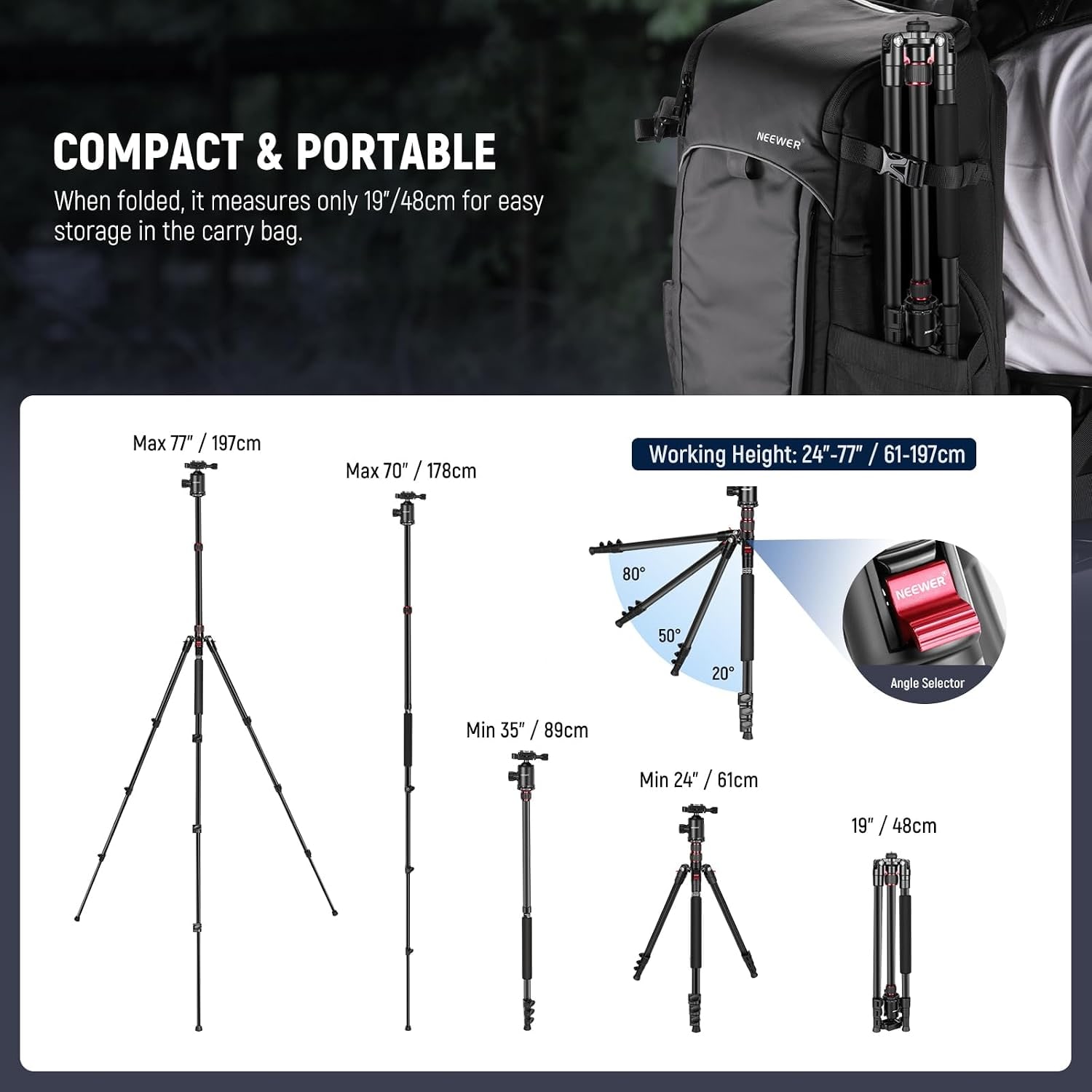
Minimum Height19 in (spec table); size diagram shows 24 in
Folded Size19 in
Monopod Height Range35 in to 70 in
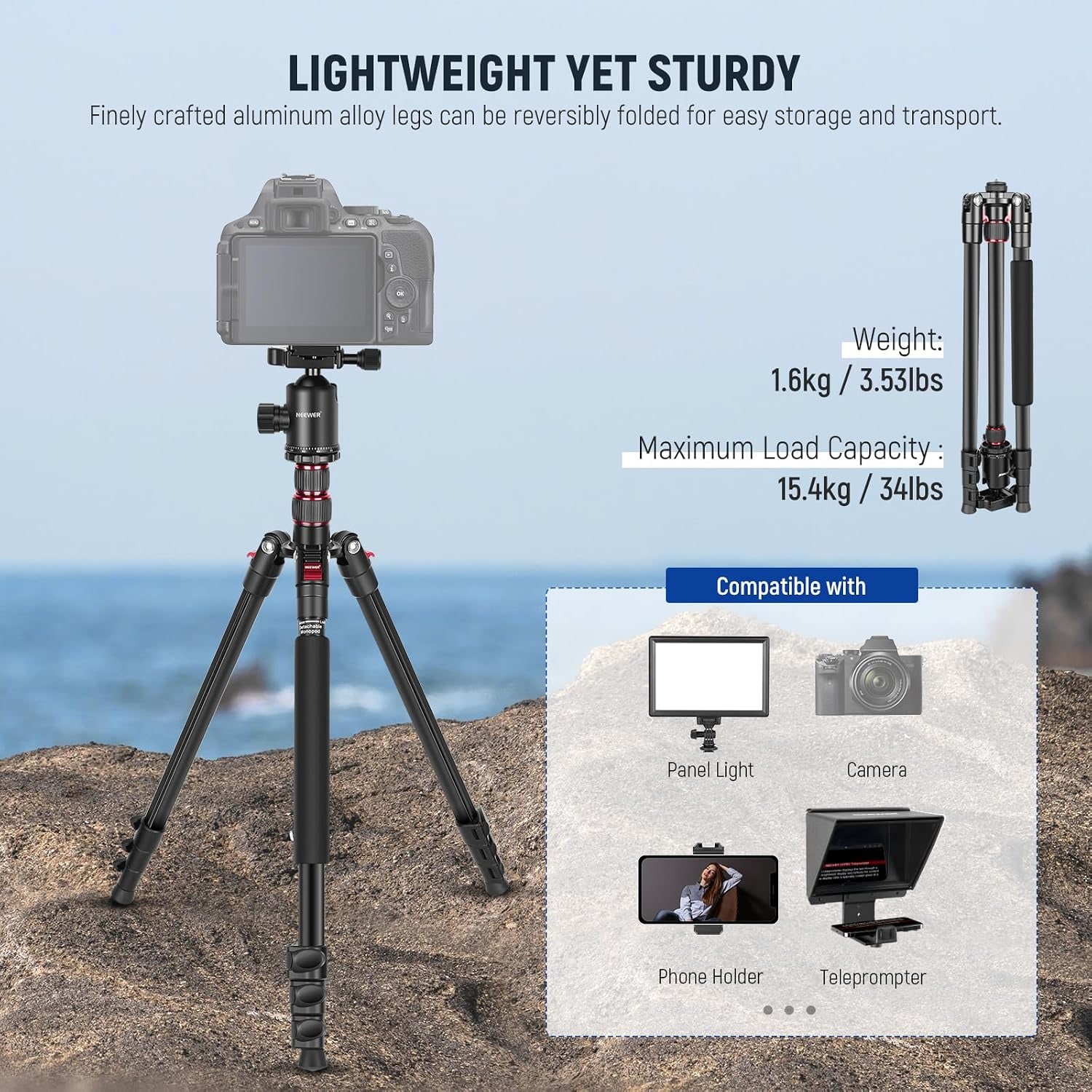
Item Weight3.1 lb (spec table); 3.53 lb / 1.6 kg net (maker text)
Weight Limit34 lb (15.4 kg) vertical, 11 lb (5 kg) tilted
Leg Sections4
Leg Diameter36 mm
Head TypeBall head, 360 degree panoramic
Quick Release PlateArca-type
Center Column2 section, invertible, with ballast hook
Leg LocksQuick flip type
Leg Angle Positions3
ColorBlack
MaterialAluminum, rubber
Compatible DevicesCamera
Water ResistanceNot water resistant
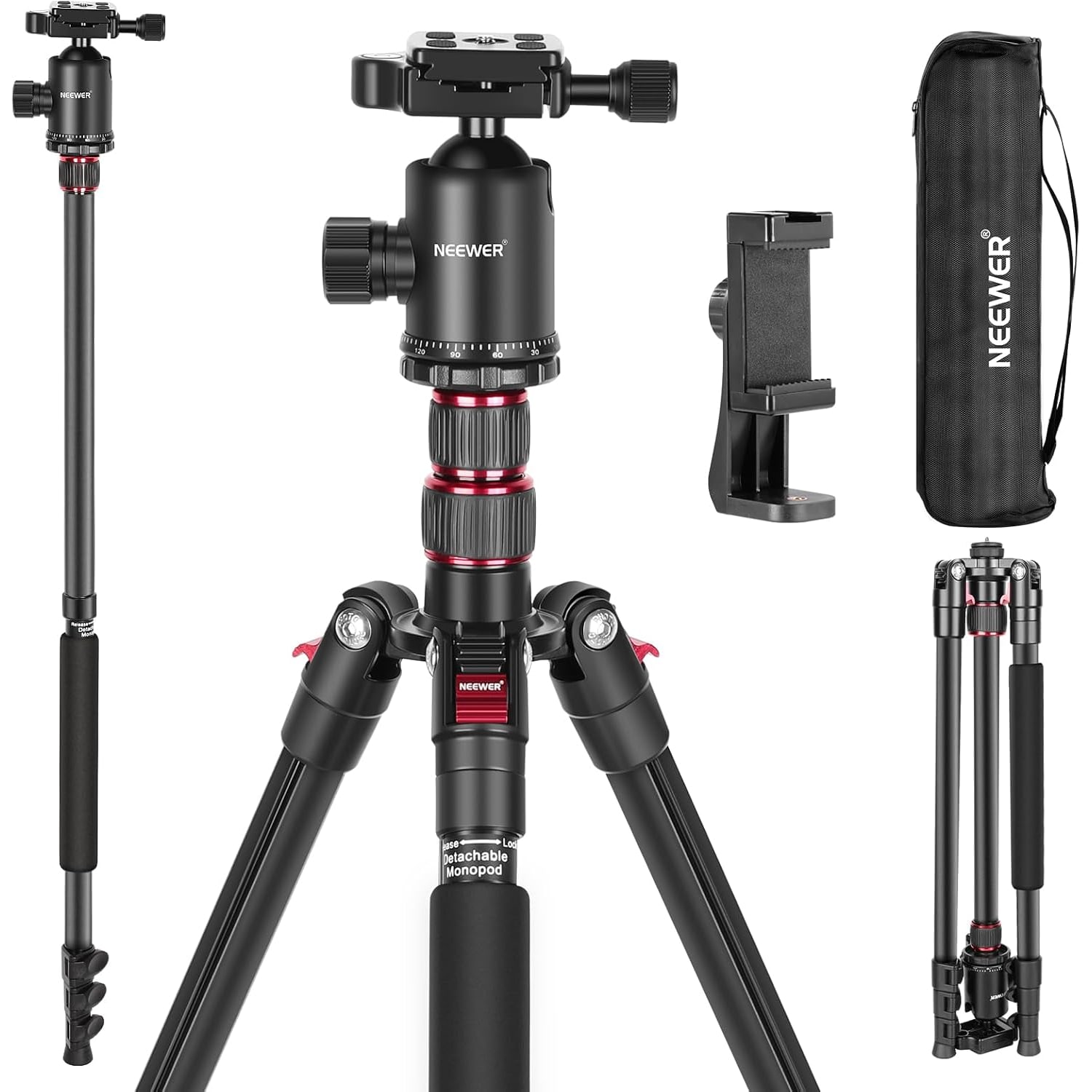
Included Components1x tripod with ball head; bag named in highlights; phone holder shown in main photo
Weight1.41 kg
Shipping & returns

Tracked delivery anywhere in the USA. It is free on orders of $150 or more, and a flat $20 below that.

If it is not right for you, send it back within 14 days of delivery in resaleable condition and we refund the price you paid, including standard delivery. That is a voluntary policy we offer on top of your legal rights. You cover the cost of returning it unless the item is faulty.

If it arrives faulty, damaged or not as described, we put it right at no cost to you under the consumer protection law of your state and the Federal Trade Commission Act, return postage included.

Shipping details · Refunds and returns

19 to 77 InchesFour leg sections and a two-part center column cover ground level to over head height.
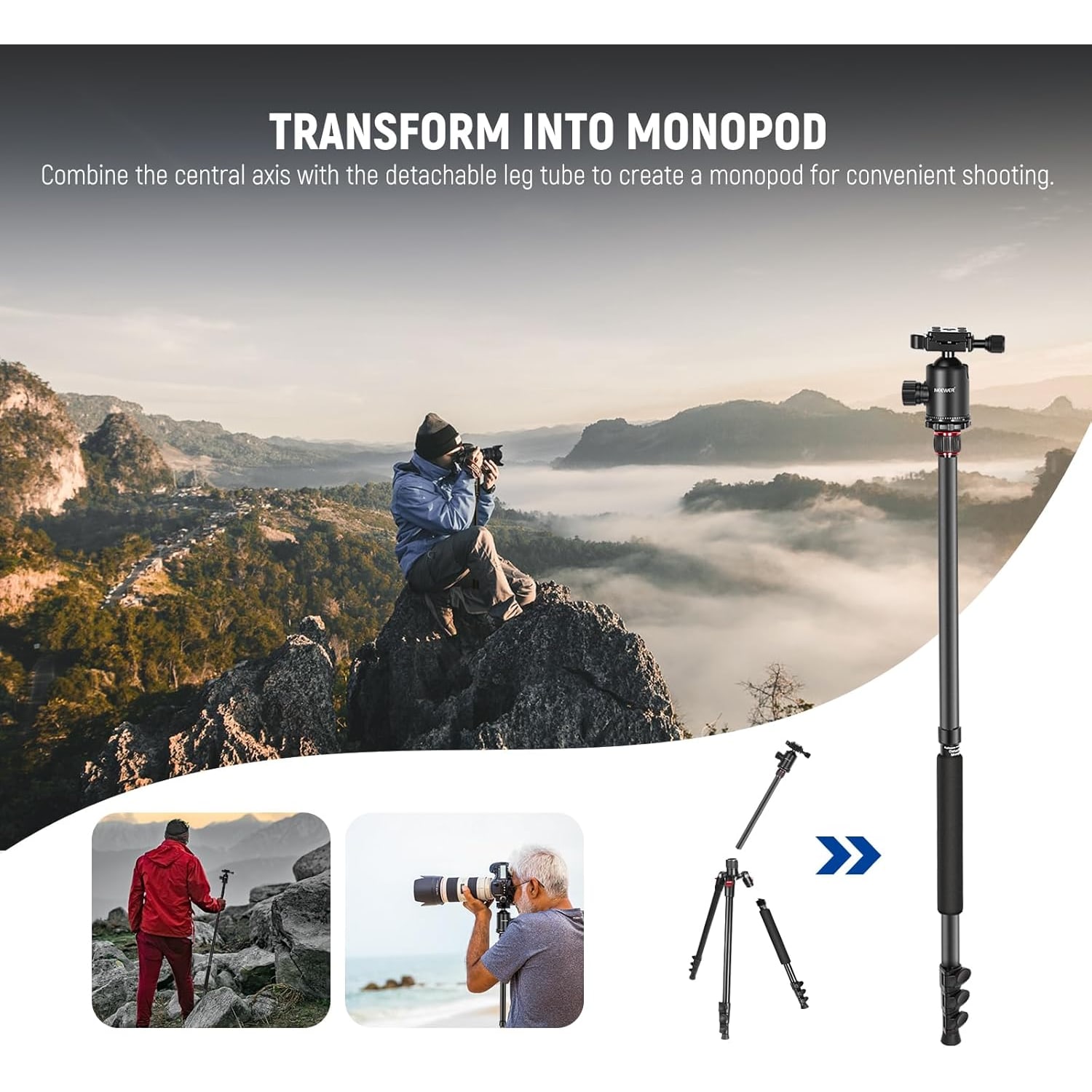
Converts To MonopodOne leg detaches and joins the center column for a 35 to 70 inch monopod.
360 Degree Ball HeadA 36mm ball with two knobs, a bubble level and an Arca-type quick release plate.
34 lb CapacityAluminum alloy legs rated to 34 pounds vertically and 11 pounds at a tilt.

Shoot from ankle height to eye level and beyond with a 77 inch aluminum tripod that folds down to 19 inches and travels in its own bag.

Four-section legs with flip locks, a two-section center column, a 36mm 360 degree panoramic ball head with bubble level and Arca-type quick release plate, plus one leg that detaches to build a monopod.

This 77 inch aluminum tripod reaches 195.58 centimeters at full stretch and folds to 19 inches, so you can shoot flowers at ground level in the morning and a crowd scene over heads in the afternoon.

Four leg sections with quick flip locks open and close in seconds, and the whole rig folds back down to a 19 inch package that fits the included bag.

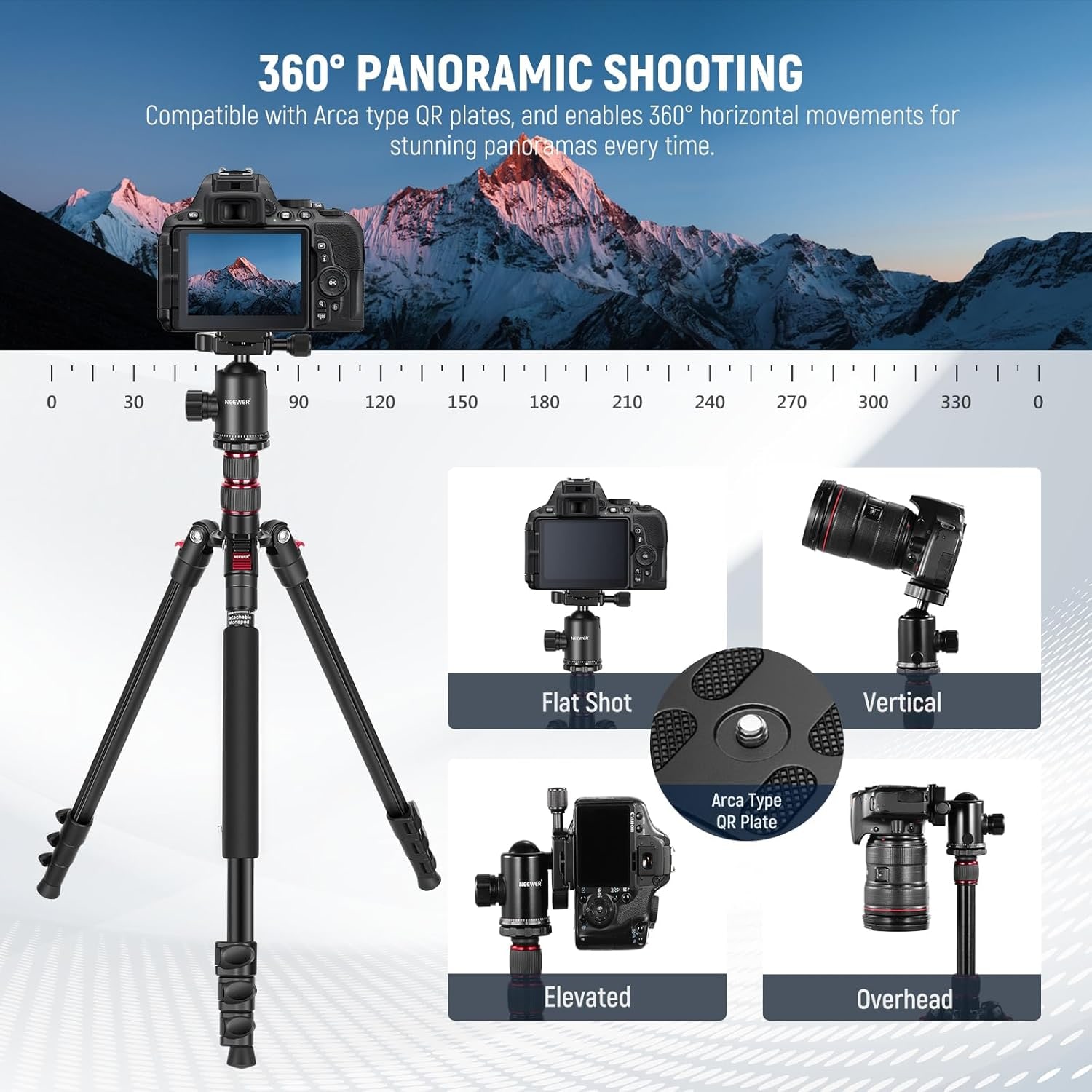
The 36mm ball head rotates a full 360 degrees with two independent knobs, a bubble level for straight horizons and an Arca-type quick release plate for fast camera swaps.

Detach one leg, connect it to the center column and you have a monopod that adjusts from 35 to 70 inches for sports, events and crowded spaces.

A hook under the center column takes a bag or sandbag for extra ballast, and the three-position leg angles let you set up on steps, slopes and uneven ground.

77 Inch Aluminum Tripod and Monopod with 360 Ball Head

Most people buy their second tripod because the first one was too short. You end up stooping over the viewfinder, or standing the legs on a chair, or giving up on the shot. This one stretches to 77 inches, which is 195.58 centimeters, so the camera sits above eye level for nearly everybody. That extra reach is the difference between shooting over a railing and shooting through it.

77 Inch Aluminum Tripod and Monopod with 360 Ball Head

The height comes from two places. There are four leg sections held by quick flip locks, which you can flick open all at once and pull out in one motion, and there is a center column built in two parts rather than one. The second column section is what pushes the top end past the usual limit. When you are done, the whole thing collapses to a 19 inch folded size and slides into the bag that comes with it, which is short enough for a carry-on or a day pack with the legs poking out the top.

77 Inch Aluminum Tripod and Monopod with 360 Ball Head

On top sits a 36mm ball head with a 360 degree panoramic base. Two separate knobs mean you can lock the tilt and still swing the camera horizontally for a panorama, which is much easier than wrestling a single-knob head. A bubble level on the head helps you find a level horizon before you start, and the Arca-type quick release plate lets you lift the camera off and put it back without unscrewing anything. If you already own Arca-compatible gear, the plate should drop straight into your routine.

77 Inch Aluminum Tripod and Monopod with 360 Ball Head

Stability is handled the old fashioned way. The legs are aluminum alloy with a stated 36mm leg diameter, and the maker rates the load at 34 pounds (15.4 kg) straight down and 11 pounds (5 kg) when the head is tilted over. Three selectable leg angles let you spread the legs wide and low on rough ground, or splay just one leg down a slope. Under the center column there is a hook. Hang your camera bag or a sandbag (not included) there and the whole setup settles down noticeably in wind.

77 Inch Aluminum Tripod and Monopod with 360 Ball Head

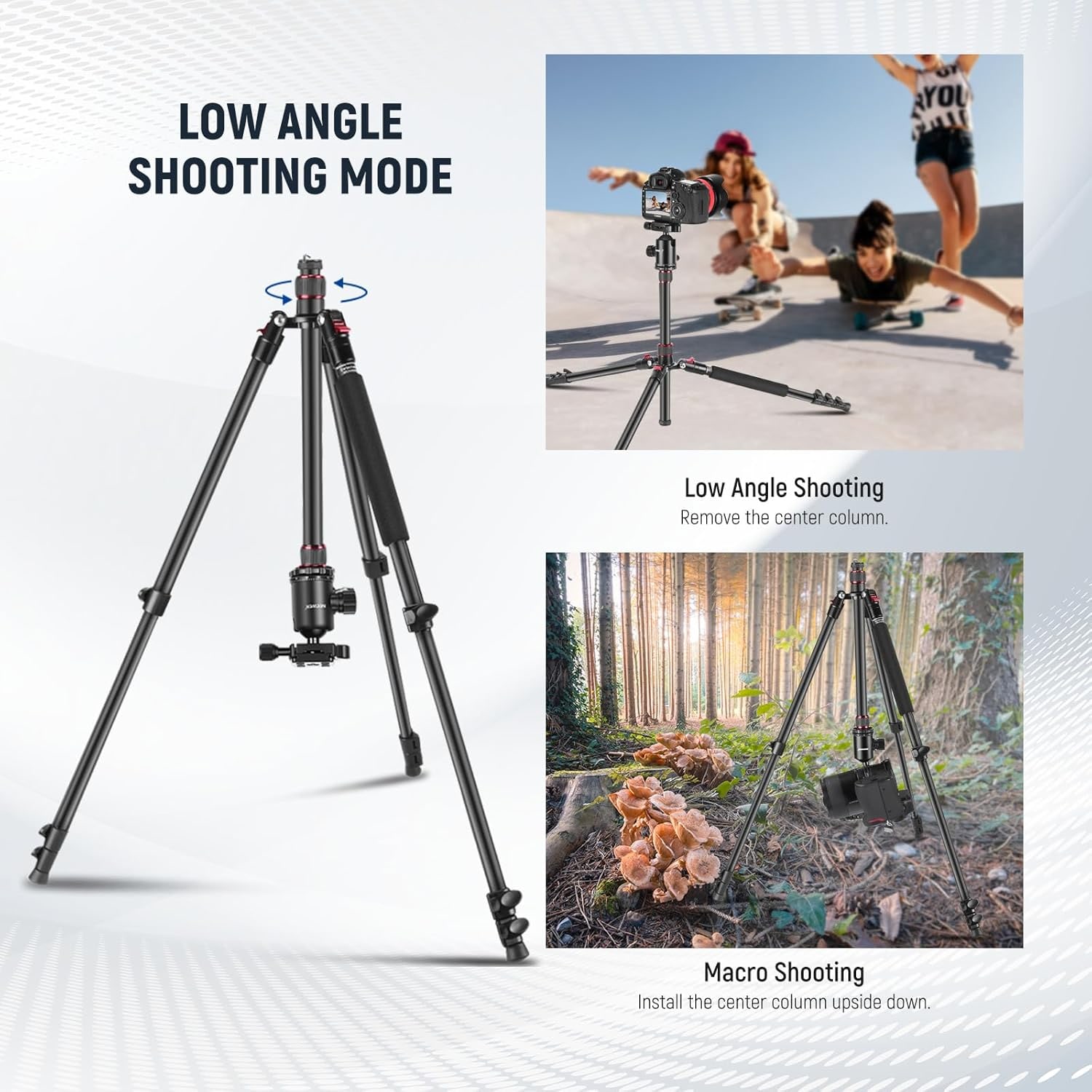
The two-in-one part is genuinely useful rather than a gimmick. One leg detaches, connects to the center column, and becomes a monopod adjustable from 35 to 70 inches. That is the tool you want at a soccer game or a wedding reception, where a full tripod is in everyone's way. Flip the center column upside down instead and the camera hangs between the legs close to the ground, which is how you shoot macro and still-life without lying in the dirt.

Not sure yet? That is fine.

A camera has to suit the job you bought it for, and you cannot always judge that from a photograph. If it is not right for you, send it back within 14 days of delivery in resaleable condition and we refund the price you paid, including standard delivery. That is a voluntary policy we offer on top of your legal rights.

If it turns up faulty, damaged or not as described, that is on us. The consumer protection law of your state covers you, and we pay the return postage. Read the full detail on our refunds and returns page, or ask us anything before you order.

Frequently Asked Questions

What exactly am I getting in the box?

The maker's component list names one tripod with the ball head fitted, and its highlights name a bag. The main photo also shows a clamp-style phone holder beside the tripod and bag. The Arca-type quick release plate is part of the head, and a sandbag for the ballast hook is not included.

How tall does it actually go?

The maximum height is 77 inches, which is 195.58 centimeters, with all four leg sections and both center column sections extended. That is above eye level for most adults. For the low end, the maker's text gives a working height from 19 inches, while its size diagram shows 24 to 77 inches and 19 inches as the folded length.

How small does it fold down?

Folded size is 19 inches. That is short enough to fit diagonally in most carry-on bags or strapped to the side of a day pack, which is part of what makes it one of the best travel tripod with bag options at this height.

How much does it weigh?

The maker gives two figures: 3.53 pounds (1.6 kg) net weight in its description and photos, and 3.1 pounds in the spec table. Either way it is light enough to carry on a half-day hike but has enough mass to stay planted with a DSLR on top.

How much camera can it hold?

The rated load is 34 pounds (15.4 kg) when the camera sits straight up, and 11 pounds (5 kg) when the head is tilted over. That covers essentially any mirrorless or DSLR body with a normal zoom, and most long telephoto setups.

Will it hold a big telephoto lens?

Within the stated load limits, yes. Keep in mind the tilted rating is 11 pounds, so a heavy lens pointed sharply up or down is the demanding case. Use a lens collar foot where your lens has one, and hang weight on the center column hook.

Does it work as a monopod?

Yes. One leg detaches and connects to the center column to form a monopod. The monopod height adjusts from 35 to 70 inches, which makes it a practical best tripod monopod combo for sports and events.

How long does the monopod conversion take?

The maker describes it as quick. You detach the leg marked as the detachable monopod, pull the center column out, and connect the two. The maker does not give a time or mention tools.

What kind of head is on it?

It is a 36mm ball head with a 360 degree panoramic base and two independent control knobs, so you can lock the tilt and still pan. There is a bubble level on the head. That combination is what people usually mean by a best ball head tripod.

Can I swap the head for a different one?

The head is supplied fitted to the tripod, and the maker describes the product as a tripod with ball head rather than a separate unit. If you want a different head, check the thread on your own before ordering, because the mounting thread size is not specified by the maker.

What size plate does it use?

It uses an Arca-type quick release plate. If your other gear already uses Arca-style clamps and L-brackets, the plate should be familiar. Arca is the most common standard in the best tripod with Arca type plate category.

What are the leg locks like?

They are quick flip type locks, one per section, four sections per leg. You can flick all the locks open with one hand and pull the leg out in a single pull, then push the levers shut. Flip locks are faster than twist locks to set up and easy to check at a glance.

Can I use this on uneven ground?

Yes. There are three leg angle positions, so you can set each leg independently. On stairs or a slope you drop one leg to a wider angle and shorten it. That flexibility is why it works well as a best tripod for landscape photography pick.

Does it go low for macro work?

The center column can be inverted so the camera hangs between the legs close to the ground. The maker says the inverted center column is how you shoot macro, and its photos also show a low angle mode with the center column removed. It is a sensible best tripod for macro photography choice on a budget.

What is the hook under the column for?

You hang ballast from it. A camera bag, a water bottle or a sandbag adds downward weight and keeps the tripod steady in wind. A sandbag is not included.

Will it take a phone?

Yes, with a phone holder on the quick release plate. The maker describes it as a tripod for phone and camera, and the main photo shows a clamp-style phone holder beside the tripod and bag. The written component list names only the tripod with ball head.

Is it good for video?

A ball head is designed for locking off a framed shot rather than smooth panning, so it is better for static video, interviews and time-lapse than for following action. For locked-off clips it is very capable, and the monopod mode helps for run-and-gun work.

Can I shoot panoramas with it?

Yes. The ball head base rotates a full 360 degrees independently of the tilt, so once you level the head using the bubble level you can swing through a series of frames at a consistent height. That is the point of a best panoramic tripod head design.

How do I level it properly?

Set the legs so the shoulder of the tripod looks roughly flat, then use the bubble level on the head to fine tune with the ball before you lock it down. Adjust leg length rather than the ball where you can, since that keeps your pan axis true.

Is it waterproof?

No. The maker states it is not water resistant. A bit of drizzle or spray will not hurt aluminum legs, but dry it off afterwards and do not submerge it or leave it standing in rain.

What is it made of?

The materials given are aluminum and rubber. The legs are aluminum alloy, and the spec table gives a 36mm leg diameter. Aluminum is heavier than carbon fiber but soaks up knocks better, which is why it is still the best aluminum tripod for DSLR territory for a lot of shooters.

What color is it?

Black.

How do I clean it after a beach or trail trip?

Rinse salt and grit off the leg sections with fresh water, open the flip locks, wipe the tubes down and let everything air dry fully before folding. Sand left inside the locks is the usual cause of sticky legs later.

How should I store it?

Store it dry in the carry bag, ideally with the locks open rather than clamped tight. Keep it somewhere it is not leaning under pressure, and avoid long spells in a hot trunk.

Can I take it on a plane?

The 19 inch folded size fits in most carry-on bags, but airline rules on tripods vary and some crews treat them as checked items. Check with your airline before you travel, and pack it in the bag it comes with either way.

Is it good for hiking?

At 3.1 to 3.53 pounds, depending on which of the maker's figures you go by, it is a reasonable carry for a day hike, especially strapped to a pack. Serious ultralight walkers tend to go carbon fiber, but for the reach you get this sits well among best lightweight tripod for hiking options.

Does it suit beginners?

Yes. Flip locks, a two-knob ball head and a quick release plate are all easy things to learn, and there is nothing fiddly to assemble. Give yourself ten minutes in the yard to practice setting it up before your first real shoot.

Would it make a good gift?

It is a safe gift for anyone with a camera, since the mount is standard and the height range suits almost any kind of shooting. The carry bag means it arrives looking complete rather than like a bare accessory.

How fast will it arrive and how is it shipped?

We deliver to addresses across the United States by tracked delivery. Most orders arrive within 3 to 8 business days of the order date, and Alaska, Hawaii and remote addresses can take a little longer. Delivery is free on orders of $150 or more and a flat $20 under that.

What if it is not right for me?

Returns are accepted within 14 days of delivery in resaleable condition, so put it up on the carpet first and check the height and head feel before you take it out in the field. Keep the bag and any packaging until you are sure. If anything arrives damaged, contact us with your order number and photos so we can help.

How to Choose a Tall Aluminum Tripod That Also Works as a Monopod

6 min read Camera Company

The problem with the tripod you already own

Almost every photographer has the same story. The first tripod was cheap, it came with the camera bundle, and it tops out somewhere around chest height. So you crouch. You tilt your head sideways to see the screen. You stand on a rock. After a while you stop bringing it, which means you stop taking the kind of photo that needs it.

Height is the fix, and it is the one spec people under-buy. A tripod that reaches 77 inches, or 195.58 centimeters, puts the camera above eye level for nearly everyone. That matters more often than you would think. Shooting over a fence at a game. Clearing a hedge to get the whole house in frame. Looking down slightly on a table of food instead of across it. Getting the lens above a crowd at a parade without holding the camera at arm's length and hoping.

The catch with tall tripods has always been bulk. Make the legs long enough to reach and they are a nuisance to carry. This one solves that with four leg sections instead of three, which means each section is shorter, which means the folded package comes down to 19 inches. That is the length of a loaf of bread plus a bit. It fits a carry-on, a locker, a bike pannier, or the included carry bag slung over a shoulder.

How the height actually works

There are two separate systems at play. The first is the legs. Four sections per leg, each one held by a quick flip lock. You flick all four levers open with your thumb, let the leg drop to the length you want, and press them shut. It is quicker than twist locks and you can see at a glance whether a lock is engaged, which is handy when you are setting up in low light.

The second is the center column, and this is the less common part. Instead of a single tube that slides up out of the shoulder, this one is built in two sections. Extending both is what pushes the maximum height past the point where a three-section leg design usually stops. You get the reach without making the folded length silly.

A word of advice about center columns in general. The higher you raise the column, the less stable the setup becomes, because you are putting your camera on top of a single thin tube rather than a triangle. Use the legs first. Extend the thickest sections before the thinnest ones. Only wind the column up when you genuinely need those last few inches. Do that and the tripod feels completely different at the same working height.

Going the other way, the column is invertible. Pull it out, flip it, and the camera hangs upside down between the legs just above the ground. Combine that with the widest of the three leg angle settings and you are shooting mushrooms, coins, insects and flat lays without lying face down. It is a handy trick that makes this a decent best tripod for macro photography choice when you are not ready to buy dedicated gear.

The head is half the tripod

People shop for legs and inherit whatever head comes attached, which is backwards. The head is where you actually interact with the thing.

This one is a 36mm ball head. Big ball, which means more surface area in the clamp and less chance of the camera creeping downward after you lock it. It has two independent knobs. One handles the ball itself, the other handles the 360 degree panoramic base. That split is important. With a single-knob head, panning means loosening the ball, and the camera flops. With a separate pan base, you lock the tilt once, level the horizon, then swing cleanly through a sequence of frames for a panorama. If panoramas are on your list, this is the feature that earns its keep.

There is a bubble level sitting on the head so you can get the horizon flat before you start. And the plate is Arca-type, which is the most widely adopted quick release standard out there. If you already own an L-bracket or a lens foot in that style, it should drop straight into the clamp. If you do not, it is a good standard to buy into, because you can add Arca accessories later without replacing anything.

Two legs, one tool

The monopod conversion is the feature that changes how you use the product rather than just how tall it is. Detach one leg, pull out the center column, connect the two, and you have a monopod that adjusts from 35 to 70 inches.

Why bother? Because there are places a tripod is simply not welcome. A crowded sideline. A church aisle during a wedding. A museum. A hiking trail where three legs would block the path. A monopod takes maybe a tenth of the floor space, kills most of the shake from a long lens, and lets you pivot and follow a moving subject instantly. It is also a decent walking stick on a slope, which is not nothing.

For anyone who shoots sports, kids' games, theater or events alongside landscape and travel, having both in one purchase saves money and saves a bag. That is the honest case for a best tripod monopod combo.

Stability, wind and uneven ground

The legs are aluminum alloy with a stated 36mm leg diameter. Aluminum is heavier than carbon fiber, but it takes knocks without drama and costs far less for the same strength. The rated load is 34 pounds (15.4 kg) straight down and 11 pounds (5 kg) with the head tilted. Those numbers comfortably cover a full-frame body with a zoom, and most telephoto setups too.

Three leg angle positions let you deal with real ground. Steps, slopes, tree roots, a rocky shoreline. Instead of fighting to make all three legs the same, you set one leg wide and short on the high side and leave the others steep. Takes ten seconds once you have the habit.

Then there is the hook under the center column. Hang your camera bag off it, or a water bottle, or a sandbag if you brought one, and the extra downward weight settles the whole frame. In breezy conditions this does more for sharpness than almost anything else you can do. Keep the ballast low and let it rest lightly rather than swing, because a bag swinging in the wind is worse than no bag at all.

A practical note on weather. The maker states this tripod is not water resistant. Light rain and sea spray will not destroy aluminum, but salt and sand will chew up the leg locks if you leave them. Rinse with fresh water, open the locks, wipe the tubes and let it dry completely before you fold it away.

Who it suits, and who it does not

It suits anyone whose current tripod is too short. It suits travel and landscape shooters who want reach without a long folded package. It suits people who want one purchase to handle both a locked-off tripod shot and a phone monopod shot. And at 3.1 to 3.53 pounds, by the maker's two figures, it is a fair carry for a day on foot, which puts it in the conversation as a best lightweight tripod for hiking option without going to carbon prices.

It is less suited to someone chasing the absolute minimum pack weight for multi-day backcountry trips, where carbon fiber wins. It is also not a fluid video head, so if your main job is smooth panning footage you will want to add a dedicated video head rather than rely on a ball.

Setting it up well

Start by extending the thickest leg sections first and leaving the thinnest ones in. Set your leg angles for the ground, not for neatness. Level the shoulder with leg length, then fine tune with the ball and check the bubble. Leave the center column down unless you need it. Hang your bag on the hook. Lock the ball firmly, then let go of the camera for a second and watch whether anything sags before you shoot.

For care, keep it simple. Dry cloth after normal use, fresh water rinse after beaches and mud, locks left open when it is stored for a long stretch, and no oil on the ball head.

The short version

You get a tripod that reaches 77 inches and folds to 19, four-section legs with fast flip locks, a two-part center column that inverts for ground-level work, a 36mm 360 degree ball head with two knobs, a bubble level and an Arca-type plate, a load rating of 34 pounds vertical, a ballast hook, three leg angles, and one leg that becomes a 35 to 70 inch monopod. It weighs 3.1 pounds by the spec table and 3.53 pounds by the maker's own text, it is black aluminum and rubber, and it comes with a bag.

If your main complaint about your current tripod is that you keep crouching, this fixes that, and it brings a monopod along for free.

Browse the shop

Not sure if 77 inches is too much tripod?

Measure from the floor to your own eye level, then compare it to the 19 to 77 inch range, and you will know straight away whether this one gives you room to grow.

Ask us a question

Page summary

A 77 inch (195.58 cm) aluminum alloy camera tripod, model TP77, part number 10096566, that converts into a monopod. It has four leg sections with quick flip locks, a two-section center column that can be inverted for low and macro work, and three leg angle positions. Folded size is 19 inches; minimum height is given as 19 inches in the spec table and 24 inches in the size diagram. Item weight is 3.1 pounds in the spec table and 3.53 pounds (1.6 kg) in the maker text. The 36mm ball head rotates 360 degrees for panoramas, has two control knobs, a bubble level and an Arca-type quick release plate. Rated load is 34 pounds (15.4 kg) vertical and 11 pounds (5 kg) tilted. The detached leg plus center column forms a monopod adjustable from 35 to 70 inches. Color black, materials aluminum and rubber. A bag is named in the highlights, and the main photo shows a phone holder. Not water resistant. Brand, origin and packed dimensions are not specified by the maker.